
Abstracto
Las fallas prematuras de los trenes de rodaje de maquinaria pesada representan una carga operativa y financiera significativa en industrias como la construcción., minería, y silvicultura. Este análisis examina las principales causas del desgaste acelerado en cadenas y rodillos., which constitute a major portion of a machine's maintenance costs. Plantea que un enfoque basado en sistemas, Basado en una comprensión de la ciencia de los materiales y la tribología., es necesario para mitigar estos problemas. La investigación se centra en cinco modos de falla principales.: desgaste abrasivo, daño por impacto, desgaste adhesivo (mortificante), corrosión, y desgaste por desalineación. Para cada modo, Se exploran los mecanismos físicos o químicos subyacentes., seguido de una discusión de las soluciones correspondientes en la selección de materiales., diseño de componentes, y tratamiento térmico. El objetivo es proporcionar a los propietarios y operadores de equipos un marco detallado para seleccionar cadenas y rodillos resistentes al desgaste adecuados.. Al hacer coincidir las especificaciones de los componentes con entornos operativos específicos, Se argumenta que la vida útil del tren de aterrizaje se puede extender significativamente., lo que lleva a una reducción del tiempo de inactividad y un menor costo total de propiedad.
Control de llave
- Haga coincidir las propiedades del material, como la dureza y la tenacidad, con su entorno de trabajo específico para evitar fallas..
- Comprender los cinco modos de falla principales: abrasión, impacto, adhesión, corrosión, y desalineación—para diagnosticar problemas.
- Pista sellada y lubricada adecuadamente mantenida (SAL) Las cadenas reducen significativamente el desgaste interno de pasadores y bujes..
- Inspeccionar y limpiar periódicamente los componentes del tren de rodaje., especialmente en condiciones húmedas o corrosivas, para extender su vida.
- Invertir en cadenas y rodillos de alta calidad y resistentes al desgaste reduce los costos operativos y el tiempo de inactividad a largo plazo.
- Considere siempre el tren de aterrizaje como un sistema integrado; Las piezas no coincidentes pueden provocar un desgaste acelerado..
- Utilice un programa de mantenimiento proactivo y realice un seguimiento de las mediciones de desgaste para predecir y planificar los reemplazos..
Tabla de contenido
- Introducción: El costo invisible del desgaste del tren de aterrizaje
- Modo de falla #1: Combatir el desgaste abrasivo en terrenos arenosos y arenosos
- Modo de falla #2: Prevención de daños relacionados con impactos en terrenos rocosos e irregulares
- Modo de falla #3: Mitigar el desgaste y el irritamiento del adhesivo en escenarios de carga alta
- Modo de falla #4: Resistir ataques corrosivos en ambientes húmedos y ricos en químicos
- Modo de falla #5: Abordar la desalineación y los patrones de desgaste desiguales
- A Buyer's Guide to Selecting Wear-Resistant Components in 2025
- Mantenimiento y monitoreo avanzados para una vida útil prolongada del tren de rodaje
- Preguntas frecuentes (Preguntas frecuentes)
- Conclusión
- Referencias
Introducción: El costo invisible del desgaste del tren de aterrizaje
Cuando miras una topadora o excavadora potente, tus ojos a menudo se sienten atraídos por el enorme cubo, el potente motor, or the operator's cab. Todavía, the foundation of that machine's mobility and stability—its undercarriage—often goes unnoticed until something goes wrong. Think of the undercarriage as the machine's entire musculoskeletal system. Soporta todo el peso de la máquina., plus any load it's carrying, y es la parte en constante, contacto brutal con el suelo. Este sistema de cadenas, rodillos, ruedas guía , y las ruedas dentadas pueden representar hasta 50% of a machine's total maintenance costs over its lifetime. Cuando falla prematuramente, las consecuencias van mucho más allá del simple coste de una pieza de repuesto.
Comprender el tren de aterrizaje como un sistema
It's a common mistake to view the undercarriage as a collection of individual parts. Un rodillo inferior no es sólo un rodillo; un enlace de seguimiento no es sólo un enlace. En cambio, imagina una orquesta finamente afinada. Cada instrumento debe estar en armonía con los demás para que la música suene bien.. El tren de aterrizaje es exactamente el mismo.. La rueda dentada impulsa la cadena de oruga., que se compone de docenas de enlaces interconectados, patas, y casquillos. Esta cadena se desplaza sobre una serie de rodillos guía y rodillos portadores., guiado en la parte delantera por el conjunto tensor. Cada componente está diseñado para funcionar en conjunto con los demás.. Si una parte está desgastada, tamaño incorrecto, o de calidad inferior, crea un efecto dominó, ejercer una tensión indebida en todos los demás componentes del sistema. Por ejemplo, a worn sprocket with a changed tooth profile will no longer engage perfectly with the track chain's bushings, lo que lleva a un desgaste acelerado en ambas partes. Este "no coincide" El desgaste es el principal factor de fallo prematuro.. Por lo tanto, entender y mantener el tren de aterrizaje como un todo, El sistema integrado es el primer paso hacia la longevidad..
Por qué una falla prematura es más que una simple pieza rota
Un solo rodillo defectuoso puede parecer un problema menor. Lo reemplazas y vuelves a trabajar., bien? La realidad es mucho más compleja. Esa pieza fallida suele ser un síntoma de un problema mayor.. ¿Fue un defecto de fabricación?? ¿O fue víctima de otro componente desgastado?, un entorno operativo hostil, o una rutina de mantenimiento inadecuada? Ignorar la causa raíz es como reparar un techo con goteras sin encontrar la fuente del agua.; you're just waiting for the next failure. Una falla prematura introduce tiempos de inactividad no planificados, a project manager's worst nightmare. Altera los horarios, aleja a los técnicos del mantenimiento de rutina, e incluso puede provocar riesgos de seguridad en el lugar de trabajo. El verdadero coste no es sólo la pieza en sí., pero las horas de productividad perdida, posibles sanciones contractuales, y el desgaste en cascada que puede haber causado ya al resto del tren de aterrizaje.
El impacto económico: Falta del tiempo, Refacción, y pérdida de productividad
Let's put this into perspective. Un gran topador que trabaja en una mina en Australia Occidental o en una obra de construcción en las ciudades en rápido desarrollo del Sudeste Asiático puede generar miles de dólares en ingresos por hora.. Si esa máquina está parada por un día esperando una pieza o un mecánico, la pérdida financiera es sustancial. Considere un escenario en el que falla una cadena de orugas en una excavadora de camino crítico. La maquina deja de funcionar. Los camiones que se estaban cargando ahora permanecen inactivos. Todo el flujo de trabajo del sitio se detiene. Estos "costos consiguientes" a menudo eclipsan la factura de reparación real. Por eso invertir en alta calidad, cadenas y rodillos resistentes al desgaste no suponen un gasto; es una póliza de seguro contra pérdidas financieras catastróficas. Eligiendo componentes diseñados para soportar los desafíos específicos de su lugar de trabajo, usted está eligiendo activamente maximizar el tiempo de actividad y proteger sus resultados.
Modo de falla #1: Combatir el desgaste abrasivo en terrenos arenosos y arenosos
Imagínese caminando por una playa de arena.. Con cada paso, tus pies se hunden ligeramente, y la arena se mueve. Ahora, imagina una excavadora de 50 toneladas haciendo lo mismo, día tras día, pero sobre una superficie hecha de material afilado, partículas arenosas. Esta es la realidad del desgaste abrasivo, La trituradora silenciosa de trenes de rodaje de maquinaria pesada.. Es quizás el tipo de desgaste más común., Prevalente en ambientes desde los desiertos del Medio Oriente hasta las canteras de África..
La ciencia de la abrasión: Cómo las partículas finas muelen sus componentes
En su núcleo, La abrasión es un proceso de desgaste mecánico.. Piensa en ello como si usaras papel de lija.. Hay dos formas principales que debemos considerar. La primera es la abrasión de dos cuerpos., donde una superficie (como una roca afilada) se desliza contra y corta el material de su componente. el segundo, y a menudo más insidioso, es abrasión de tres cuerpos. Esto ocurre cuando son pequeños, partículas duras (como arena, arena, o fragmentos finos de roca) quedar atrapado entre dos superficies en movimiento, por ejemplo, entre el pasador y el casquillo, o entre el rodillo y el eslabón de la cadena. Estas partículas atrapadas actúan como pequeñas herramientas de corte., ranurado, rascarse, y lentamente puliendo el acero.
La eficacia de esta "molienda" Depende de las propiedades de las partículas abrasivas.. Cuanto más dura sea la partícula (P.EJ., la arena de cuarzo es muy dura), cuanto más daño hace. Cuanto más nítida sea la partícula, cuanto más corta. Cuando estas partículas se mezclan en una suspensión con agua, la situación empeora aún más, ya que la lechada se puede bombear a cada pequeña grieta del tren de aterrizaje, asegurando el máximo contacto y el máximo desgaste.
Soluciones materiales: Acero de alta dureza y tratamientos térmicos avanzados
Entonces, ¿Cómo luchamos contra esta incesante molienda?? El arma principal es la dureza.. En un sentido simple, un material más duro es más resistente a ser rayado o golpeado por otro. Si el acero de su rodillo inferior es significativamente más duro que las partículas abrasivas que encuentra, las partículas serán trituradas o apartadas con un daño mínimo al rodillo. Por eso es tan fundamental la selección del acero y su posterior tratamiento térmico..
Los fabricantes de cadenas y rodillos de alta calidad y resistentes al desgaste utilizan aleaciones especializadas de acero al boro.. Boro, incluso en pequeñas cantidades, aumenta dramáticamente la "templabilidad" del acero. Esto significa que durante el proceso de tratamiento térmico, Se puede lograr una capa profunda y uniforme de dureza.. El proceso normalmente implica calentar el componente a una temperatura muy alta. (un proceso llamado austenitización) y luego enfriarlo rápidamente (temple). This locks the steel's crystal structure into a very hard state known as martensite. Siguiendo esto, Se utiliza un proceso de templado para reducir ligeramente la fragilidad y aumentar la dureza.. El objetivo es crear un componente con una "carcasa" exterior muy dura." para resistir la abrasión, manteniendo un tono más suave, núcleo interno más duro" para absorber golpes y evitar grietas.
| Mecanismo de desgaste | Causa primaria | Propiedad material ideal | Solución común de material/diseño |
|---|---|---|---|
| Desgaste abrasivo | Partículas duras (arena, arena) moler contra superficies. | Alta dureza | Acero de aleación de boro con endurecimiento por inducción profunda.. |
| Desgaste por impacto | Repentino, cargas de gran fuerza provenientes de rocas o terreno irregular. | Alta dureza | Acero totalmente templado o de doble dureza; bridas de rodillos reforzadas. |
| Desgaste adhesivo | Microsoldadura y desgarro entre superficies metálicas no lubricadas bajo carga elevada. | Baja fricción/resbaladizo | Pista sellada y lubricada (SAL) cadenas; revestimientos de superficies especializados. |
| Desgaste corrosivo | Reacción química con la humedad., sales, o ácidos. | Resistencia a la corrosión | Mayor contenido de cromo en aleaciones de acero.; sistemas de sellado robustos. |
Selección de las cadenas y rodillos adecuados para entornos de alta abrasión
Cuando especifica piezas para una máquina que vivirá en un ambiente arenoso o arenoso, Su pregunta principal a un proveedor debe ser sobre la dureza de la superficie., típicamente medido en la escala Rockwell C (HRC). Para rodillos y polines, debe buscar una dureza superficial en el rango de HRC 50-60. Cualquier cosa menos se desgastará prematuramente.
Igualmente importante es la profundidad de esta dureza.. Un componente barato puede tener una capa endurecida muy fina que se desgasta rápidamente, exponiendo el núcleo blando debajo. Esto es como un lápiz con sólo una pequeña punta de mina.. Un componente de calidad tendrá un profundo, profundidad efectiva del caso, asegurando que mantenga su resistencia al desgaste durante un período mucho más largo. Para enlaces de pista, que se enfrentan tanto a la abrasión como a altas tensiones de tracción, una dureza ligeramente menor (alrededor de HRC 45-50) Se utiliza a menudo para equilibrar la resistencia al desgaste con la dureza necesaria para evitar roturas.. Caterpillar's Heavy Duty Extended Life (HDXL) El tren de rodaje es un excelente ejemplo de un sistema diseñado con material de desgaste adicional y perfiles de dureza optimizados específicamente para aplicaciones de alta abrasión. (Rodillo guía Caterpillar, 2025).
Estudio de caso: Una operación de cantera en Australia
Considere una cantera de granito que opera cerca de Perth., Australia. El medio ambiente es una combinación brutal de duras, polvo de granito afilado y carga de alto impacto. Inicialmente, La cantera utilizó rodillos estándar de posventa en sus excavadoras principales y experimentó una vida útil promedio de los rodillos de solo 1,500 horas, llevando a frecuentes, costoso tiempo de inactividad. despues de una consulta, cambiaron a un conjunto de rodillos inferiores de primera calidad Diseñado específicamente para condiciones de alta abrasión y alto impacto.. Estos nuevos rodillos estaban hechos de una aleación de acero con alto contenido de boro y presentaban un perfil de endurecimiento por inducción más profundo.. El resultado? La vida útil media de los rodillos aumentó a más de 4,000 horas. While the initial purchase price was higher, the reduction in downtime and labor costs resulted in a 40% decrease in the total cost of ownership for the undercarriage over a two-year period. This demonstrates the tangible value of matching the component's material properties to the specific challenges of the job.
Modo de falla #2: Prevención de daños relacionados con impactos en terrenos rocosos e irregulares
If abrasion is a slow, grinding death, impact is a sudden, catastrophic blow. Every operator who has driven a tracked machine over a field of boulders or dropped the machine off a ledge knows that heart-stopping jolt. These high-energy events send massive shockwaves through the undercarriage, and if the components are not designed to handle them, the result can be chipped roller flanges, cracked track links, or bent frames. This type of failure is common in demolition, mining in hard rock areas like the Russian Urals, and logging on steep, uneven terrain.
The Physics of Impact: Stress Concentrators and Fracture Mechanics
To understand impact failure, we need to think about toughness, not just hardness. While hardness helps a material resist being scratched, toughness is its ability to absorb energy and deform without fracturing. A ceramic plate is very hard, but it has low toughness—drop it, and it shatters. A rubber mallet is much softer, but it has high toughness—you can hit it against concrete all day, and it won't break.
When a track roller flange smashes against a rock, the force is concentrated on a very small area. Any sharp corners, casting flaws, or even scratches on the component can act as a "stress concentrator" or "stress riser." Think of how a piece of paper tears easily once you make a small nick in the edge. These stress risers multiply the force at a microscopic level, initiating a tiny crack. With each subsequent impact, that crack can grow until it leads to complete fracture. This is the domain of fracture mechanics, the study of how cracks propagate through materials.
The Importance of Toughness vs. Hardness in Component Design
This presents a fundamental challenge for engineers. The properties that make a steel hard (like a very rigid crystal structure) often make it more brittle and less tough. The properties that make it tough (like the ability for its crystal structure to deform and absorb energy) can make it softer. The art of designing wear-resistant track chains and rollers for high-impact environments lies in finding the perfect balance.
This is achieved through a combination of alloy selection and sophisticated heat treatment. Por ejemplo, a track roller might be "through-hardened" to a moderate hardness level (P.EJ., HRC 45) all the way to its core. This provides good overall strength and excellent toughness to resist cracking under impact. Alternatively, some advanced designs use "dual hardness" tratamiento térmico, where the flange areas that see the most impact are kept slightly softer and tougher, while the rolling path that contacts the track chain is made harder to resist abrasive wear. This tailored approach provides the best of both worlds.
Design Features of Impact-Resistant Rollers and Chains
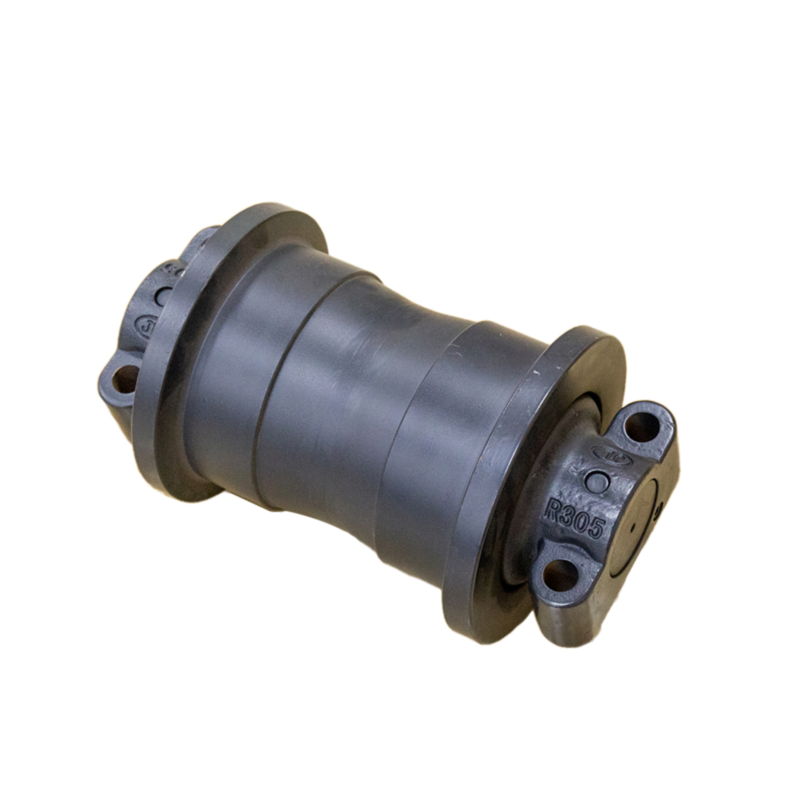
Beyond materials, the physical design of the component plays a huge role. Look at the flange of a track roller. A roller designed for high impact will have a thicker, more robust flange profile with generous radii (rounded corners) at the base. These rounded corners help to distribute stress over a wider area, avoiding the dangerous stress concentrations that can lead to cracks. You can see the basic structure of these rollers in many interactive diagrams (hrparts.com).
For track chains, the links themselves are designed with added material in critical stress areas. The "pin bosses," the areas where the pins connect the links, are particularly vulnerable. Alta calidad, impact-resistant links will have a beefier design in this area to prevent the link from stretching or cracking under high shock loads. The fit and finish are also paramount; a smoothly forged surface is far more resistant to fatigue cracking than a rough-cast one with surface imperfections.
Operational Best Practices to Minimize Impact Loads
While quality components are the foundation, the operator is the final line of defense against impact damage. An experienced operator can dramatically extend undercarriage life through technique. This includes:
- Avoiding high-speed travel in reverse: Machines are designed to absorb impact better when moving forward, as the idler and track spring assembly can cushion the blow.
- Minimizing counter-rotation: Spinning the machine in place puts enormous twisting forces on the track frames and rollers.
- Making wide, gradual turns: Afilado, aggressive turns scrape the sides of the track links and roller flanges, causing unnecessary wear and stress.
- Planning the path: A good operator will scan the ground ahead and choose a path that avoids the largest rocks and sharpest drops.
- Controlling descent on slopes: Instead of letting gravity take over, the operator should use the machine's power to control the speed down a hill, minimizing shocks.
Training operators on these simple, wear-reducing techniques can provide a return on investment that is just as significant as buying premium parts.
Modo de falla #3: Mitigar el desgaste y el irritamiento del adhesivo en escenarios de carga alta
We have discussed the external threats of abrasion and impact. Ahora, let's turn our attention to an internal enemy: desgaste adhesivo, often called scuffing or galling. This type of wear occurs between two metal surfaces in direct, sliding contact under high pressure, without adequate lubrication. It is a major concern for the internal components of a track chain—the pin and the bushing.
What is Galling? The Micro-Welding Phenomenon
Imagine two clean, flat steel blocks. If you press them together with immense force and then try to slide one across the other, what happens? At a microscopic level, the peaks (or "asperities") on the two surfaces come into contact. The immense pressure at these tiny points generates enough heat to cause the metal to momentarily fuse together, creating a microscopic "cold weld." As the sliding motion continues, this weld is immediately torn apart. When it tears, a fragment of metal might be ripped from one surface and transferred to the other, or it might break off as a loose wear particle. This process of welding and tearing, repeated millions of times, is galling. It leads to a rapid increase in friction, severe surface damage, y finalmente, seizure of the joint. In a track chain, this manifests as a "frozen" link that no longer articulates properly, causing the chain to jump off the sprocket.
The Role of Lubrication: Pista sellada y lubricada (SAL) Cadenas
The most effective way to combat adhesive wear is to prevent the two metal surfaces from ever touching. This is the job of a lubricant. The vast majority of modern heavy equipment uses Sealed and Lubricated Track (SAL) cadenas. The concept is brilliantly simple yet revolutionary. Each joint in the track chain—where a pin rotates inside a bushing—is designed as a sealed reservoir containing a special, heavy-grade oil.
A series of polyurethane or nitrile seals at each end of the bushing keeps the oil in and, just as importantly, keeps abrasives like dirt and water out. This oil creates a hydrodynamic film, a thin, high-pressure layer of lubricant that separates the pin from the bushing. As long as this seal remains intact and the oil film is present, direct metal-to-metal contact is prevented, and internal adhesive wear is virtually eliminated. This allows the internal components to last dramatically longer, often matching the lifespan of the external parts of the chain. The development of SALT technology was one of the single greatest advancements in extending undercarriage life.
Ingeniería de Superficies: Coatings and Finishes that Reduce Friction
Even with lubrication, extreme pressures can sometimes momentarily break down the oil film. To provide an extra layer of protection, manufacturers employ advanced surface engineering techniques. The surfaces of pins and bushings are often polished to a mirror-like finish. A smoother surface has fewer high peaks (asperities), reducing the chances of micro-welding.
In some premium applications, components may receive special surface treatments or coatings. Processes like phosphating create a thin, crystalline layer on the steel that helps to retain oil and provides a sacrificial, anti-galling surface during the initial break-in period. These small details, often invisible to the naked eye, make a significant difference in the component's ability to withstand the extreme pressures found inside a track joint.
Choosing Components for High-Tension Applications (P.EJ., dozing, ripping)
Certain applications place enormous tension on the track chain. A dozer pushing a full blade of material or an excavator using a ripper attachment to break up rock creates immense pulling forces. This high tension translates directly into higher pressure within the pin and bushing joints. En estos escenarios, the quality of your SALT system is paramount.
When selecting chains for high-load applications, you should inquire about the seal design and material. Are they using a multi-part seal (P.EJ., a load ring and a toric ring) that provides better pressure distribution and sealing capability? What is the temperature rating of the seal material? A seal that becomes hard and brittle in the cold of a Russian winter or soft and weak in the heat of a Middle Eastern summer will fail quickly. Investing in a chain with a robust, high-performance sealing system is critical for preventing internal wear and ensuring you get the full, designed life out of your track chain.
Modo de falla #4: Resistir ataques corrosivos en ambientes húmedos y ricos en químicos
Metal's oldest enemy is corrosion. From the moment steel is made, it wants to revert to its natural, more stable state: iron oxide, o óxido. This process is greatly accelerated by the presence of water, and even more so by salts, ácidos, or other chemicals. For machinery operating in coastal areas, dredging operations, waste management facilities, or certain types of mines, corrosion is not a secondary concern; it is a primary mode of failure.
The Chemistry of Corrosion: Rust and Beyond
Corrosion is an electrochemical process. It requires an anode (a site where the metal gives up electrons), a cathode (a site where the electrons are accepted), and an electrolyte (a medium, like water, that can conduct ions). A piece of steel in a wet environment creates millions of these tiny electrochemical cells on its surface. The iron atoms at the anode dissolve, Liberando electrones que viajan a través del metal hasta el cátodo., donde reaccionan con el oxígeno y el agua. Los iones de hierro disueltos luego reaccionan con los iones de hidróxido formados en el cátodo para crear hidróxido de hierro., que rápidamente se convierte en el familiar color marrón rojizo, sustancia escamosa que llamamos óxido.
El óxido no es sólo un problema estético. Es físicamente más grande que el acero al que reemplaza., lo que puede provocar que las piezas se atasquen. Más importante aún, es débil y poroso. Una superficie oxidada no puede soportar una carga y se desgasta fácilmente, exponer acero fresco debajo para continuar el ciclo de corrosión. Esta combinación de ataque químico y desgaste mecánico se conoce como desgaste corrosivo., y puede ser increíblemente destructivo.
Selección de materiales para resistencia a la corrosión: Composición de la aleación
Standard carbon steel has very little inherent resistance to corrosion. The primary way to improve this is by adding other elements to create an alloy. The most famous of these is chromium, the key ingredient in stainless steel. Chromium forms an incredibly thin, invisible, and non-reactive layer of chromium oxide on the surface. This "passive layer" is self-healing; if it gets scratched, the exposed chromium immediately reacts with oxygen to reform the protective barrier.
While full stainless steel undercarriages are generally too expensive and not hard enough for most applications, manufacturers of wear-resistant components do carefully control the alloy composition to enhance corrosion resistance. Small additions of elements like chromium and nickel can improve the steel's ability to withstand corrosive attack without compromising the hardness and toughness needed for wear resistance.
| Component Type | OEM (Fabricante de equipos originales) | Mercado de repuestos de alta calidad |
|---|---|---|
| Costo | Highest initial price. | Lower initial price (15-40% menos). |
| Material & R&D | Extensive R&D, proprietary steel alloys and heat treatments. Full traceability. | Often uses comparable steel grades (P.EJ., 40mnb), relies on reverse-engineering. |
| Garantía & Apoyo | Garantía integral respaldada por una red global de distribuidores. | Warranty varies by supplier; support is through the seller. |
| System Integration | Designed as a perfectly matched system with all other machine components. | Designed to meet or exceed OEM specifications for fit and function. |
| Disponibilidad | Primarily through authorized dealers; may have lead times for specific parts. | Widely available from various suppliers, often with better stock levels. |
| Best For | New machines under warranty; users prioritizing brand assurance above all. | Post-warranty machines; budget-conscious fleets; experienced owners. |
Protective Coatings and Seal Integrity
Since we can't always rely on the base metal alone, protective coatings are another line of defense. A high-quality paint or epoxy coating on the non-wear surfaces of track frames, ruedas guía , and rollers provides a physical barrier against the electrolyte (agua). For this to be effective, the surface preparation must be perfect, and the coating must be thick and durable enough to resist chipping and scratching.
Sin embargo, the most critical defense in a corrosive environment is the integrity of the seals. We discussed the SALT system in the context of preventing internal adhesive wear. In a wet environment, its role in preventing corrosive wear is just as vital. If a seal fails and corrosive fluid enters the pin and bushing joint, it will not only wash away the lubricant but also aggressively attack the highly polished internal surfaces. This leads to a rapid and catastrophic failure of the joint. Por lo tanto, in wet or chemical-rich applications, the specification and regular inspection of the track chain seals are of the utmost importance.
Maintenance in Corrosive Conditions: Cleaning and Inspection Protocols
In a corrosive environment, maintenance practices must be adapted. The most important practice is regular cleaning. Permitir barro, escombros, and corrosive materials to pack around the undercarriage creates a poultice that holds moisture against the steel, dramatically accelerating corrosion. Al final de cada turno, the undercarriage should be thoroughly washed down with fresh water to remove these contaminants.
During cleaning, a visual inspection should be performed. Look for areas where the paint is chipped or peeling, and touch them up promptly. Pay close attention to the track chain seals. Look for any signs of leakage (streaks of oil) o daño. A single compromised seal can condemn an entire track chain if not addressed. Regular inspection and a commitment to cleanliness can add hundreds, if not thousands, of hours to the life of an undercarriage operating in a hostile, corrosive world.
Modo de falla #5: Abordar la desalineación y los patrones de desgaste desiguales
Our final failure mode is one of mechanical precision. The undercarriage is a geometric system. The rollers must be parallel, the idler must be aligned with the track frame, and the sprocket must be in the same plane as the chain. When this geometry is compromised, a condition known as misalignment occurs. This forces components to interact at incorrect angles, leading to bizarre and accelerated wear patterns that can be confusing to diagnose if you don't know what to look for.
The Kinematics of a Poorly Aligned Undercarriage
Think about driving a car with a bad wheel alignment. The tires wear out unevenly on the edges, and the car might pull to one side. The same principles apply to a tracked machine, but the forces are much higher. If a track frame is bent, or an idler is misaligned, the track chain will be forced to ride against the side of the idler flange or the roller flanges. This side-loading creates a powerful grinding action. You might see one side of the rollers wearing down much faster than the other, or the sides of the track links becoming scalloped and thin.
This not only wears out the sides of the components but also puts immense twisting forces on the track chain itself. The seals in the SALT joints are not designed to handle these high side loads, and misalignment can lead to premature seal failure, allowing dirt in and oil out.
The Role of Idlers and Sprockets in Maintaining Alignment
The components at the front and back of the track group—the idler and the sprocket—are the primary guides for the chain. The front idler, mounted in a yoke, is responsible for setting the track tension and guiding the chain onto the rollers. If the idler's mounting is worn or damaged, it can wobble or tilt, feeding the chain into the system at an angle.
La rueda dentada trasera proporciona la fuerza motriz.. Los dientes desgastados de la rueda dentada pueden permitir que la cadena "trepe," creando un movimiento de bofetada que envía ondas de choque a través del sistema. Más críticamente, si la rueda dentada está desgastada de manera desigual, puede empujar la cadena hacia un lado, causando que roce contra las protecciones de la oruga y el marco.. Mantener estos dos componentes en buen estado es fundamental para mantener la alineación de todo el sistema..
Diagnóstico de desalineación: Señales visuales y técnicas de medición
Un técnico experimentado a menudo puede detectar una desalineación con solo observar los patrones de desgaste.. Los aspectos clave que debe buscar incluyen:
- Desgaste unilateral: ¿Las bridas de los rodillos o los lados de los eslabones de la cadena están desgastados significativamente más en el lado interior o exterior??
- Raspado o pulido: ¿Hay brillantes?, polished streaks on the sides of components where they shouldn't be rubbing?
- Uneven sprocket wear: Are the tips of the sprocket teeth worn into a sharp, hooked profile on one side?
- Flange wear: Are the idler and roller flanges wearing thin or becoming sharp on one edge?
For a more precise diagnosis, technicians can use a straight edge or string line to check the alignment of the rollers relative to each other and to the track frame. Measuring the distance between the track frames at the front and rear can also reveal if the frame is bent or "toed-in" or "toed-out."
How Quality Rollers and Chains Tolerate Minor Misalignment
No system is perfect, and even a well-maintained machine will experience some minor flexing and misalignment under heavy load. This is another area where the quality of the components makes a difference. High-quality wear-resistant track chains and rollers are manufactured to very tight dimensional tolerances. This precision ensures that they fit together perfectly from the start, minimizing any built-in misalignment. Además, the robust design of the flanges on quality rollers and the overall strength of quality track links mean they are better able to withstand the side loads generated by minor misalignment without failing prematurely. While they are not a substitute for proper frame and alignment repair, superior components provide a larger margin of error, helping to protect the undercarriage from the inevitable stresses of hard work.
A Buyer's Guide to Selecting Wear-Resistant Components in 2025
Navigating the market for undercarriage parts can be daunting. You are faced with a wide spectrum of options, from Original Equipment Manufacturer (OEM) parts to a vast array of aftermarket suppliers, each claiming to offer the best performance and value. As we stand in 2025, with global supply chains more complex than ever, making an informed decision requires a clear understanding of what you are buying.
OEM frente a. Mercado de repuestos de alta calidad: Un análisis de costo-beneficio
The most common dilemma facing an equipment owner is whether to stick with OEM parts or explore the aftermarket. Let's break down the arguments.
OEM parts, supplied by the machine's original manufacturer like Caterpillar or Komatsu, offer the highest level of assurance. They are the result of millions of dollars in research and development and are designed as an integral part of the machine's total system (Rodillo guía Caterpillar, 2025). The metallurgy, tratamiento térmico, and dimensional tolerances are precisely controlled to work in perfect harmony with the rest of the machine. This is particularly important for new machines still under warranty. The downside is, predictably, costo. OEM parts carry a significant price premium.
High-quality aftermarket parts, por otro lado, offer a compelling value proposition. Reputable aftermarket manufacturers invest heavily in reverse-engineering OEM parts and often use comparable materials and manufacturing processes. Their goal is to provide a product that meets or exceeds OEM specifications for fit, form, and function, but at a substantially lower price point, a menudo 15-40% menos. For owners of post-warranty machines or managers of large, mixed fleets, these savings can be substantial. The key word here is "high-quality." The aftermarket is vast, e incluye proveedores de piezas inferiores que pueden causar más daño que bien.. El desafío es identificar los socios confiables del mercado de repuestos que respalden sus productos.. Muchos proveedores como Equipment-X ofrecen una amplia gama de opciones OEM y de posventa. ().
Descifrando las especificaciones técnicas: Que buscar
Cuando comparas componentes, hay que mirar más allá del precio y preguntar por las especificaciones técnicas. Así se separa a los proveedores de calidad del resto. Los parámetros clave incluyen:
- Grado del material: Pregunte por la aleación de acero específica que se utiliza.. Busque aceros al boro (como 23MnB o 35MnB) para piezas que requieren alta dureza.
- Dureza (HRC): Solicite la dureza de la superficie objetivo y la dureza del núcleo.. Como se discutió, Los rodillos deben tener una alta dureza superficial. (HRC 50+) para resistir la abrasión, mientras que el núcleo debería ser más duro (alrededor de HRC 30-40).
- Profundidad del caso: This is a measure of how deep the hardened layer extends into the part. A greater case depth means longer wear life. Ask for the "effective case depth."
- Proceso de fabricación: Are the parts forged or cast? Forging generally produces a stronger, more fatigue-resistant component than casting.
- Seal Material: For SALT chains, what is the seal made from? Is it polyurethane or nitrile? What are its temperature and wear resistance properties?
A reputable supplier will be able and willing to provide you with this information. If a supplier is evasive or cannot answer these questions, it is a significant red flag.
The Importance of System-Matching: Why Components Must Work Together
We've returned to our central theme: the undercarriage is a system. Cuando reemplazas un componente, you must ensure it will work with the existing parts. The most critical relationship is "pitch." Pitch is the distance from the center of one track pin to the center of the next. As a track chain wears, its pitch increases or "stretches" because the pins and bushings wear down. A new sprocket is designed to match the pitch of a new chain. If you put a new sprocket on a heavily worn, stretched chain, the mismatch will be severe, and the new sprocket will wear out in a fraction of its normal lifespan. This is why it is often recommended to replace the track chains and sprockets as a set. Similarmente, ensure the roller and idler profiles match the track link design of your chain. A reputable supplier of high-quality undercarriage components can help you ensure you are getting a properly matched set of parts for your specific machine.
A Checklist for Evaluating Track Rollers Before Purchase
Before you commit to a purchase, use this simple checklist:
- Request the Technical Data Sheet: Does it specify the steel grade, hardness levels (surface and core), and case depth?
- Examine the Finish: Does the roller have a smooth, well-machined finish, free of rough casting marks or sharp edges?
- Check the Flange Design: For high-impact applications, does it have a thick, reinforced flange profile?
- Inquire About the Warranty: What is the warranty period, and what does it cover? A supplier who is confident in their product will offer a solid warranty.
- Ask for References: Can the supplier provide testimonials or case studies from customers in your region or industry?
By being a diligent and informed buyer, you can navigate the market with confidence and select components that will deliver true, long-term value.
Mantenimiento y monitoreo avanzados para una vida útil prolongada del tren de rodaje
Purchasing the right wear-resistant track chains and rollers is only half the battle. To extract the maximum possible value from that investment, you must pair it with a smart, proactive maintenance strategy. The old model of "run to failure"—using a part until it breaks and then replacing it—is incredibly inefficient and costly. The modern approach focuses on monitoring, prediction, and planning.
The Principles of Proactive Maintenance
Proactive maintenance is about shifting your mindset from reactive repair to preventative care. It involves a few key activities:
- Limpieza periódica: Como se mencionó, this is the single most effective maintenance task. A clean undercarriage is easier to inspect and runs cooler, and it prevents the corrosive poultice effect of packed-in mud.
- Routine Inspection: This should be part of the operator's daily walk-around. Look for loose hardware, oil leaks from rollers or seals, and any obvious signs of abnormal wear.
- Track Tension Management: This is absolutely vital. A track that is too tight dramatically increases the load on all components, desgaste acelerado en alfileres, casquillos, piñones, y ruedas guía . It also consumes more horsepower, quemando más combustible. A track that is too loose can cause the machine to "throw a track" and can lead to slapping and impact damage. The correct tension (or "sag") is specified in the operator's manual and should be checked regularly, especially when working conditions change.
- Component Rotation and Swaps: En algunos casos, wear can be evened out by swapping components. Por ejemplo, if you consistently work on a side slope, the downhill side of the undercarriage will wear faster. Swapping the left and right track groups halfway through their life can help to even out the wear and extend the overall life of the system.
Implementing a Custom Track Service (CTS) Program
For larger fleets, a more structured approach is needed. This is where a Custom Track Service (CTS) or a similar undercarriage management program comes in. This service, often offered by dealers or specialized third parties, involves a technician visiting your site at regular intervals (P.EJ., cada 250 o 500 horas) to professionally measure and record the wear on all your undercarriage components.
Using specialized ultrasonic tools and calipers, the technician will measure things like roller diameters, track link heights, and the external wear on pins and bushings. This data is then entered into a software program that tracks the wear rate of each component and compares it to established benchmarks. The output is a detailed report that not only shows the current state of your undercarriage but also predicts its future wear. It can tell you, Por ejemplo, that your track rollers have approximately 800 hours of life remaining, or that your pins and bushings will need to be turned at the 4,000-hour mark. This predictive capability is invaluable. It allows you to schedule downtime for repairs at a time that is convenient for your operation, order parts in advance to ensure they are on hand, and budget for future maintenance costs with a high degree of accuracy.
The Future: IoT Sensors and Predictive Wear Analysis
The next evolution of undercarriage management is already here. The Internet of Things (IoT) is bringing a new level of intelligence to heavy machinery. Manufacturers are beginning to embed sensors directly into undercarriage components. Imagine a track roller with a built-in temperature sensor that can alert you to a failing bearing before it seizes, or a track pin with a strain gauge that can measure the tension in the chain in real-time.
This data can be streamed wirelessly to a central platform, where artificial intelligence (AI) and machine learning algorithms can analyze it. The AI can learn the unique wear patterns of each machine based on its specific application, operator, and environment. It can then generate incredibly accurate predictions about component life and even provide real-time feedback to the operator on how their technique is affecting wear rates. This move from periodic measurement to continuous, real-time monitoring represents the ultimate form of proactive maintenance, promising to further reduce downtime and optimize the life cycle of every single component.
Preguntas frecuentes (Preguntas frecuentes)
How do I know when to replace my track chains and rollers?
The best way is through a professional undercarriage inspection program (like CTS) that uses ultrasonic tools to measure wear against manufacturer specifications. Visualmente, key indicators include sprocket teeth becoming sharp and hooked, roller flanges wearing thin, and track links showing significant scraping or scalloping. Another sign is when the track chain has "stretched" hasta el punto que el ajustador de orugas está en su extensión máxima y ya no puede mantener la tensión adecuada.
What's the difference between a single and double flange roller?
Los rodillos inferiores vienen en dos tipos principales.. Un rodillo de brida única tiene una brida en un solo lado. (normalmente el lado exterior), mientras que un rodillo de doble pestaña tiene pestañas en ambos lados. Se utilizan en un patrón alterno en el marco de la pista.. Los rodillos de doble pestaña proporcionan la guía principal para la cadena de oruga., manteniéndolo centrado, mientras que los rodillos de una sola pestaña soportan la carga en el medio. Esta disposición evita que la cadena de oruga quede pellizcada y le permite flexionarse mientras gira alrededor de la rueda dentada y la rueda guía..
¿Puedo mezclar y combinar piezas del tren de rodaje OEM y no originales??
Si bien es posible, hay que hacerlo con precaución. El factor más importante es garantizar que los componentes sean dimensionalmente compatibles., especialmente el paso de la cadena y la rueda dentada. Mezclar piezas de diferentes fabricantes a veces puede provocar índices de desgaste no coincidentes.. Generalmente es más seguro reemplazar componentes en juegos combinados de un solo, proveedor acreditado, ya sea el OEM o una fuente confiable del mercado de repuestos.
¿Cómo afecta la técnica operativa a la vida útil del tren de rodaje??
La técnica del operador es uno de los factores más importantes en la longevidad del tren de rodaje. Hábitos agresivos como viajar a alta velocidad. (especialmente al revés), giros bruscos, funcionamiento constante en pendientes laterales, y el giro innecesario acelerará drásticamente el desgaste.. Un suave, Un operador experto que planifica sus movimientos puede fácilmente duplicar la vida útil de un tren de aterrizaje en comparación con uno imprudente..
What are the main benefits of using sealed and lubricated tracks (SAL)?
SALT chains provide a sealed, internal oil reservoir for each pin and bushing joint. This prevents direct metal-to-metal contact, virtually eliminating internal adhesive wear ("pin and bushing wear"). This allows the internal components to last much longer, often enabling a "pin and bushing turn" where the worn parts can be rotated 180 degrees to a new wear surface, effectively doubling their life. They also keep abrasives out, which is critical in sandy or dirty conditions.
Conclusión
The undercarriage of a tracked machine is a masterpiece of mechanical engineering, designed to withstand some of the harshest conditions on Earth. Todavía, it is not invincible. Its longevity is a direct result of a partnership between the manufacturer, the parts supplier, and the machine owner. El viaje para maximizar la vida útil del tren de rodaje comienza con un profundo reconocimiento por él como sistema integrado., where each component's performance is intimately linked to the others. Al comprender los principales modos de falla: la abrasión, impacto, adhesión, corrosión, y desalineación: usted obtiene el poder de diagnosticar problemas y tomar decisiones inteligentes.
Invertir en alta calidad, cadenas y rodillos resistentes al desgaste, ya sea de un OEM o de un proveedor de posventa acreditado, es una decisión estratégica que paga dividendos a través de un tiempo de inactividad reducido, mayor productividad, y un menor costo total de propiedad. Esta inversión, sin embargo, debe estar protegido por un compromiso de mantenimiento proactivo, inspección diligente, y operación calificada. Al adoptar este enfoque holístico, Usted transforma el mantenimiento del tren de rodaje de un gasto reactivo a una estrategia proactiva para la excelencia operativa y el éxito financiero..
Referencias
Rodillo guía Caterpillar. (2025). Tren de rodaje Cat® para topadoras grandes. Obtenido de
Equipo-X. (2025). Piezas de miniexcavadora – OEM & componentes del mercado de accesorios. Obtenido de
H&Piezas R. (2023). Diagrama interactivo de piezas de excavadora.: Busque y aprenda sobre excavadoras.. Obtenido de https://www.hrparts.com/blog/post/excavator-parts-diagram-interactive
Máquina KQD. (2025). Análisis detallado de cilindros hidráulicos de excavadora.. Obtenido de https://www.kqdmachine.com/info/detailed-analysis-of-excavator-hydraulic-cylin-102920309.html
Ssab. (2025). Diseño de cubo. Obtenido de
XCMG. (2025). Excavadora minera XE700D. Obtenido de