
Teiste
An examination of heavy machinery operation reveals that undercarriage systems can constitute up to half of a machine's total maintenance expenditure. Cuireann an réaltacht seo ualach suntasach ar bhainisteoirí cabhlaigh agus ar úinéirí-oibreoirí, who must navigate the complex market of replacement parts. This article provides a comprehensive analytical framework for selecting Caterpillar undercarriage aftermarket solutions in the 2025 heavy equipment landscape. It moves beyond a simplistic comparison of initial price points to a more robust evaluation methodology. The analysis delves into the foundational principles of material science, contrasting manufacturing techniques such as forging and casting, and elucidating the profound impact of metallurgical composition and heat treatment on component longevity. It further scrutinizes engineering and design philosophies, the critical importance of supplier credibility and support infrastructure, and the implementation of a Total Cost of Ownership (TCO) Mionsamhail. The objective is to equip decision-makers with the intellectual tools necessary to make informed, rational choices that optimize machine uptime, enhance operational efficiency, and secure long-term financial viability.
Eochair -earraí beir leat
- Evaluate material specifications and heat treatment processes, not just the part's dimensions.
- Prioritize aftermarket suppliers who demonstrate design improvements over simple reverse engineering.
- Assess a supplier's warranty, technical support, and regional presence before purchasing.
- Focus on Total Cost of Ownership (TCO) rather than the initial purchase price alone.
- Choose Caterpillar undercarriage aftermarket solutions based on your specific job site conditions.
- Regularly inspect and maintain undercarriage parts to maximize their operational lifespan.
- Understand that proper maintenance and quality parts work together to reduce downtime.
Tábla na nÁbhar
- A Deep Dive into Material Science and Manufacturing Processes
- Engineering and Design: Beyond a Simple Copy
- Evaluating Supplier Credibility and Support Systems
- Costas Iomlán na hÚinéireachta (TCO) vs. Praghas Ceannacháin Tosaigh
- Application-Specific Selection and Maintenance Synergy
- Ceisteanna coitianta (Ceisteanna CCanna)
- Conclúid
- Tagairtí
A Deep Dive into Material Science and Manufacturing Processes
The decision to invest in replacement undercarriage parts for a Caterpillar machine is not merely a procurement task; it is an exercise in applied engineering and financial foresight. The ground-engaging components of a dozer or excavator are subjected to immense stress, scriosadh, agus tionchar a imirt. Their ability to withstand these forces is not a matter of chance but a direct result of their material composition and the manufacturing journey they have undergone. To choose wisely is to look past the paint and the price tag, and to begin to understand the very soul of the steel from which these parts are born. This first point of our checklist, mar sin, is a foundational one: you must become a student of materials and methods. Without this understanding, you are navigating a complex market with an incomplete map, where the lowest price often leads to the highest cost.
The Soul of Steel: Understanding Metallurgy in Undercarriage Parts
Let us consider what "steel" truly is. It's easy to think of it as a single, uniform substance, but that is a profound simplification. Steel is an alloy, a sophisticated recipe of iron and carbon, with a host of other elements added in precise quantities to achieve specific characteristics. Think of a master chef who doesn't just use flour, but carefully selects a specific grind and protein content, then adds salt, yeast, and perhaps other ingredients to create the perfect loaf of bread for a specific purpose. Metallurgy operates on a similar principle.
The base of our recipe is iron, but in its pure form, it is relatively soft. The primary hardening agent is carbon. By introducing a small percentage of carbon (typically less than 2%) into the iron matrix, we create steel. The way these carbon atoms arrange themselves within the iron's crystalline structure is what begins to give steel its remarkable strength. But for the brutal environment of an undercarriage, this is only the beginning.
High-performance undercarriage components, such as track links, bioráin, bustaí, agus rollóirí, require a more complex recipe. Metallurgists introduce other alloying elements to enhance specific properties. Manganese is a common addition; it increases hardness and resistance to wear without making the steel overly brittle. Imagine it as an ingredient that makes our bread crusty and durable without it shattering into a thousand pieces. Chromium is another vital element, prized for its ability to improve corrosion resistance and, in sufficient quantities, to form hard carbides that are exceptionally resistant to abrasion. For parts that must endure both wear and heat, molybdenum might be added to maintain strength at elevated temperatures.
Perhaps one of the most significant advancements in modern steel for undercarriage parts is the use of boron. Boron is a "micro-alloying" element, meaning it is effective in incredibly small amounts. Its primary function is to increase the "hardenability" den chruach. This concept is central. Hardenability is not the same as hardness; in áit, it is the steel's ability to be hardened deeply and uniformly during the heat treatment process. A steel with low hardenability might only harden on the very surface, leaving a soft, vulnerable core. A boron-treated steel, cén dóigh faoin spéir a ...?, allows the hardening effect to penetrate much deeper, creating a component that is tough through and through. This is the difference between a thin candy shell and a solid jawbreaker.
When you evaluate Caterpillar undercarriage aftermarket solutions, you are, go bunúsach, evaluating the quality of these metallurgical recipes. A reputable manufacturer will not be shy about their materials. They should be able to provide material specification sheets that detail the chemical composition of their steel. Look for the presence of these key alloying elements. A simple carbon steel might be cheaper to produce, but it will lack the resilience of a properly formulated alloy steel. You must ask the question: What is this part truly made of? The answer will tell you a great deal about its potential for a long and productive life on your machine.
Gaibhniú vs. Réitigh: What's the Real Difference for Durability?
Once the steel recipe is chosen, the raw material must be shaped into a recognizable component like a track link or a roller shell. Two dominant methods exist for this process: brionnú agus réitigh. While both can produce a part that looks identical to the naked eye, the internal structure, and therefore the performance, can be vastly different. Understanding this difference is like knowing the difference between a sculpture carved from a single block of marble and one assembled from plaster.
Casting is a process where molten steel is poured into a mold of the desired shape and allowed to cool and solidify. It is an efficient way to create complex shapes, and it is often a less expensive manufacturing route. As the liquid metal cools, crystals, or "grains," begin to form and grow, much like ice crystals forming on a window pane. The final structure is a collection of these grains, randomly oriented. While this process is effective, it can sometimes introduce microscopic voids or porosity if not perfectly controlled. The random grain structure means the part has uniform strength in all directions, but it lacks the enhanced, directionally-aligned strength that can be achieved through other methods.
Gaibhniú, i gcodarsnacht, begins with a solid billet of steel. This billet is heated to a malleable temperature and then shaped using immense pressure, either from a powerful hammer or a press. Imagine a blacksmith working a piece of red-hot iron, hammering it into the shape of a sword. The principle is the same, but on a massive, industrial scale. This process of plastic deformation does something remarkable to the internal grain structure of the steel. It forces the grains to elongate and align themselves with the flow of the material as it's being shaped.
This "grain flow" is the secret to forging's superior strength and fatigue resistance. The aligned grains act like fibers in a rope, providing strength along the lines of stress that the component will experience in the field. A forged track link, mar shampla, will have a grain flow that follows its contours, reinforcing it against the pulling and bending forces it must endure. This refined, non-porous grain structure makes forged components exceptionally resistant to impact and fatigue failure. Tá siad, molecule for molecule, denser and tougher than their cast counterparts.
Does this mean all cast parts are inferior? Ní gá. Modern casting techniques have improved significantly, and for certain components with complex internal geometries or those under less stress, casting can be a perfectly acceptable and cost-effective choice. ach, for critical, high-stress components like track links, slabhraí, and idler yokes, the consensus in high-performance engineering is that forging provides a distinct advantage in durability and reliability. When considering various Caterpillar undercarriage aftermarket solutions, asking whether a part is forged or cast is a critical question. A supplier who prominently advertises forged components is signaling a commitment to a higher standard of quality and durability, a commitment that often justifies a difference in price.
Tábla 1: Comparative Analysis of Undercarriage Part Tiers
| Gné | OEM (Monaróir Trealaimh Bunaidh) | Premium Aftermarket | Low-Tier Aftermarket |
|---|---|---|---|
| Material Composition | High-grade alloy steel with specific proprietary formulations. | Cruach cóimhiotal ard-ghrád, often with boron; specs are transparent. | Basic carbon or low-alloy steel; specs often undisclosed. |
| Próiseas Déantúsaíochta | Primarily forged for high-stress parts; highly controlled casting. | Often forged for critical parts; advanced casting techniques. | Predominantly cast, even for high-stress parts; quality varies. |
| Cóireáil Teasa | Deep, uniform induction hardening with precise case depth. | Through-hardening or deep induction hardening. | Superficial or inconsistent hardening; soft core is common. |
| Innealtóireacht & Dearadh | Original R&D, optimized for the specific machine model. | May include design improvements (e.g., better seals, wear profiles). | Often a direct copy ("reverse-engineered") without optimization. |
| Bharántas & Tacaíocht | Barántas cuimsitheach le tacaíocht ó líonra déileálaithe domhanda. | Strong warranty, often comparable to OEM; backed by the supplier. | Limited or pro-rata warranty; support can be difficult to access. |
| Praghas Ceannacháin Tosaigh | is airde | Measartha (go hiondúil 20-40% níos lú ná OEM) | Ísle |
| Costas Iomlán na hÚinéireachta | Predictable and often low due to long life and reliability. | Potentially the lowest due to excellent value and long life. | Often highest due to premature failure, downtime, and labor costs. |
Ról Criticiúil na Cóireála Teasa: Beyond Surface Hardness
If metallurgy is the recipe and manufacturing is the shaping, ansin is é an chóireáil teasa an ceann deireanach, transformative cooking process. A perfectly formulated and forged steel component is still in a relatively soft, or "annealed," state. It has potential, but it lacks the hardness and wear resistance required for its arduous job. Heat treatment is a carefully controlled cycle of heating and cooling that unlocks this potential, fundamentally altering the steel's microstructure to create a component with a hard, wear-resistant surface and a tough, shock-absorbing core.
Think of it like tempering chocolate. A chocolatier melts and cools the chocolate to precise temperatures to encourage the formation of specific cocoa butter crystals. The result is a chocolate bar with a glossy finish, a satisfying "snap," and a smooth melt. An improperly tempered bar will be dull, bog, and crumbly. The same principle applies to steel, albeit at much higher temperatures and with much greater consequence.
The most common method for undercarriage parts is induction hardening. Sa phróiseas seo, the specific wear surface of the part—like the rail of a track link or the tread of a roller—is placed within a copper coil. A powerful alternating current is passed through the coil, which "induces" a rapid heating effect in the steel surface. The temperature is raised to a critical point (a process called austenitizing), where the crystalline structure of the steel changes. Ansin, the part is immediately and rapidly cooled, nó “múchadh," typically with a spray of water or polymer solution.
This rapid quench freezes the altered crystal structure into a new, extremely hard and brittle form called martensite. The depth of this hardened layer, known as the "case depth," is a crucial quality parameter. A shallow case depth means the part will wear through its hardened layer quickly, exposing the soft core beneath and leading to rapid failure. A deep, uniform case depth, ar an láimh eile, provides a long-lasting reservoir of wear resistance.
ach, a fully hardened, martensitic structure is too brittle. A hard impact could cause it to shatter. Dá réir sin, a final step is required: faghartha. The part is reheated to a lower temperature and held for a period of time. This process relieves some of the internal stresses from the quench and slightly reduces the hardness, but it dramatically increases the toughness—the ability to absorb impact without fracturing. The goal is to achieve a perfect balance: a surface hard enough to resist abrasive wear, backed by a core tough enough to withstand the shocks and stresses of operation.
When you examine Caterpillar undercarriage aftermarket solutions, the quality of the heat treatment is often an invisible but defining characteristic. A low-cost provider might cut corners by using a less precise method, achieving only a superficial hardness, or by skipping the tempering process altogether to save time. These parts might look and feel hard initially, but they will fail prematurely under real-world stress. A premium supplier will invest in sophisticated, computer-controlled induction hardening equipment and will be able to provide data on their target case depths and hardness patterns. They understand that heat treatment is not just a final step; it is the process that gives the part its character and its capacity to endure.
Deimhnithe Díchódaithe: Cad ISO 9001 and Other Standards Mean for You
In a global marketplace filled with countless suppliers, how can you differentiate between a disciplined, quality-focused manufacturer and a workshop with inconsistent standards? One of the most reliable indicators is third-party certification, with the most recognized being the ISO 9001 caighdeánach. Understanding what these certifications represent is a vital part of your evaluation process.
Iso 9001 nach caighdeán táirge é; is caighdeán próisis é. It does not certify that a track roller itself is of a certain quality. In ionad, it certifies that the manufacturer has a robust and documented Quality Management System (QMS) in place. Think of it as an audit of the entire factory's rulebook and its adherence to that rulebook. To achieve ISO 9001 deimhniú, a company must demonstrate that it has formalized procedures for everything from how it handles raw material inspection to how it calibrates its manufacturing equipment, from how it trains its employees to how it handles customer complaints and non-conforming products.
What does this mean for you, the buyer of undercarriage parts? It signifies several important things. Ar dtús, it suggests a commitment to consistency. ISO 9001 certified company is less likely to have wide variations in quality from one batch of parts to the next because their processes are standardized and monitored. Dara, it implies a focus on traceability. If a problem does occur with a part, a certified company will have the records to trace it back to the specific batch of steel, the machine it was made on, and the operator who oversaw it. This is invaluable for diagnosing systemic issues and preventing their recurrence.
Tríú, and perhaps most importantly, Iso 9001 is built on a principle of "continual improvement." It requires the company not just to have a system, but to be actively measuring its performance and seeking ways to make it better. This culture of improvement often translates into better products over time.
While ISO 9001 is the most common, other standards can also be relevant. Mar shampla, Iso 14001 certifies a company's environmental management system, which can indicate a responsible and modern operation. Specific industry or national standards might also apply, demonstrating a deeper level of compliance. The American Society of Mechanical Engineers (ASME), mar shampla, publishes standards like ASME B30.1-2020 which, while focused on safety for jacks and industrial rollers, reflects a broader culture of engineering discipline that serious manufacturers often embrace in their overall philosophy (ASME, 2020).
When a potential supplier for your Caterpillar undercarriage aftermarket solutions advertises their ISO 9001 deimhniú, don't just see it as a logo on their website. See it as evidence of a disciplined operational philosophy. It is a sign that the company has invested in the systems and processes that are the foundation of reliable quality. It is a strong indicator that the promises they make about their material science, déantúsaíocht, and heat treatment are backed by a verifiable system of control and accountability. It is a powerful tool for reducing your risk in a complex purchasing decision.
Engineering and Design: Beyond a Simple Copy
The original Caterpillar undercarriage is a marvel of engineering, the result of immense investment in research, forbartha, and field testing. It is tempting for an aftermarket manufacturer to simply acquire an original part, measure it meticulously, and create an exact replica. This practice, often called "reverse engineering," is the basis for a significant portion of the aftermarket industry. ach, the best Caterpillar undercarriage aftermarket solutions are born from a deeper philosophy—one that respects the original design but is not constrained by it.
A part's dimensions are only one aspect of its performance. The true art of aftermarket engineering lies in understanding the why behind the original design and then seeking opportunities for intelligent improvement. Why is a seal shaped a certain way? Why is a wear limit set at a specific depth? A manufacturer that can answer these questions is one that can move beyond imitation to innovation. They can identify common failure modes in the original design and engineer solutions to mitigate them. This second point of our checklist is about looking for this intelligence in design. Are you buying a mere copy, or are you investing in a part that represents an evolution in engineering thought?
The Pitfalls of "Reverse Engineering": Why Identical Dimensions Aren't Enough
At first glance, creating a perfect physical copy of an OEM part seems like a logical path to success. If the dimensions, meáchan, and appearance are identical, surely the performance will be too. This is a dangerous and often costly assumption. A part that has been purely reverse-engineered, without a deep understanding of the underlying engineering principles, is likely to harbor hidden deficiencies.
The first pitfall lies in the invisible properties we have already discussed: metallurgy and heat treatment. A company can perfectly replicate the shape of a track pin but make it from an inferior steel alloy. They can machine a roller shell to precise tolerances but apply a superficial heat treatment that wears away in a fraction of the expected time. Without the original manufacturer's proprietary specifications for materials and processes, the reverse-engineer is often just guessing, and their guesses are typically guided by cost reduction, not performance optimization.
The second pitfall relates to tolerances and system integration. An undercarriage is not a collection of individual parts; is casta é, dynamic system. The way a pin fits into a bushing, the way a track link engages with a sprocket, the way a roller supports the chain—all these interactions are governed by precise clearances and tolerances designed by the original engineers. A simple copy might get the dimensions of a single part right, but it may fail to replicate the critical tolerances needed for the entire system to function harmoniously. This can lead to accelerated wear not only on the replacement part itself but also on the expensive OEM components it mates with. Imagine replacing one gear in a fine Swiss watch with a visually identical but slightly ill-fitting copy; you might save money on the gear, but you risk destroying the entire movement.
Ar deireadh, pure reverse engineering misses the opportunity for improvement. The OEM design, while excellent, is not always perfect. Over years of service in diverse global conditions—from the frozen tundra of Siberia to the abrasive sands of the Middle East—certain wear patterns and failure modes may become apparent. A manufacturer that only copies the original design also copies its inherent weaknesses. They are stuck in the past, unable to incorporate the lessons learned from millions of service hours. This is why it is not enough for a supplier of Caterpillar undercarriage aftermarket solutions to say their parts are "to OEM spec." The more important question is, "How have you understood and improved upon the OEM design?"
Innovations in Aftermarket Design: Sealing Technology and Wear Life
The most progressive aftermarket manufacturers distinguish themselves not by how well they copy, but by how intelligently they innovate. They act as both engineers and detectives, studying how and why undercarriage components wear and fail, and then redesigning them to be more robust. Some of the most significant advancements have come in two key areas: sealing technology and wear material management.
Sealing technology is absolutely fundamental to the life of components like rollers, díomhaoin, and track pins. These components contain internal pins and bushings that must be continuously lubricated. The seal's job is to keep that vital lubricant in and to keep abrasive materials like sand, salachar, and water out. A failed seal is a death sentence for a roller or a track joint; once abrasives enter the internal chamber, they form a grinding paste that rapidly destroys the component from the inside out.
OEM seals are very good, but aftermarket innovators have developed proprietary designs that often offer enhanced performance. This might involve using more durable materials that are less prone to cracking or permanent-setting. It could involve changing the cross-sectional shape of the seal to create more contact points or a stronger sealing force. Some designs focus on better protection for the seal itself, shielding it from direct impact and debris. Nuair a bhíonn soláthraí á mheas, ask detailed questions about their seal design. Do they use standard, off-the-shelf seals, or have they engineered their own? Can they explain why their design provides a superior defense against contamination? A company that has invested heavily in seal R&D understands that the life of a hundred-dollar roller depends on a one-dollar part, and they have acted on that knowledge. High-quality carrier rollers for Caterpillar, mar shampla, often feature advanced duo-cone seal designs that are a testament to this focus on internal protection.
Another area of innovation is in the strategic placement and shaping of wear material. A traditional track link has a uniform rail height. As it wears, the entire rail surface lowers. Some innovative aftermarket designs feature "hi-rail" or reinforced links, which have extra wear material in the areas that experience the most contact and abrasion. This can significantly extend the usable life of the track chain before it needs a pin and bushing turn or a complete replacement. Mar an gcéanna, the shape of a roller or idler tread can be optimized to better match the wear pattern of the track chain, promoting more even wear across the entire system and extending the life of all components. These are not changes you can see with a casual glance, but they are intelligent design modifications that can translate into hundreds of extra hours of service life.
Compatibility and Integration: Ensuring a Perfect Fit with Your Cat Machine
Even the most brilliantly designed and manufactured aftermarket part is worthless if it does not fit and function correctly on your machine. Ensuring perfect compatibility is a non-negotiable aspect of engineering. This goes far beyond simply matching the bolt pattern on a sprocket or the diameter of a track pin. It involves a holistic understanding of the entire undercarriage system and the machine it belongs to.
A responsible manufacturer of Caterpillar undercarriage aftermarket solutions invests in maintaining an extensive and up-to-date database of Caterpillar machine models and serial number ranges. They understand that Caterpillar is constantly updating and refining its designs, and a part that fits a D8T dozer from 2015 might not fit a 2025 Mionsamhail. Their engineering department must be diligent in tracking these changes to ensure their parts remain compatible.
This compatibility extends to the system level. When you replace a component, it must integrate seamlessly with the remaining parts, which may be a mix of original OEM and other aftermarket components. Mar shampla, the "pitch" of a track chain—the distance from the center of one pin to the center of the next—is a critical dimension. If an aftermarket track chain has a pitch that is even fractionally different from the OEM sprocket it runs on, it will cause a mismatch. This mismatch creates a grinding, high-impact engagement between the track bushing and the sprocket tooth, leading to catastrophically rapid wear of both the new chain and the expensive sprocket.
A top-tier aftermarket supplier guarantees this "pitch control" and overall system compatibility. They achieve this through rigorous quality control in their manufacturing processes and by designing their components to adhere to the established industry standards for a given machine family. They will be able to confidently state that their track group will work with an OEM sprocket, or that their bottom rollers will properly support an OEM track chain.
When engaging with a potential supplier, probe their process for ensuring compatibility. How do they manage data for different machine serial numbers? How do they control critical dimensions like pitch in their production? Do they offer complete undercarriage groups, or do they only sell individual components? A company that can provide a complete, integrated system is often more confident in the compatibility and performance of their products. This guarantee of a perfect fit is a cornerstone of a reliable engineering program and a key factor in protecting your overall equipment investment.
The Function of Key Components: Rollóirí, Díomhaoin, sproicéid, and Tracks
To appreciate the nuances of aftermarket engineering, it helps to have a clear mental model of how the main undercarriage components work together. Let's break down this synchronized mechanical ballet.
Slabhraí rianta (or Track Links): These form the articulated "rail" that the machine runs on. A series of individual forged links are connected by hardened steel pins and bushings. This assembly, often called the "track group" or "chain," is the backbone of the undercarriage. The engineering challenge here is immense: the links must resist the immense tensile forces of pulling the machine, while the pins and bushings must pivot smoothly under load hundreds of thousands of times, all while resisting internal and external wear. The quality of the link forging, the depth of the rail hardening, and the integrity of the sealed and lubricated pin joints determine the life of the chain.
Bróga Track (or Grousers): These are the plates bolted to the track chains that make direct contact with the ground. Their design is a balance between traction, snámhachta, and turning ability. A ard, single-grouser shoe provides maximum traction in soft soil, while a flatter, multi-grouser shoe is better for working on hard surfaces like pavement, as it reduces vibration and surface damage. The engineering choice here involves matching the shoe type and width to the primary application. A quality aftermarket supplier will offer a wide range of options to optimize performance for different conditions.
Rollóirí rianta (or Bottom Rollers): These are the wheels that run along the track chain's rail, supporting the entire weight of the machine. They are subjected to constant high pressure and impact. A typical dozer has a series of single-flange and double-flange rollers, which not only support the weight but also guide the track chain and prevent it from slipping off. The life of a roller depends on the quality of its shell forging, the depth of its tread heat treatment, agus, is tábhachtaí, the integrity of its internal bearing and seal system (Tata, 2011). A single failed roller can cause cascading damage to the track chain, making their reliability paramount.
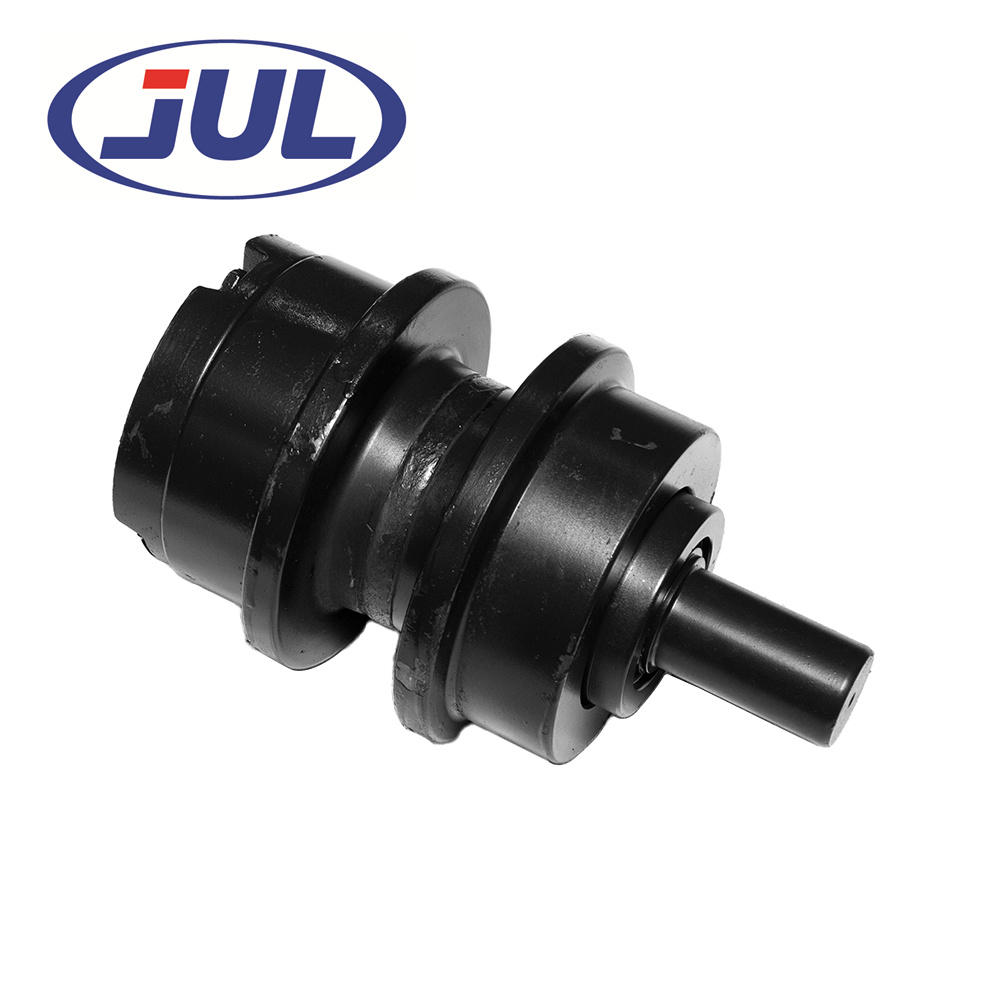
Rollóirí Iompróir (or Top Rollers): These smaller rollers support the weight of the upper section of the track chain, preventing it from sagging and maintaining proper tension. While they don't bear the full weight of the machine, they are still critical for smooth operation. Exploring different Caterpillar carrier roller options from a specialized supplier can be a cost-effective way to maintain system integrity.
Idlers and Tensioners: The idler is a large wheel at the front (or sometimes rear) of the track frame that guides the track chain onto the rollers. It is connected to a tensioning system (often a hydraulic cylinder) that allows the operator to maintain the correct track "sag" or tension. Proper tension is vital; a track that is too tight causes immense stress and accelerated wear on all components, while a track that is too loose can cause the track to come off the idler or sprocket ("de-tracking"). The idler's tread must be hardened to resist wear, and its internal bearing structure must be robust.
sproicéid: This is the toothed, driven gear at the rear of the machine that engages with the track chain's bushings and propels the machine forward or backward. As the final drive component, it transfers all the engine's power to the track. The teeth of the sprocket must be precisely shaped and hardened to engage smoothly with the bushings. As we discussed, any mismatch in pitch between the sprocket and chain is a recipe for disaster.
Understanding this interplay clarifies why a systems approach to engineering is so important. A weakness in any one of these components can compromise the entire system. A great aftermarket engineer doesn't just design a good roller; they design a roller that works perfectly with their track chain, which is designed to engage perfectly with their sprocket, creating a symphony of durable, reliable motion.
Evaluating Supplier Credibility and Support Systems
A superior undercarriage part is the product of more than just good steel and smart design; it is the product of a trustworthy and competent organization. When you purchase a set of track chains or rollers, you are not just buying metal—you are entering into a relationship with the supplier. The quality of that relationship, the transparency of their operations, and the robustness of their support systems are just as important as the physical characteristics of the part itself. A cheap part from an unknown source with no support is a gamble. A fairly priced part from a reputable supplier with a strong warranty and accessible technical expertise is an investment. This third point of our checklist, mar sin, moves from the product to the provider. You must evaluate the character and capability of the company standing behind the part.
From Factory to Field: The Importance of a Transparent Supply Chain
Where do your parts actually come from? In today's globalized economy, this can be a surprisingly difficult question to answer. A company might have a sales office in your country but source its components from various factories around the world, with varying levels of quality control. A transparent and direct supply chain is a powerful indicator of a supplier's credibility.
A top-tier supplier is often vertically integrated, meaning they control multiple stages of the production process. They might not own the steel mill, but they will have direct control over the forging, meaisínithe, cóireáil teasa, and assembly of their components. This control allows them to enforce their quality standards at every step. They are not simply a "re-boxer" who buys parts on the open market and puts their name on them. They are a true manufacturer.
Nuair a dhéantar grinnfhiosrúchán ar sholáthraí, ask about their manufacturing facilities. Where are they located? Do they own the factory, or do they use contractors? Can they provide virtual or even physical tours of their production line? A company that is proud of its manufacturing process will be open and transparent about it. They will be able to show you their CNC machining centers, their computer-controlled induction hardening stations, and their rigorous quality inspection labs. This transparency builds confidence and demonstrates a genuine commitment to quality.
Ina theannta sin, consider their logistics and distribution network, especially in your region, whether it be Australia, Oirdheisceart na hÁise, or Russia. A reliable supply chain isn't just about manufacturing; it's about getting the right part to the right place at the right time. A supplier with established distribution centers in your region can significantly reduce shipping times and costs. They are more likely to have the specific parts for your machine in stock, minimizing your downtime. This logistical capability is a sign of a mature and well-run organization that understands the urgent needs of the heavy equipment industry (Coia, 2013).
Tábla 2: Supplier Evaluation Checklist
| Evaluation Area | Key Questions to Ask | Ideal Response / Positive Indicator | Red Flag / Negative Indicator |
|---|---|---|---|
| Manufacturing & Ar ardchaighdeán | Are you the manufacturer? Where are your factories? Are you ISO 9001 deimhnithe? | Direct manufacturer, transparent about facilities, current ISO 9001 deimhniú. | Re-boxer/trader, evasive about origins, no quality certifications. |
| Innealtóireacht & Dearadh | Are your parts forged or cast? Can you explain your heat treatment process? What design improvements have you made over OEM? | Forged high-stress parts, detailed explanation of deep hardening, clear examples of innovation (e.g., rónta). | All parts are cast, vague on heat treatment ("it's hardened"), parts are just "OEM-spec" copies. |
| Bharántas & Tacaíocht | What is the warranty period and what does it cover? Where do I go for a claim? Do you have technical support staff? | Glan, bharántas cuimsitheach (e.g., 3000 hours/2 years), local or responsive claims process, accessible engineers. | doiléir, pro-rata, or parts-only warranty; complex or international claims process; only salespeople available. |
| Regional Presence | Do you have a warehouse or distributor in my region (e.g., Astráil, Meán-Oirthear)? What is the typical lead time? | Established regional distribution center, stock on hand for common parts, short lead times. | Ships only from a central overseas warehouse, long and unpredictable lead times. |
| Reputation & History | How long have you been in business? Can you provide case studies or references from customers in my industry/region? | Long company history, positive and verifiable customer testimonials and case studies. | New company with no track record, unable or unwilling to provide references. |
| Product Range | Do you offer complete undercarriage systems or just individual parts? Do you supply other parts like buckets or rippers? | A comprehensive range of integrated undercarriage components and other GETs. | Limited, scattered selection of only the most popular, fast-moving parts. |
Warranty and Technical Support: Your Safety Net Against Premature Failure
No matter how good a manufacturer is, failures can still happen. The immense stresses placed on undercarriage components mean that there will always be a small but real possibility of a defect or a premature failure. What separates a great supplier from a poor one is how they handle these situations. A strong warranty and accessible technical support are your safety net, transforming a potential catastrophe into a manageable problem.
Ar dtús, examine the warranty itself. A confident manufacturer will back their products with a clear and comprehensive warranty. Look for the duration, typically expressed in both service hours and calendar months (e.g., "3000 hours or 24 mhí, whichever comes first"). A longer warranty period is a direct signal of the manufacturer's confidence in their product's longevity.
Leis, scrutinize what the warranty covers. Does it cover just the replacement part, or does it also contribute to the labor costs of the repair? Does it cover "consequential damage"—for example, if a failed roller damages the track link, is the link also covered? A pro-rata warranty, which offers decreasing value as the part is used, is less desirable than a full replacement warranty. Read the fine print. Are there unreasonable conditions that could void the warranty, such as requiring exclusive use of that brand's parts across the entire machine?
Equally important is the warranty claim process. If a part fails on a job site in rural Australia, how do you file a claim? Do you have to ship the heavy, broken part back to a factory in another country at your own expense? A reputable supplier will have a streamlined process, often handled through their regional distributor. They will have clear procedures for inspection (often using photos and measurements) and will make a fair and timely decision.
Beyond the warranty, consider the availability of technical support. What happens when you have a question about installation, or when you notice an unusual wear pattern? Can you speak to someone who understands undercarriage systems, or are you stuck with a salesperson who only knows part numbers? A premium supplier of Caterpillar undercarriage aftermarket solutions will have experienced technicians or engineers on staff who can provide genuine advice. They can help you diagnose problems, recommend the correct parts for a specific application, and provide guidance on maintenance procedures. This expertise is an invaluable resource that adds significant value beyond the part itself.
Ag léamh idir na línte: Analyzing Customer Reviews and Case Studies
In the age of information, direct feedback from other users is a powerful tool. ach, you must learn to analyze this feedback critically. Not all reviews are created equal, and a savvy buyer knows how to read between the lines.
Start by seeking out detailed testimonials and case studies, preferably from companies in your industry and region. A generic "Great parts, loingseoireachta go tapa!" review is less useful than a detailed account from a mining operator in Western Australia who documents achieving 4,000 service hours on a set of aftermarket track chains in highly abrasive conditions. A quality supplier will actively collect and publish these case studies. They are a form of proof, demonstrating their product's performance in a real-world context.
When reading reviews, look for patterns. A single negative review could be an anomaly, but if multiple customers from different regions report the same failure mode—for example, "the track pins came loose after 500 hours"—that is a significant red flag. Os a choinne sin, if multiple users praise the supplier's excellent customer service in handling a warranty claim, that speaks volumes about the company's integrity.
Be wary of sources. Reviews on the supplier's own website are naturally going to be curated. Look for feedback on independent industry forums, social media groups for heavy equipment operators, or through your own professional network. Ask other fleet managers or owner-operators in your area what their experiences have been with different aftermarket brands. This word-of-mouth reputation is often the most honest and reliable indicator of a supplier's true quality and service level.
Ar deireadh, consider the supplier's response to negative feedback. Does a company that receives a public complaint ignore it? Or do they respond professionally, offering to investigate the issue and make it right? A supplier who engages constructively with criticism demonstrates accountability and a commitment to customer satisfaction. This public behavior can be a very telling glimpse into the company's culture.
Regional Expertise: Why a Supplier's Presence in Your Market Matters
The world of heavy equipment is not monolithic. The challenges faced by a machine in the humid, muddy conditions of Southeast Asia are vastly different from those in the rocky, arid Middle East or the frozen ground of a Russian winter. A supplier with genuine regional expertise and a physical presence in your market offers significant advantages.
A regional presence, whether through a company-owned branch or a dedicated, long-term distributor, means the supplier has "skin in the game" in your market. They are not a faceless entity on another continent; they are part of your local business community. This local presence usually translates into a better understanding of your specific operational challenges. They will know which track shoe designs work best in your local soil conditions. They will have experience with the common failure modes seen on machines in your area. They can provide advice that is tailored, specific, and immediately applicable.
This regional presence also has immense practical benefits. Mar a luadh, it means better parts availability and shorter lead times. When a machine is down, waiting weeks for a part to clear customs is not an option. A local warehouse can often get you the part you need within a day. This logistical advantage alone can justify choosing a supplier with a strong regional network.
Ina theannta sin, a local presence simplifies everything from sales to service. You can build a relationship with a local representative who speaks your language and understands your business. If a warranty issue arises, you have a local point of contact to help you resolve it. If you need urgent technical advice, you can speak to someone in your own time zone. This level of accessibility and support is incredibly valuable and is something that remote, internet-only suppliers can rarely match. When evaluating your options for Caterpillar undercarriage aftermarket solutions, place a high value on those suppliers who have invested in building a real presence in your corner of the world.
Costas Iomlán na hÚinéireachta (TCO) vs. Praghas Ceannacháin Tosaigh
Perhaps the single most important conceptual shift a fleet manager or owner-operator can make is to move from thinking about "price" to thinking about "cost." The initial purchase price of an undercarriage component is merely the tip of the iceberg. The true cost—the Total Cost of Ownership (TCO)—is a much larger and more complex figure that includes not only the purchase price but also the cost of installation, the expected lifespan of the part, its effect on other components, agus, is tábhachtaí, costas downtime meaisín. A cheap part that fails prematurely is often the most expensive part you can buy. This fourth point of our checklist is a call to embrace a TCO mindset. It requires discipline and a willingness to look beyond the immediate savings on an invoice, but it is the only rational way to manage the immense expense of undercarriage maintenance.
The Iceberg Analogy: Uncovering Hidden Undercarriage Costs
The iceberg is a perfect analogy for TCO. The visible part, floating above the water, is the purchase price. It's easy to see, easy to compare, and it's what most people focus on. But the vast, hidden mass of the iceberg below the waterline represents the other associated costs. It is this hidden mass that can sink your budget.
Let's break down what's below the surface. Ar dtús, there is the cost of installation labor. It takes a significant number of man-hours to remove an old undercarriage and install a new one. Let's say a complete undercarriage replacement costs you 40 hours of technician labor. If you buy a cheap set of track groups that lasts only 2,000 uair an chloig, you will incur that 40-hour labor cost twice in a 4,000-hour period. If you had instead purchased a premium aftermarket set that lasts 4,000 uair an chloig, you would only pay that labor cost once. The "savings" on the cheap parts are quickly eaten up by the extra labor.
Dara, there is the cost of accelerated wear on other components. As we've discussed, a poor-quality track chain with an incorrect pitch can rapidly destroy a perfectly good, and very expensive, OEM sprocket. A poorly sealed roller that seizes can cause gouging and damage to the track links running over it. These "consequential damages" are a direct cost attributable to the low-quality part.
Tríú, and by far the largest hidden cost, is the cost of unscheduled downtime. When a machine goes down unexpectedly due to a failed undercarriage component, the costs multiply rapidly. You have the direct cost of the machine being unproductive—it's not earning revenue. You may have an operator who is being paid to wait. You might have other machines on the job site—trucks, loaders—that are now idled because the dozer or excavator is out of commission. You could face penalties for missing project deadlines. This cost of downtime can easily run into thousands or even tens of thousands of dollars per day. A single catastrophic failure of a cheap part can cost you more in downtime than the entire price of a premium OEM undercarriage. The TCO model forces you to quantify this risk and factor it into your decision.
Calculating TCO: A Practical Framework for Fleet Managers
Calculating a precise TCO can seem daunting, but even a simplified framework is far better than relying on purchase price alone. Let's create a basic model. You need to compare two options for a set of track groups: a low-tier option and a premium aftermarket option.
Ar dtús, gather your inputs for each option:
- p: Purchase Price of the components.
- L: Labor Cost for installation (Technician hours x Hourly rate).
- H: Expected Lifespan in service hours (be realistic and use data from suppliers, cás-staidéir, or your own experience).
- D: Cost of Downtime for one replacement cycle (Lost revenue/day x Days to repair). This is for unscheduled failure, so it's a risk factor.
Anois, we can calculate a "Cost Per Hour" for each option. The basic formula is: Costas in aghaidh na huaire = (p + L) / H
Let's use an example for a mid-size dozer:
Rogha A: Low-Tier Aftermarket
- P = $12,000
- L = $3,200 (40 hours @ $80/hr)
- H = 2,500 uair an chloig (supplier claim, but your experience suggests it's optimistic)
- Costas in aghaidh na huaire = ($12,000 + $3,200) / 2,500 uair an chloig = $6.08 in aghaidh na huaire
Rogha B: Premium Aftermarket
- P = $18,000
- L = $3,200 (40 hours @ $80/hr)
- H = 4,500 uair an chloig (backed by warranty and case studies)
- Costas in aghaidh na huaire = ($18,000 + $3,200) / 4,500 uair an chloig = $4.71 in aghaidh na huaire
Sa chás seo, even though the premium option had a 50% higher purchase price, its cost per hour of operation is over 22% lower. An “níos saoire" option is actually more expensive in the long run.
Anois, let's factor in the risk of downtime. Let's say there's a 25% chance the low-tier parts will suffer a catastrophic failure before reaching their expected life, causing 3 days of downtime at a cost of $5,000 per day. The risk-adjusted cost is 0.25 x (3 x $5,000) = $3,750. If we add this to the low-tier option's cost over its life, the TCO becomes even worse. The premium part, with its higher quality control and better warranty, might have only a 5% chance of such a failure.
This type of analysis transforms the purchasing decision from an emotional one based on sticker shock to a rational, data-driven business decision. It provides a logical justification for investing in quality. As a manager, you can use this framework to defend your choice of high-quality Caterpillar undercarriage aftermarket solutions to senior management or clients.
The Impact of Downtime: How a Cheap Part Can Become Your Most Expensive
Let's humanize the cost of downtime. Imagine you are managing a road construction project in a remote area of Africa. You have a tight deadline. Your primary dozer, fitted with recently installed, low-cost track chains, suffers a failure. A track link cracks and the chain separates. The machine is immobilized in the middle of the project.
What happens next? The operator calls you. You have to dispatch a field service truck with at least two technicians. They may have to travel for hours to reach the site. They diagnose the problem, but you don't have a spare track chain on hand because you weren't expecting a failure so soon. Cuireann tú glaoch ar an soláthraí, who is located in another country. It will take them two days to process the order and a week to ship the part by air freight, at a huge cost. Then it has to clear customs. Best case scenario, you get the part in 10 laethanta.
For those 10 laethanta, your entire project is crippled. The excavator that was feeding the crushers is idle. The trucks that were hauling material are parked. Your entire crew is either sent home or is being paid for unproductive time. Your project falls behind schedule, and you start facing late-completion penalties from your client. The total cost of this single failure—the air freight, the emergency technician call-out, the idled fleet, the contract penalties—could easily exceed $50,000. That amount could have purchased two sets of the highest-quality premium undercarriage available.
This is not a far-fetched scenario. It happens every day around the world. It is the brutal reality of what happens when a purchasing decision is based solely on the initial price tag. The true cost of a part is not what you pay for it, but what it costs you when it fails. A TCO mindset is, mar sin, a form of risk management. By investing in quality parts from reputable suppliers, you are buying reliability. You are buying predictability. You are buying insurance against the catastrophic cost of unscheduled downtime.
Balancing Quality and Budget: Finding the "Sweet Spot" in Aftermarket Solutions
Adopting a TCO mindset does not mean you must always buy the most expensive option available, which is often the OEM part. The goal is not to spend the most, but to achieve the lowest possible cost per hour. This is where premium aftermarket solutions find their "sweet spot."
OEM parts set the benchmark for quality and performance, but they come at a premium price, partly to cover the manufacturer's vast R&D and marketing overheads. Low-tier aftermarket parts offer a very low initial price but carry an unacceptably high risk of premature failure and a high TCO, as we have demonstrated.
The premium aftermarket occupies the valuable middle ground. These manufacturers have studied the OEM designs, understood the material science, and invested in modern, quality-controlled manufacturing. They may have even engineered improvements to the original design. Because they have a leaner corporate structure and focus specifically on high-wear parts, they can offer a product with performance that is close to, or sometimes even exceeds, OEM standards, but at a significantly lower purchase price (often 20-40% less).
This is the sweet spot. By choosing a premium aftermarket supplier, you can achieve a cost per hour that is often lower than both the OEM and the cheap aftermarket options. You get the long life and reliability you need to minimize downtime, but without the high initial capital outlay of buying from the dealer.
Finding this sweet spot requires doing the homework outlined in this checklist. You must research the materials and manufacturing (Point 1), evaluate the engineering intelligence (Point 2), and verify the supplier's credibility and support (Point 3). When you combine that due diligence with a rigorous TCO analysis (Point 4), you are in the strongest possible position to make a decision that is both financially prudent and operationally sound. You are no longer just buying parts; you are making a strategic investment in your fleet's productivity and your business's profitability.
Application-Specific Selection and Maintenance Synergy
The final piece of the puzzle involves recognizing two profound truths about undercarriage management. Ar dtús, not all job sites are created equal. The ideal undercarriage for a dozer working in soft, sandy soil is different from one working on hard, carraig ghéar. Selecting a part that is optimized for its specific application is a critical step toward maximizing its life. Dara, an undercarriage's lifespan is not solely determined by the quality of its parts. It is the result of a symbiotic relationship between the quality of the parts and the quality of the maintenance they receive. A great set of parts can be destroyed by poor maintenance, while even mediocre parts can have their life extended through diligent care. This final point of our checklist is about creating a powerful synergy between smart selection and proactive maintenance.
Matching the Part to the Terrain: High-Impact vs. High-Abrasion Environments
Thinking about your machine's working environment is crucial. We can broadly classify most job sites into two categories: high-impact and high-abrasion.
High-Impact Environments: These are conditions involving large, hard objects that can strike the undercarriage. Common examples include demolition sites with broken concrete, quarries with large blasted rock (shot rock), or logging operations with stumps and boulders. In these environments, the primary risk is not gradual wear, but sudden fracture or bending. A track shoe can crack, a track link can be bent, or a roller flange can be broken off by a single impact event.
For high-impact applications, the toughness of the steel is paramount. This goes back to our discussion of material science and heat treatment. You need parts made from high-quality forged steel that have been properly tempered to absorb shock without fracturing. While surface hardness is still important, an overly hard and brittle part can be a liability here. You also might select specific components designed for this work. Mar shampla, "extreme service" or "super extreme service" track shoes are thicker and more robustly designed to resist bending and cracking. The choice of Caterpillar undercarriage aftermarket solutions must prioritize strength and impact resistance above all else.
High-Abrasion Environments: These are conditions involving small, hard particles that constantly grind away at the undercarriage components. Sandy soils, gravel operations, and many mining environments fall into this category. An áit seo, the primary enemy is gradual wear. The sand and grit form a lapping compound that slowly erodes the hardened surfaces of the track links, rollóirí, díomhaoin, agus sprockets.
For high-abrasion applications, surface hardness and the depth of that hardness are the most important characteristics. You need parts with a deep, uniform case hardening that can withstand this constant grinding for as long as possible. Components with extra wear material, like the "hi-rail" track links we discussed earlier, can provide a significant life extension in these conditions. The material's ability to resist being worn away, its "abrasion resistance," is the key property to seek. This is where the quality of the heat treatment process really shows its value.
Many job sites, ar ndóigh, are a mixture of both impact and abrasion. The key is to analyze your primary operating conditions and discuss them with your parts supplier. A knowledgeable supplier can act as a consultant, helping you select the right combination of components—the right track shoe type, the right grade of track chain—to build an undercarriage system that is optimized for your world.
The Symbiotic Relationship Between Parts and Maintenance Practices
You can buy the best, most expensive undercarriage in the world, but if you fail to maintain it correctly, you will have wasted your money. Os a choinne sin, a disciplined maintenance program can squeeze every last hour of life out of your components. The relationship is symbiotic; quality parts respond better to good maintenance, and good maintenance protects your investment in quality parts.
The most fundamental maintenance practice is regular cleaning. The undercarriage should be cleaned out as often as possible, ideally at the end of every shift. Packed mud, grean a chur síos, and debris can cause a host of problems. It increases the weight of the undercarriage, robbing the machine of power. It can prevent rollers from turning, creating flat spots as the track drags over them. In freezing climates, is féidir le láib pacáilte reoite soladach thar oíche, effectively seizing the entire undercarriage and putting immense strain on the drive motors and track pins when the operator tries to move the machine in the morning. A simple 15-minute pressure wash at the end of the day is one of the highest-return investments you can make in undercarriage life.
Another critical practice is maintaining proper track tension, or "sag." A track that is too tight is one of the most common and destructive errors in undercarriage management. It dramatically increases the friction and load on the entire system, luasghéarú ar chaitheamh ar bhioráin, bustaí, sproicéid, díomhaoin, agus rollóirí. It's like driving your car with the parking brake partially engaged. A track that is too loose is also problematic, as it can wander and cause the machine to de-track. Every machine has a specific procedure and measurement for setting the correct sag. This should be checked regularly and adjusted as conditions change.
Operator technique also plays a massive role. An operator who understands how to minimize undercarriage wear can save you a fortune. This includes simple habits like minimizing high-speed reverse travel (which causes more wear on the reverse-drive side of the track bushings), making wide, casadh de réir a chéile in ionad casadh géar mhaighdeog, and trying to balance the amount of turning in each direction. Training operators on these best practices is a vital part of any comprehensive undercarriage management program.
Extending Undercarriage Life: Proactive Inspection and Care
The key to long undercarriage life is moving from a reactive ("fix it when it breaks") to a proactive ("manage the wear") mindset. This requires regular and systematic inspection. An experienced technician or operator can learn to "read" the wear patterns on an undercarriage and take action to maximize its life.
One of the most important proactive measures is managing the "wear life" of the pins and bushings on a sealed and lubricated track chain. As the machine works, the internal pin and bushing wear on one side. After a certain amount of wear (which can be measured), there is still significant life left on the other side. A" bioráin agus cas bushing" is a maintenance procedure where the track chain is removed, and each pin and bushing is pressed out and rotated 180 céimeanna. Nochtann sé seo úr, dromchla neamhchaite don sprocket, effectively resetting the wear clock and often doubling the life of the track chain for a fraction of the cost of a new one. Knowing when to perform this turn—not too early and not too late—is a critical skill.
Regular undercarriage measurement is the foundation of this proactive approach. Using specialized ultrasonic tools and calipers, a technician can measure the remaining wear on all the key components: track link rail height, trastomhas tread sorcóir, sprocket tooth profile, and so on. These measurements can be tracked over time to predict when components will reach their wear limits. This allows you to plan for replacements in an orderly fashion, scheduling the downtime rather than having it forced upon you. It also allows you to make smart decisions, like replacing a worn sprocket at the same time as the track chain to ensure the new components start their life together on an equal footing. Many premium aftermarket suppliers offer these undercarriage inspection services as part of their customer support.
Réitigh Chustaim: When Standard Aftermarket Parts Aren't Enough
For the vast majority of applications, a standard configuration from a quality aftermarket supplier will provide excellent performance and value. ach, there are unique and extreme applications where a custom solution is required. This might be for a machine working in an ultra-corrosive environment like a salt mine, or a specialized machine like a pipeline layer that puts unusual stresses on its undercarriage.
In these cases, you need to partner with a supplier who has a deep engineering bench and a flexible manufacturing process. This is the ultimate test of a supplier's capability. Can they work with you to analyze your unique problem? Can they recommend a special alloy, a custom heat treatment specification, or a modified component design to address your challenge?
Mar shampla, for a machine working in a swamp, a supplier might recommend extra-wide "low ground pressure" (LGP) track shoes to increase flotation. They might also suggest a special coating for the components to improve corrosion resistance. For a machine working on a steep slope, they might recommend a specific grouser pattern to improve grip.
The ability to provide these custom solutions is a hallmark of a true engineering partner, not just a parts seller. It demonstrates a deep understanding of material science, application engineering, and customer needs. While you may not need a fully custom solution for your fleet, a supplier's ability to offer them is a powerful indicator of their overall technical competence and their commitment to solving customer problems. It's a final confirmation that you are dealing with an expert in the field of Caterpillar undercarriage aftermarket solutions.
Ceisteanna coitianta (Ceisteanna CCanna)
Are aftermarket Caterpillar undercarriage parts reliable?
The reliability of aftermarket parts varies dramatically. Premium aftermarket parts from reputable manufacturers who use high-quality alloy steels, proper forging and heat treatment processes, and innovative designs can be as reliable as, and sometimes more reliable than, Páirteanna OEM. Os a choinne sin, low-tier parts from unknown sources often use inferior materials and processes, leading to premature failure and unreliability. The key is diligent supplier evaluation.
How can I tell if an aftermarket part is high-quality?
Look for several key indicators: the use of forged steel for high-stress components, transparent material specifications (look for alloys with manganese, cróimiam, agus bórón), deep and uniform induction hardening, Iso 9001 certification for the manufacturer, a comprehensive warranty, and positive, detailed case studies from other users in your industry.
Will using aftermarket parts void my Caterpillar machine's warranty?
In many jurisdictions, such as the United States with the Magnuson-Moss Warranty Act, a manufacturer cannot void the entire machine warranty simply because you used an aftermarket part. They would have to prove that the specific aftermarket part caused the failure of the warranted OEM component. ach, the failed aftermarket part itself and any damage it causes would not be covered by the Caterpillar warranty. It's best to use high-quality aftermarket parts with their own strong warranty.
What is the single biggest mistake people make with their undercarriage?
The most common and destructive mistake is running the tracks too tight. Over-tightening the tracks dramatically increases the load and friction on every single component in the system—pins, bustaí, naisc, rollóirí, díomhaoin, and sprockets—leading to significantly accelerated wear and premature failure. Regularly checking and maintaining the proper track sag is the most effective maintenance practice for extending undercarriage life.
How much money can I really save with aftermarket undercarriage parts?
While the initial purchase price of premium aftermarket parts can be 20-40% lower than OEM, the real savings come from a lower Total Cost of Ownership (TCO). By providing a long service life comparable to OEM at a lower price point, premium aftermarket solutions can deliver the lowest cost-per-hour of operation, saving you money on parts, labor, agus, is tábhachtaí, costly machine downtime.
What does "pitch" mean and why is it important?
Pitch is the center-to-center distance from one track pin to the next. It is a critical dimension. If you install a new track chain whose pitch does not perfectly match the pitch of the existing sprocket, the chain's bushings will not seat correctly in the sprocket's teeth. This creates high-impact, grinding contact that will rapidly destroy both the new chain and the sprocket.
Should I replace the whole undercarriage at once or just the worn parts?
While it can be tempting to replace only the most worn components, it is often more cost-effective in the long run to replace components that wear together as a set. Mar shampla, a new track chain should always be installed with a new sprocket. Putting a new chain on a worn sprocket will cause the new chain to wear out very quickly. A proactive management approach using regular measurements helps plan these system-level replacements for maximum value.
Conclúid
Navigating the world of Caterpillar undercarriage aftermarket solutions is an endeavor that rewards diligence and a holistic perspective. The allure of a low initial price can be a powerful siren's call, but it often leads to the rocky shores of premature failure, excessive downtime, agus ar deireadh thiar, higher total costs. The truly astute approach, mar atá iniúchadh déanta againn, is one that transcends the sticker price and embraces a deeper form of inquiry.
It is a process that begins with an appreciation for the very substance of the components—the specific metallurgy and manufacturing processes that imbue steel with the strength to endure. It continues with a critical eye for engineering intelligence, favoring innovation and system compatibility over mere imitation. It demands a thorough evaluation of the supplier's character, seeking transparency, robust support, and a verifiable track record of success. An chuid is mó go mór, it requires a mental shift from purchase price to Total Cost of Ownership, a framework that illuminates the true financial impact of reliability and longevity.
By integrating these principles—by matching the right components to the right application and uniting them with a disciplined maintenance program—you transform a simple purchase into a strategic investment. You are no longer just a buyer of parts; you become a manager of assets, a mitigator of risk, and a driver of operational efficiency. The path to optimizing your fleet's performance and profitability lies not in finding the cheapest part, but in finding the best value, armed with the knowledge and framework to confidently identify it.
Tagairtí
ASME. (2020). Jacks, industrial rollers, air casters, and hydraulic gantries (ASME B30.1-2020). The American Society of Mechanical Engineers.
Coia, A. (2013, October 4). Caterpillar moves the earth for better distribution. Automotive Logistics. https://www.automotivelogistics.media/caterpillar-moves-the-earth-for-better-distribution/9431.article
Gwidon, S., & Wranik, J. (2022). Analysis of the wear of undercarriage parts of a crawler chassis. Eksploatacja i Niezawodnosc–Maintenance and Reliability, 24(2), 332–340.
Pfestorf, H., Weiss, F., Matucha, K. H., & Wincierz, p. (2011). Bearing materials. In Ullmann's Encyclopedia of Industrial Chemistry. Wiley-VCH.
Grian, J., & Wang, Y. (2011). A review on recent research and development of wear-resistant metallic materials for mining applications in China. Advanced Materials Research, 287-290, 1888-1894. https://doi.org/10.4028/www.scientific.net/AMR.287-290.1888
Tata, R. p. (2011). Principles and use of ball & roller bearings (Course No: M06-024). Continuing Education and Development, Inc.
Totten, G. O. (Ed.). (2006). Lámhleabhar cóireála teasa cruach. CRC brúigh.
Trafimczyk, J., & Gierulski, Thiar. (2010). Analysis of the factors affecting the wear of caterpillar track chains. Journal of KONES, 17(4), 469-476.