
خلاصة
The selection of appropriate track chain and track shoe parts represents a determination of profound consequence for the operational longevity and economic efficiency of heavy construction machinery. This analysis examines the multifaceted process of procuring these critical undercarriage components, moving beyond superficial price-based assessments to a more nuanced evaluation of material science, manufacturing integrity, and application-specific design. It posits that a discerning approach, grounded in an understanding of metallurgical properties, dimensional precision, and sealing technologies, is indispensable for mitigating premature wear and catastrophic failure. The investigation extends to the economic realities of ownership, advocating for a cost-per-hour metric as a more rational basis for investment than initial acquisition cost. بالإضافة إلى, the role of the supplier is explored, not merely as a vendor, but as a crucial partner whose expertise, quality assurance protocols, and logistical support contribute substantively to the end-user's success. This discourse is tailored for stakeholders in demanding environments, such as those found across Russia, أستراليا, الشرق الأوسط, وجنوب شرق آسيا, where terrain and climate impose extreme stresses on machinery, rendering informed component selection a matter of operational survival.
الوجبات الرئيسية
- Scrutinize the steel alloy and heat treatment process for maximum durability.
- Verify the dimensional accuracy, especially track pitch, to prevent system wear.
- Match track shoe design (grouser type) to your specific ground conditions.
- Evaluate the track chain and track shoe parts' seal system to extend internal life.
- Analyze the total cost of ownership rather than only the initial purchase price.
- Choose a supplier with proven quality control and strong regional support.
جدول المحتويات
- 1. Scrutinize Material Composition and Manufacturing Processes
- 2. Verify Component Compatibility and Dimensional Accuracy
- 3. Assess the Design of Track Shoes for Your Specific Application
- 4. Evaluate the Sealing System and Lubrication Technology
- 5. Investigate the Supplier’s Quality Control and Testing Protocols
- 6. Analyze Long-Term Cost of Ownership, Not Just Upfront Price
- 7. Consider the Supplier’s Reputation and Regional Expertise
- الأسئلة المتداولة (التعليمات)
- خاتمة
- مراجع
1. Scrutinize Material Composition and Manufacturing Processes
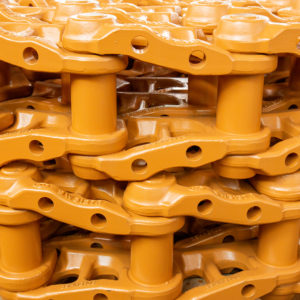
When we begin to consider the underpinnings of a tracked machine's mobility, we are invariably led to the track assembly itself. It is the machine's direct interface with the earth, a system of articulated steel that bears the full weight of the equipment and translates engine power into motion. To think of the track chain and track shoe parts as mere commodities is to fundamentally misunderstand their role. هم, in a very real sense, the bones and sinews of the machine's lower body. الفشل هنا ليس إزعاجًا بسيطًا; it is a crippling event that brings a multi-ton, multi-million-dollar asset to a grinding halt. لذلك, our first and most foundational check must be an inquiry into the very substance of these components: their material DNA and the story of their creation.
The Heart of Durability: Steel Alloys and Hardness
Let us begin with the steel. It is easy to say a track link is "made of steel," but this is akin to saying a book is "made of paper" without considering the quality of the prose. The specific alloy of steel used is the primary determinant of a track component's ability to resist the dual threats of abrasive wear and high-impact shock. لروابط المسار, دبابيس, والبطانات, manufacturers often turn to specialized steel alloys containing elements like manganese, الكروم, and boron.
Imagine you are baking a cake. The base ingredients—flour, sugar, eggs—are essential. But it is the addition of cocoa, vanilla, or spices that defines its character. In steelmaking, iron and carbon are the base ingredients. Manganese acts as a vital deoxidizing agent and also improves hardenability and toughness. Chromium enhances corrosion resistance and, more importantly for our purposes, increases the depth to which the steel can be hardened. البورون, حتى بكميات ضئيلة, has a powerful effect on hardenability, allowing for a deep and uniform hardness to be achieved through heat treatment without making the steel overly brittle (Kilic, 2021). A track link forged from a high-quality boron steel alloy is intrinsically more capable of withstanding the rigors of a quarry floor than one made from a simpler carbon steel.
This brings us to the concept of hardness, يتم قياسه عادة على مقياس روكويل سي (HRC). Hardness is the measure of a material's resistance to localized plastic deformation, such as scratching or indentation. You want the outer surfaces of your track pins, البطانات, and the rail surface of your track links to be exceptionally hard to fight against the constant grinding of sand, صخر, and dirt. لكن, you also need the core of the component to be softer and tougher, capable of absorbing the shock of the machine dropping onto a rock or lurching over uneven ground. If the entire component were hardened to the maximum, it would be as brittle as glass, shattering under the first significant impact. This duality is the central challenge of undercarriage metallurgy. A well-manufactured track link might have a surface hardness of 52-58 HRC but a core hardness of around 30-35 HRC. This differential is not an accident; it is the deliberate result of sophisticated manufacturing.
تزوير مقابل. صب: What It Means for Performance
How a component takes its shape is just as meaningful as the material from which it is made. The two predominant methods for forming track links are forging and casting. Let us consider the difference through an analogy. Think of the grain in a piece of wood. If you carve a shape from a block of wood, the grain runs straight through it, creating potential lines of weakness. This is similar to casting, where molten metal is poured into a mold. While modern casting techniques are highly advanced, the resulting product has a random, equiaxed grain structure.
الآن, imagine taking that same piece of wood and, using steam and pressure, bending it into the desired shape. The grain of the wood would follow the curve, making it inherently stronger. This is the principle behind forging. In forging, a solid billet of steel is heated and then pounded or pressed into shape by immense mechanical or hydraulic forces. This process physically alters the internal grain structure of the steel, محاذاته مع ملامح الجزء. This aligned grain flow eliminates the internal voids that can occur in casting and produces a component of superior density, قوة الشد, and fatigue resistance. For a part like a track link, which is subjected to immense and continuous pulling forces, the structural integrity imparted by forging is a significant advantage. While casting can be a viable and cost-effective method for certain components, for the most demanding applications, forged track links are generally considered the superior choice.
الدور الحاسم للمعالجة الحرارية
If forging gives the component its strong bones, heat treatment gives it its hardened skin and tough heart. This is perhaps the most critical and nuanced stage of the manufacturing process for track chain and track shoe parts. It is a form of "steel alchemy" where controlled heating and cooling cycles are used to manipulate the material's crystalline structure, locking in the desired properties of hardness and toughness.
The most common method is induction hardening. Imagine the rail surface of a track link, the part that contacts the rollers. An induction coil, powered by a high-frequency alternating current, is passed over this surface. This generates intense, localized heat very rapidly, heating only the surface layer to a critical transformation temperature. Immediately following the coil is a spray of quenching fluid (often water or a polymer solution), which cools the surface at a precise rate. This rapid heating and cooling "freezes" the crystalline structure in a very hard state known as martensite. The key is that the heat does not have time to penetrate deep into the part, so the core remains unaffected, retaining its softer, more ductile properties.
The same principle applies to track pins and bushings. A track pin must be able to pivot within the bushing under immense pressure, so both surfaces need to be incredibly wear-resistant. They are typically through-hardened or case-hardened to a significant depth to provide a long wear life. An improperly executed heat treatment can be disastrous. Too shallow a hardened depth, and the part will wear out quickly. Too deep, or an incorrect quench rate, and the part can become brittle or develop internal stresses that lead to cracking. When you evaluate a potential supplier, you are not just buying a piece of steel; you are buying their expertise in metallurgy and their mastery of the heat treatment process.
2. Verify Component Compatibility and Dimensional Accuracy
Having established the foundational importance of material and manufacturing, we must now turn our attention to the geometry of the components. In the intricate dance of an undercarriage system, precision is everything. The track chain is not an isolated component; it is a member of an ensemble cast that includes the drive sprocket, العاطلين الأمامي والخلفي, and the top and bottom rollers. For the system to function harmoniously and efficiently, every component must be perfectly in sync. A dimensional mismatch, even one that seems minor, can introduce a cascade of destructive forces that dramatically accelerates wear across the entire undercarriage, turning a significant investment into a premature pile of scrap.
Pitch Perfect: Why Track Pitch Measurement is Non-Negotiable
The single most important dimension in a track chain is its pitch. لذا, what is track pitch? Imagine a simple bicycle chain. The pitch is the distance from the center of one pin to the center of the next pin. It is the fundamental unit of the chain's length. In a heavy equipment track chain, the concept is identical, just scaled up immensely. This pitch must correspond exactly to the distance between the teeth on the drive sprocket and the guiding surfaces on the rollers and idlers.
Let us think about what happens when the pitch is incorrect. Consider a new track chain installed on a worn sprocket. The sprocket's teeth have been ground down, and the distance between them has effectively increased. As the chain engages the sprocket, the pin will not seat perfectly in the valley between the teeth. بدلاً من, it will ride up on the tooth face. Under the massive torque of the drive motor, the sprocket tooth will grind against the track bushing, attempting to force it into place. This creates a point of high-pressure contact that rapidly wears both the bushing's outer surface and the sprocket's tooth profile. The same destructive mismatch occurs if you install a new chain with an incorrect pitch onto a new sprocket.
This phenomenon is known as "pitch mismatch," and it is a primary driver of accelerated undercarriage wear. متأخر , بعد فوات الوقت, as a track chain operates, its pins and bushings naturally wear internally. This causes the chain to "stretch," meaning its effective pitch increases. This is a normal part of the wear process. لكن, starting with an incorrect pitch from day one due to poor manufacturing tolerances is an unforced error. Before purchasing any track chain and track shoe parts, it is imperative to get a specification sheet from the supplier that clearly states the pitch dimension and the allowable tolerance. For a large dozer, a tolerance of +/- 0.5 mm might be acceptable, but anything more should be a significant cause for concern.
| Component Mismatch Scenario | Primary Wear Location | Secondary Effect | Consequence |
|---|---|---|---|
| New Chain on Worn Sprocket | Sprocket Teeth, Track Bushings | Increased operational noise | Rapid destruction of new bushings |
| Worn Chain on New Sprocket | Sprocket Teeth | Chain "jumping" under load | Potential for sprocket tooth breakage |
| Incorrect Pitch Chain (جديد) | البطانات, ضرس, العاطلون | High stress on all components | Catastrophic, rapid system-wide wear |
| Mismatched Link Height | بكرات المسار, Link Rails | Uneven load distribution | Accelerated roller and link wear |
Interfacing with Sprockets, بكرات, and Idlers
The pitch is the star of the show, but other dimensions play crucial supporting roles. The height of the track link rail, the surface that runs over the rollers, must be consistent. If some links are taller than others, those links will bear a disproportionate amount of the machine's weight as they pass over the rollers, leading to localized wear on both the link and the rollers.
The dimensions of the track bushing—its outer diameter and length—are also vital. The bushing is the component that makes contact with the sprocket tooth. Its diameter must match the sprocket's design profile to ensure a smooth transfer of power. The track pin diameter and its fit within the link are equally important. This is the pivot point for the entire joint. A loose fit will lead to "peening" and deformation of the pin bore in the link, while a fit that is too tight can cause the joint to seize, especially in extreme temperatures.
Think of it as assembling a high-performance engine. You would never use pistons that are slightly the wrong size for the cylinders or a crankshaft with improperly ground journals. The tolerances are measured in thousandths of an inch because the forces are immense, and the operational speeds are high. The same mindset must be applied to an undercarriage. It is a low-speed, high-torque system, but the principles of mechanical precision are identical. A reputable supplier will be able to provide detailed mechanical drawings with all critical dimensions and their associated manufacturing tolerances. Do not be hesitant to ask for them.
Understanding Tolerances for Global Climates
The operating environment adds another layer of complexity to dimensional considerations. Metal expands when heated and contracts when cooled. While these changes may seem minuscule, they can have a real impact on the performance of heavy machinery, especially in the extreme climates where many of these machines operate.
Consider a dozer operating in the Siberian winter, where temperatures can plummet to -50°C. At these temperatures, the steel in the undercarriage will contract. The lubricant inside the track joints will become incredibly viscous, almost solid. The clearances and tolerances between the pin, bushing, and seals must be designed to accommodate this. If the tolerances are too tight, the contraction of the metal could cause a joint to seize, placing immense strain on the drive system or even causing a link to fracture.
الآن, contrast that with a machine working in a mine in the Pilbara region of Western Australia or a construction site in the Middle East, where ambient temperatures can exceed 50°C. The steel will expand. The constant friction and pressure will generate even more heat. If the tolerances are not sufficient to allow for this thermal expansion, the internal pressure within the sealed joint can build up, potentially causing seals to fail or components to bind. This is why understanding a supplier's expertise is so important. A manufacturer that primarily serves a temperate market may not have the engineering experience to design track chain and track shoe parts with tolerances suitable for the extreme cold of Russia or the intense heat of Africa. When sourcing أجزاء الهيكل السفلي, it is wise to partner with a supplier who can demonstrate experience with your specific regional climate challenges.
3. Assess the Design of Track Shoes for Your Specific Application
If the track chain is the skeleton of the undercarriage, the track shoes are its feet. They are the final point of contact with the ground, responsible for providing the traction, flotation, and protection necessary for the machine to do its job. Just as you would not wear dress shoes for a mountain hike, you cannot expect one type of track shoe to perform optimally in all conditions. The selection of the correct track shoe design is a critical decision that directly impacts machine performance, fuel consumption, and the wear life of the entire undercarriage system. Making the right choice requires a thoughtful assessment of your typical working environment.
Single, Double, or Triple Grouser: Matching Tread to Terrain
The most visible feature of a track shoe is its grouser bars—the protruding ribs of steel that bite into the ground. The number and shape of these grousers define the shoe's primary characteristics. The three most common types are single, مزدوج, and triple grouser shoes.
Single Grouser Shoes: Imagine the cleat on a soccer player's boot. It is designed for one thing: maximum penetration and grip on a soft surface. The single grouser shoe operates on the same principle. With one tall, aggressive grouser bar, it offers the highest level of traction and ground penetration. This makes it the ideal choice for work in soft soils, heavy mud, and on steep slopes where preventing slippage is paramount. لكن, this aggressive design comes with trade-offs. The tall grouser concentrates the machine's weight onto a smaller surface area, increasing ground pressure. On hard, rocky surfaces, this can lead to the grouser bending or breaking. بالإضافة إلى, the deep penetration and aggressive turning action cause significant ground disturbance and place very high turning stresses on the entire undercarriage, accelerating wear on pins, البطانات, وبكرات. Single grouser shoes are specialists, best used when maximum traction is the undisputed priority.
Triple Grouser Shoes: الآن, think of the tread on a standard all-terrain tire for a truck. It is designed to be a good all-rounder. This is the role of the triple grouser shoe. With three shorter, less aggressive grousers, it distributes the machine's weight over a much larger contact area. This reduces ground pressure, making it suitable for a wide variety of ground conditions from soil to gravel and even some rock. The lower grouser height means less ground penetration, which results in significantly lower turning resistance. This is a crucial point. A machine with triple grouser shoes can pivot and turn much more easily than one with single grousers, which drastically reduces the twisting forces exerted on the track chain and its internal components. This translates to a longer life for the entire undercarriage system. For general construction, excavation, and earthmoving, the triple grouser shoe is the standard and most versatile choice.
Double Grouser Shoes: The double grouser shoe represents a compromise between the two extremes. It offers better traction and penetration than a triple grouser but with less turning resistance and a longer wear life than a single grouser. It is often found on front-end loaders and other machines that require a balance of good traction and high maneuverability. It is a good option for mixed ground conditions that include both soft soil and harder, more abrasive surfaces.
| Track Shoe Type | Ideal Terrain | الجر | Turning Resistance | Wear on Hard Surfaces |
|---|---|---|---|---|
| Single Grouser | التربة الناعمة, الطين, Steep Slopes | الأعلى | الأعلى | عالي |
| Double Grouser | التربة المختلطة, Gravel, الأوساخ | عالي | Medium | Medium |
| Triple Grouser | Varied, الغرض العام | Medium | أدنى | قليل |
| مستنقع (Low Ground Pressure) | Saturated Soil, Marsh, التندرا | قليل | أدنى | عالية جدًا |
Specialty Shoes: Swamp Pads, Rubber Pads, and Extreme Service Shoes
Beyond the common grouser types, a world of specialized track shoes exists for unique applications.
Swamp Shoes (or Low Ground Pressure Shoes): These are extra-wide shoes, often with a flat or very low grouser profile. Their purpose is flotation. By dramatically increasing the surface area of the track, they reduce the machine's ground pressure, allowing it to work on extremely soft, saturated ground like swamps, marshes, or tundra without sinking. Think of them as the snowshoes of the heavy equipment world.
Rubber Pads: For machines that must operate on finished surfaces like asphalt or concrete, steel grousers are not an option as they would destroy the surface. هنا, rubber pads are used. These can be bolt-on pads attached to a standard triple grouser shoe or a "clip-on" style that attaches to the chain itself. There are also "rubber-bonded" shoes where the rubber is permanently bonded to a steel shoe plate. These are essential for urban construction, road work, and any application where surface damage is a concern.
Extreme Service (ES) Shoes: In the most abrasive and high-impact environments, such as quarries, demolition sites, and mining operations, standard shoes may not suffice. Extreme service shoes are built with more material and a more robust design. They typically have a greater plate thickness and taller, stronger grousers made from a harder, more wear-resistant steel alloy. While they represent a higher initial investment, their extended wear life in severe conditions can lead to a lower overall cost of ownership. When you are looking at a supplier's offerings, exploring a full catalog of أجزاء الهيكل السفلي can reveal specialized solutions you may not have considered.
The Importance of Grouser Height and Width
A final rule of thumb in shoe selection is to always use the narrowest shoe possible that still provides adequate flotation for your machine. Why? Because a wider shoe acts as a longer lever. As the machine travels over uneven ground, a rock or obstacle under the edge of a wide shoe will exert a much greater twisting force on the track pin and bushing joint than it would on a narrower shoe. This torsional stress is a significant contributor to internal pin and bushing wear and can even lead to seal failure. Wider shoes also increase the strain on all undercarriage components during turning. While you need enough width to keep the machine from sinking, using an excessively wide shoe "just in case" is a common and costly mistake that needlessly shortens the life of your track chain and track shoe parts.
4. Evaluate the Sealing System and Lubrication Technology
We have delved into the external armor of the undercarriage—the hardness of the steel and the design of the shoes. الآن, we must venture inside, into the hidden world of the track joint. A track chain is composed of dozens of articulated joints, each consisting of a pin that pivots inside a bushing. This is where the real battle against wear is fought. The internal, metal-on-metal friction within these joints is what causes a chain to "stretch" and eventually reach the end of its life. The single most important factor in prolonging the life of a track chain is the effectiveness of its sealing system and the lubricant it contains. A track joint is, في جوهره, a sealed-for-life bearing, and its longevity is entirely dependent on keeping the lubricant in and the abrasive contaminants out.
Grease-Lubricated vs. Oil-Lubricated Chains: A Deep Dive
Historically, track chains were "dry," meaning they had no internal lubrication. The pins and bushings simply ground against each other, leading to very short service lives. The first major innovation was the development of the sealed and lubricated track (ملح). These early versions were typically grease-lubricated.
Grease-Lubricated Chains: في هذا التصميم, the space between the pin and the bushing is packed with a heavy-duty grease during assembly. The seals at either end of the bushing are designed to hold this grease in. Grease has the advantage of being thick and tacky, so it tends to stay put. It provides a good lubricating film that dramatically reduces the rate of internal wear compared to a dry chain. For many smaller machines or those in less demanding applications, a well-designed grease-lubricated chain offers a very good balance of performance and cost. لكن, grease does have its limitations. It does not flow easily, so it may not fully recoat the wear surfaces after being displaced by high pressure. متأخر , بعد فوات الوقت, it can also dry out or become contaminated.
Oil-Lubricated Chains: For larger machines and more demanding applications, oil-lubricated chains represent the next step in performance. في هذا التصميم, each track joint acts as its own sealed oil reservoir. A channel is drilled through the center of the track pin, and this reservoir is filled with a specialized gear oil. As the joint articulates, the oil is able to flow and circulate, constantly replenishing the lubricating film between the pin and the bushing. Oil is a superior lubricant to grease in this application because it provides better cooling and can more effectively flush away any microscopic wear particles. This results in a significantly lower rate of internal wear and can extend the life of the track chain by 50% or more compared to a grease-lubricated design under the same conditions (يرقة, 2018). The trade-off is that oil-lubricated systems are more complex and place a much higher demand on the sealing system. A seal failure in an oil-lubricated chain is more critical, as the low-viscosity oil will leak out relatively quickly, leaving the joint unprotected.
When making your choice, consider the size of your machine and the intensity of your work. For a large dozer in a 24/7 mining operation, the extended life of an oil-lubricated chain is almost always worth the investment. For a mini-excavator doing intermittent utility work, a grease-lubricated chain might be the more economical and perfectly adequate choice.
The Anatomy of a Seal: Polyurethane Seals and Their Function
The track seal is a small, often overlooked component, but the entire lubrication system depends on its integrity. It is the gatekeeper of the track joint. Modern track seals are marvels of material science and precision engineering. They are typically composed of two main parts: a load ring and a seal ring.
ال load ring is a robust, square-sectioned rubber ring that provides the static force. It is compressed during assembly and acts like a spring, constantly pushing the seal ring against the polished metal faces of the bushing and the link. This provides the energy that keeps the seal interface tightly closed.
ال seal ring is the dynamic component. It is a precisely shaped ring, often made from a highly durable polyurethane compound. This is the part that does the actual sealing. It has two finely polished faces that ride against the equally polished end of the bushing and the inside of the track link. The interface between these two polished faces is what contains the lubricant and excludes the dirt. The shape of the seal ring is critical. It is often designed with a slight "cone" shape to create a specific pressure distribution across the sealing face, ensuring a tight seal without generating excessive friction or heat.
The quality of the polyurethane used in the seal ring is paramount. It must be able to resist abrasion from any fine grit that gets near the seal. It must be resistant to chemical breakdown from the lubricant inside and any contaminants from the outside. Most importantly, it must retain its shape and elasticity across a huge range of temperatures, from the deep freeze of a Russian winter to the baking heat of an African mine. A low-quality seal will quickly harden, كسر, or deform, leading to lubricant loss and the ingress of dirt, which spells a rapid death for the track joint. When questioning a supplier about their track chain and track shoe parts, ask specifically about the material and design of their seals. A confident supplier will be proud to detail the advanced polyurethane compounds and precision engineering that go into their sealing systems.
Preventing Internal Wear: The Unsung Hero of Track Life
The entire purpose of the lubrication and sealing system is to manage internal wear. This is the wear that occurs on the outer diameter of the pin and the inner diameter of the bushing as they pivot against each other. This wear is not visible from the outside, but it is what causes the chain to elongate or "stretch."
As the pin and bushing wear, the material is removed, and the distance from the center of one pin to the center of the next increases. This is the change in pitch we discussed earlier. A technician can measure this change to determine the percentage of internal wear a chain has experienced. على سبيل المثال, a track chain might be considered 100% worn internally and in need of a "pin and bushing turn" when its pitch has increased by 3 مم.
"دوران الدبوس والجلبة" is a maintenance procedure where the track is disassembled, and the pins and bushings are rotated 180 درجات. This presents a new, unworn surface to the high-contact areas, effectively resetting the clock on internal wear and extending the life of the chain. لكن, this procedure is only possible if the external wear on the bushing has not been too severe. An effective sealing system that preserves the internal lubricant is what makes a pin and bushing turn a viable and economical option. It prevents the rapid internal wear that would otherwise make the chain unusable long before the external components are worn out. لذلك, investing in a chain with a superior sealing system is not just about extending the first life of the chain; it is about enabling a second and even third life through effective maintenance, dramatically lowering the total cost of ownership.
5. Investigate the Supplier’s Quality Control and Testing Protocols
You have now examined the theoretical aspects of what makes a high-quality track component—the right materials, the right dimensions, the right design. But how can you be confident that the specific track chain you are about to purchase actually meets these standards? The answer lies in the supplier's commitment to quality control (مراقبة الجودة) and rigorous testing. A specification sheet is a promise; a robust QC program is the proof that the promise is being kept. For a buyer located in Australia or Africa, far from the manufacturing facility, this proof is not just reassuring; it is a fundamental requirement for a secure investment. You cannot afford to have a component fail on a remote site because of a manufacturing defect that should have been caught at the factory.
Beyond the Spec Sheet: Requesting QC Reports
Every reputable manufacturer of track chain and track shoe parts will have a quality management system in place, often certified to an international standard like ISO 9001. This system dictates that checks and measurements are performed at various stages of the production process. As a discerning buyer, you have the right to see the evidence of this process.
Do not hesitate to ask a potential supplier for copies of their typical quality control reports for a production batch. What should you look for in these reports?
- شهادة المواد: The process should begin with a certificate from the steel mill, verifying the chemical composition of the raw steel billet. Does it confirm the presence of the specified alloys like boron and manganese?
- Dimensional Checks: The report should show measurements taken after forging or casting and after final machining. Key dimensions like pitch, link height, and bore diameters should be recorded and compared against the engineering drawing's specified tolerances.
- Hardness Testing: This is one of the most important checks. The report should show the results of Rockwell hardness tests performed on multiple samples from the batch. It should specify not just the surface hardness but also the case depth (the thickness of the hardened layer) and the core hardness. Are these values consistent and within the specified range?
- التفتيش النهائي: A final visual and dimensional inspection report should confirm that the parts are free from cracks, burrs, or other visual defects and that all final dimensions are correct.
A supplier who is transparent and readily provides this documentation is demonstrating confidence in their processes. A supplier who is hesitant or claims such reports are "internal only" should be viewed with caution. Their reluctance may suggest a lack of confidence in their own consistency or a process that is not as tightly controlled as they claim. This documentation is your window into the factory floor, and it is a crucial tool for due diligence.
اختبار غير مدمر (NDT) Methods: ما الذي تبحث عنه
While dimensional and hardness checks are vital, some of the most dangerous defects are invisible to the naked eye. Internal cracks from the forging process or subsurface flaws from heat treatment can lead to sudden, catastrophic failure under load. To find these hidden defects, manufacturers employ a range of Non-Destructive Testing (NDT) methods. As a buyer, knowing what these tests are and asking if they are performed can provide an extra layer of assurance.
فحص الجسيمات المغناطيسية (MPI): This is a common method for detecting surface and near-surface cracks in ferromagnetic materials like steel. الجزء ممغنط, and a fine iron powder (either dry or suspended in a liquid) is applied to the surface. If there is a crack or flaw, سوف يعطل المجال المغناطيسي, causing the iron particles to gather at the location of the flaw, making it visible to an inspector. Asking if track links are subjected to MPI after forging and heat treatment is a very pertinent question.
اختبار الموجات فوق الصوتية (يوتا): This method uses high-frequency sound waves to detect internal flaws. A transducer sends a pulse of sound into the part. ينتقل الصوت عبر المادة وينعكس على الجدار الخلفي. The time it takes for the echo to return is measured. If there is an internal flaw like a crack, a void, or an inclusion, it will create an additional reflection that appears on the technician's screen, revealing the flaw's location and approximate size. UT is an excellent method for ensuring the internal integrity of critical components like track pins.
Liquid Penetrant Inspection (LPI): This can be used on non-ferromagnetic materials and is very effective at finding surface-breaking cracks. A brightly colored liquid dye (the penetrant) is applied to the surface. After a certain dwell time, the excess penetrant is cleaned off. ثم, a developer is applied, which acts like a blotter, drawing the penetrant out of any cracks and making them clearly visible.
A manufacturer that invests in and regularly utilizes these NDT methods is demonstrating a serious commitment to preventing defective parts from ever leaving their facility. This is a hallmark of a top-tier supplier of undercarriage components and attachments like buckets and rippers.
Tracing the Supply Chain: From Raw Material to Final Product
A final aspect of quality assurance is traceability. In the event of a failure, it is essential to be able to trace the part back through the manufacturing process to identify the root cause. A robust traceability system ensures that each individual component or, more commonly, each production batch, has a unique identifying number.
This number should allow the supplier to track:
- The specific batch of raw steel it was made from.
- The date and shift it was forged or cast.
- The heat treatment batch it was part of, along with the corresponding furnace charts and hardness test results.
- The final machining and inspection reports.
This level of traceability is not just for post-failure analysis. It is also a powerful internal tool for the manufacturer to maintain process control. If a hardness test on one batch comes back slightly out of spec, they can immediately quarantine that entire batch and adjust their heat treatment process for the next one. For you, the buyer, it is a sign of a mature and professional operation. When you receive your track chain and track shoe parts, look for these batch numbers or serial numbers etched or stamped onto the components. Their presence is a quiet testament to a quality system that stands behind the product.
6. Analyze Long-Term Cost of Ownership, Not Just Upfront Price
In the world of heavy equipment, few temptations are as alluring as a low upfront price. When presented with two seemingly identical track chains, one costing 20-30% less than the other, the impulse to choose the cheaper option is powerful. لكن, this is often a false economy. The true cost of an undercarriage component is not the price on the invoice; it is the total cost incurred over the component's entire service life, divided by the number of hours it operates. This concept, known as the Total Cost of Ownership (TCO) or cost-per-hour, is the only rational metric for evaluating the value of track chain and track shoe parts. A decision based on purchase price alone is a gamble that rarely pays off.
The Hidden Costs of Premature Wear and Downtime
Let us construct a scenario. You manage a fleet of excavators on a major infrastructure project in Southeast Asia. You need to replace the track groups on one of your machines. Supplier A offers a complete track group for $15,000. Supplier B, a premium provider, offers a seemingly identical group for $20,000. ال $5,000 saving is tempting. You opt for Supplier A.
The cheaper track group is installed, and for the first few hundred hours, everything seems fine. لكن, this chain was made with a lower-grade steel alloy and a less precise heat treatment. Its internal seals are made from an inferior polymer. Around the 2,500-hour mark, long before you would expect it, the chain shows signs of significant pitch extension. A seal has failed, the joint has run dry, and internal wear has accelerated dramatically. The machine is "down."
الآن, the hidden costs begin to accumulate. أولاً, there is the cost of the downtime itself. A large excavator can generate thousands of dollars in revenue per day. Every hour it sits idle is lost profit. The project schedule may be impacted, potentially incurring penalties. ثانية, there is the cost of labor. You have to pay a team of mechanics to remove the failed track and install a new one. This might involve bringing in a mobile service truck, adding to the expense. ثالث, there is the cost of the replacement part itself. You have to buy another track group, and this time, you are unlikely to make the same mistake. You buy the premium one for $20,000.
In this scenario, your pursuit of a $5,000 upfront saving has resulted in thousands, أو حتى عشرات الآلاف, of dollars in downtime losses, additional labor costs, and the need to purchase a second replacement part far earlier than planned. The "cheaper" option has become monumentally more expensive.
Calculating Cost-Per-Hour: A Better Metric for Value
A more enlightened approach is to shift the focus from price to value, calculated as cost-per-hour. Let us revisit our scenario with this new perspective.
Track Group A (Cheaper Option):
- التكلفة الأولية: $15,000
- Achieved Service Life: 2,500 ساعات
- Cost-Per-Hour: $15,000 / 2,500 hours = $6.00 كل ساعة
Track Group B (Premium Option):
- التكلفة الأولية: $20,000
- Expected Service Life (based on manufacturer data and case studies): 5,000 ساعات
- Cost-Per-Hour: $20,000 / 5,000 hours = $4.00 كل ساعة
Viewed through this lens, the decision becomes clear. The track group that was 33% more expensive upfront is actually 33% cheaper to operate on an hourly basis. This calculation does not even include the massive costs of the unscheduled downtime associated with the premature failure of the cheaper option. A high-quality component, born from superior metallurgy and manufacturing, delivers more hours of productive service, which is the ultimate goal. When you engage with a potential supplier, ask them for performance data. Can they provide case studies or wear-life data from machines operating in conditions similar to yours? A supplier confident in their product's longevity will have this information and be eager to share it, as it justifies their price point and demonstrates the superior value they offer.
Warranty and After-Sales Support as a Value Multiplier
The final components of the TCO equation are the warranty and the after-sales support offered by the supplier. A warranty is more than just a promise to replace a defective part; it is a statement of the manufacturer's confidence in its own product quality and durability.
A comprehensive warranty that covers a reasonable number of hours or years provides a crucial safety net. It protects your investment against the possibility of a rare manufacturing defect. Compare the warranty terms offered by different suppliers carefully. A longer and more comprehensive warranty is a tangible asset that adds value to the purchase.
Equally important is the after-sales support. What happens if you have a technical question during installation? What if you need help diagnosing a wear pattern? A supplier that acts as a partner will have knowledgeable technical staff available to assist you. They might offer services like undercarriage inspections and wear analysis to help you manage your fleet more effectively. This level of support can be invaluable, helping you to maximize the life of all your undercarriage components, including not just the track chain and track shoe parts, but also the rollers, العاطلون, والعجلات. This support transforms the supplier from a simple vendor into a long-term partner in your operational success, a trait often found by understanding a supplier's mission and history.
7. Consider the Supplier’s Reputation and Regional Expertise
Our final check transcends the physical object of the track chain and delves into the character and capabilities of the organization that supplies it. في السوق العالمية, you can source components from anywhere in the world. لكن, the best suppliers are more than just transactional vendors; they are partners who bring a wealth of experience, a demonstrable commitment to quality, and a deep understanding of the specific challenges you face in your region. Choosing the right supplier is as important as choosing the right part, as their expertise and support can be the difference between a successful investment and a frustrating ordeal.
Sourcing for Success: The Value of a Specialized Supplier
The market for heavy equipment parts is vast. It ranges from generalist suppliers who sell everything from filters to final drives, to highly specialized companies that focus exclusively on a narrow range of products. When it comes to high-wear, critical components like a track chain, there is immense value in partnering with a specialist.
A specialized supplier of undercarriage parts lives and breathes this technology. Their entire business is built on an intimate knowledge of metallurgy, wear dynamics, and application engineering. Their technical staff are not just salespeople; they are experts who can diagnose a complex wear problem or recommend the perfect track shoe for a challenging soil condition. They have likely encountered and solved the very problems you are facing many times before. This depth of knowledge is an invaluable resource.
بالإضافة إلى, a specialized supplier's reputation is built entirely on the performance of their chosen product line. They cannot hide a poor-quality track chain behind a broad catalog of other parts. Their success is directly tied to the durability and reliability of the undercarriage components they sell. This creates a powerful incentive to source only high-quality products and to maintain rigorous quality assurance standards. They are staking their name on the performance of that track chain, which gives you, the buyer, a significant degree of confidence. When you engage with a specialized heavy machinery parts supplier, you are not just buying a product; you are buying access to a pool of focused expertise.
Case Studies and Testimonials from Your Region
Theoretical performance and factory testing are one thing; real-world performance in your specific environment is another. The abrasive, silica-rich sands of the Australian Outback, the corrosive humidity of a Southeast Asian jungle, the permafrost of a Siberian mine, and the rocky terrain of an African quarry all present unique and severe challenges to an undercarriage.
A truly global and experienced supplier will be able to demonstrate their success in these challenging environments. Ask for case studies or performance data from customers operating in your country or a region with similar conditions. A case study detailing how a specific track chain achieved 6,000 hours of service life on a dozer in a Western Australian iron ore mine is far more compelling than a generic brochure.
Testimonials from other equipment owners and fleet managers in your region are also powerful indicators of a supplier's quality and reliability. In the close-knit community of heavy equipment operators, reputations are earned the hard way. A supplier that is consistently recommended by others in your area has likely proven their ability to deliver durable products and responsive service. This regional validation is a crucial piece of the puzzle, providing assurance that the supplier's products are not just good in theory, but proven in practice where it matters most to you.
Navigating Logistics and Support in Remote Locations
The final consideration is the practical reality of getting the parts to your machine and receiving support when you need it. For operators in remote parts of Russia, أستراليا, أو أفريقيا, logistics are a major challenge. A track group for a large dozer can weigh several tons. Shipping such an item across the globe is a complex and expensive undertaking.
A supplier with experience serving your region will have established and reliable logistics channels. They will understand the intricacies of customs clearance in your country and be able to provide accurate shipping times and costs. They may have regional distribution centers that can significantly reduce delivery times and costs compared to shipping directly from a central factory halfway around the world.
This regional presence also extends to after-sales support. If you have a warranty claim or a technical issue, can you speak to someone in a reasonably close time zone? Do they have technical representatives who can, if necessary, visit your site? A supplier with a strong regional network demonstrates a long-term commitment to the market. They are not just interested in making a single sale; they are invested in supporting your operations for the long haul. This logistical and support infrastructure is the final, crucial element that transforms a simple purchase into a true partnership and a secure, long-term investment in your machine's productivity. It ensures that the high-quality track chain and track shoe parts you have so carefully selected are backed by a support system that is just as robust and reliable.
الأسئلة المتداولة (التعليمات)
1. What is the difference between OEM, genuine, and aftermarket track parts?
تصنيع المعدات الأصلية (الشركة المصنعة للمعدات الأصلية) parts are components made by the company that manufactured the machine or by its designated supplier. Genuine parts are those branded by the machine manufacturer (على سبيل المثال, يرقة, كوماتسو) but may be made by a third-party supplier to their exact specifications. Aftermarket parts are produced by independent companies. High-quality aftermarket suppliers can offer parts that meet or even exceed OEM specifications in terms of materials and performance, في كثير من الأحيان عند نقطة سعر أكثر تنافسية. The key is to vet the aftermarket supplier thoroughly using the checks outlined in this guide.
2. How often should I inspect my track chain and track shoe parts?
Regular inspections are vital. A daily walk-around to check for loose bolts, visible cracks, or significant damage is a good practice. More thorough undercarriage inspections, including measuring components for wear, should be conducted periodically by a trained technician. The frequency depends on the application's severity, but a common interval is every 500 service hours. This allows you to track wear rates and plan for maintenance or replacement proactively.
3. Can I mix and match components from different brands in my undercarriage?
While sometimes unavoidable, it is generally not recommended to mix major components like track chains and sprockets from different manufacturers. كما نوقش, dimensional compatibility is critical. Even slight differences in pitch or tooth profile between brands can lead to accelerated wear. It is safest to replace interacting components, such as the chain and sprocket, as a matched set from a single, trusted supplier.
4. What is a "pin and bushing turn," and when should it be done?
A pin and bushing turn is a maintenance procedure for sealed and lubricated track chains. When the internal wear on the pins and bushings reaches a certain limit (typically measured as chain "stretch"), the chain is disassembled, and the pins and bushings are rotated 180 degrees to present a new, unworn surface. This can effectively double the life of the track link assembly. It should be done when internal wear reaches the manufacturer's recommended limit, عادة حولها 100%, but before external bushing wear becomes excessive.
5. My machine works in both soft soil and hard rock. What is the best track shoe to use?
This is a classic dilemma. For mixed conditions, a triple grouser shoe is almost always the best compromise. It provides adequate performance in most situations with the lowest turning resistance, which preserves the life of the entire undercarriage. If you spend more than 75% of your time in extreme rock, an Extreme Service (ES) shoe might be justified. If you spend most of your time in deep mud, a single grouser might be necessary, but you must accept the accelerated wear that will occur when you operate on harder surfaces.
6. Why is using the narrowest possible track shoe recommended?
A wider track shoe acts as a longer lever, increasing the twisting forces (torsional stress) on the track pins and bushings when the machine travels over uneven ground or turns. This stress accelerates internal wear and increases the risk of seal failure. While you need a shoe wide enough to provide adequate flotation for your ground conditions, using an unnecessarily wide shoe adds strain and weight, reducing the life of your track chain and track shoe parts.
7. What does "HRC" mean when discussing steel hardness?
HRC stands for the Rockwell Hardness Scale, Part C. It is a standard method for measuring the hardness of steel and other metals. The test involves pressing a diamond-tipped cone into the material with a specific force and measuring the depth of the indentation. A higher HRC number indicates a harder material that is more resistant to wear. For track components, a high surface hardness (على سبيل المثال, 52-58 HRC) is desired for wear resistance, while a lower core hardness (على سبيل المثال, 30-35 HRC) is needed for toughness and impact resistance.
خاتمة
The journey through the intricate world of track chain and track shoe parts reveals a fundamental truth: diligence in selection is not an expense but an investment in operational uptime and profitability. To view these components as simple steel commodities is to ignore the complex interplay of metallurgy, الدقة الهندسية, and application-specific design that defines their performance. The initial price tag, while immediately apparent, is a poor and often misleading indicator of true value. A more profound understanding, rooted in an analysis of material composition, المعالجة الحرارية, dimensional accuracy, and sealing technology, empowers the buyer to look beyond the surface.
By adopting a cost-per-hour mentality, the focus shifts from short-term savings to long-term efficiency. This perspective acknowledges the immense hidden costs of premature failure and unscheduled downtime, reframing the higher upfront cost of a premium component as a sound investment in reliability. The seven checks outlined here provide a structured framework for this discerning approach. They encourage a dialogue with suppliers that moves beyond price to a substantive discussion of quality control, testing protocols, and proven performance. أخيرًا, the selection of these foundational components is a choice between a short-term transaction and a long-term partnership—a partnership with a supplier whose expertise and support are as durable as the steel they provide, ensuring your machinery remains productive and profitable in the most demanding environments on earth.
مراجع
يرقة. (2018). Caterpillar undercarriage guide (3rd ed.). Caterpillar Inc.
Kilic, م. (2021). Effect of boron on the hardenability of steels. Journal of Materials Research and Technology, 15, 2235-2244.