
Abstrait
La sélection d'un mini-fabricant de pièces de fouille représente une décision stratégique importante pour les gestionnaires de flotte et les propriétaires-opérateurs, avec des implications directes pour la disponibilité opérationnelle, rentabilité à long terme, et la sécurité du site d'emploi. Ce document examine le processus multiforme de vérification et de choix d'un fournisseur pour des composants critiques tels que les pièces de train de roulement, seaux, éventreurs, et des ciseaux. Il se déplace au-delà de l'analyse des coûts superficiels pour proposer un, seven-question framework designed to probe a manufacturer's core competencies. L'enquête plonge dans les domaines nuancés de la science matérielle et de la métallurgie, La rigueur des systèmes de fabrication et de contrôle de la qualité, et la profondeur des capacités de recherche et de développement. Il explore en outre les aspects pratiques de la compatibilité des parties, les complexités de la logistique de la chaîne d’approvisionnement mondiale, la vérification des allégations de performance par des preuves empiriques, et le caractère indispensable d’un support technique après-vente robuste. En abordant systématiquement ces domaines, les acheteurs peuvent développer une compréhension globale d’un fournisseur potentiel, leur permettant de forger des partenariats qui améliorent la longévité des machines et offrent une valeur durable dans des environnements opérationnels divers et exigeants à travers le monde.
Plats clés à retenir
- Evaluate a manufacturer's metallurgical expertise and material sourcing transparency.
- Examiner les protocoles de contrôle qualité depuis la matière première jusqu'à l'inspection finale.
- Assess a supplier's commitment to research, développement, et innovation produit.
- Vérifier les méthodes utilisées pour garantir la compatibilité des pièces et un montage précis.
- Choisissez un mini fabricant de pièces de excavatrice avec une stratégie logistique globale robuste.
- Exiger des preuves empiriques de performance par le biais d'études de cas et de témoignages régionaux.
- Prioriser les partenaires qui offrent un soutien technique complet et des garanties équitables.
Table des matières
- 1. Quelle est votre approvisionnement matériel et votre expertise métallurgique?
- 2. Pouvez-vous détailler vos processus de fabrication et vos protocoles de contrôle de la qualité?
- 3. Quelle est la portée de vos recherches, Développement, et capacités d'ingénierie?
- 4. Comment assurez-vous la compatibilité des pièces et l'ajustement sur différentes marques et modèles?
- 5. Quelle est votre stratégie mondiale de la logistique et de la chaîne d'approvisionnement, Surtout pour ma région?
- 6. Pouvez-vous fournir des preuves de performance et de durabilité par le biais d'études de cas et de témoignages?
- 7. Quel niveau de soutien après-vente et d'expertise technique proposez-vous?
- Questions fréquemment posées (FAQ)
- Conclusion
- Références
1. Quelle est votre approvisionnement matériel et votre expertise métallurgique?
La conversation avec tout fabricant potentiel de pièces de excavatrice doit commencer à ne pas commencer avec le prix, mais avec la substance même des composants eux-mêmes: l'acier. La durabilité d'un seau, La résilience d'un éventreur, et la durée de vie d'un train de roulement ne sont pas des questions de hasard; Ce sont des résultats directs des choix délibérés faits bien avant la première soudure ou la coupe. Pour se renseigner sur l'approvisionnement en matériaux, c'est enquêter sur la philosophie fondamentale du fabricant. Construisent-ils pour la longévité, ou s'assemblent-ils simplement à un prix? Cette question révèle le caractère du fournisseur et fournit le premier, indicateur le plus révélateur de la qualité à laquelle vous pouvez vous attendre. La maîtrise d'un fabricant dans le langage de la métallurgie est le reflet directe de son engagement envers l'intégrité de leur produit et, par extension, au succès de vos opérations.
L'importance fondamentale des matières premières
Imaginez deux liens de piste identiques. L'un est forgé d'un carbone élevé, acier allié de bore. L'autre est fabriqué à partir d'un générique, acier au carbone de qualité inférieure. À l'œil nu, Ils ne sont pas en distingue. Encore, dans l'abrasif, environnement à fort impact d'un chantier, Leurs destins sont très différents. Le premier pourrait supporter des milliers d'heures de service, tandis que le second peut échouer prématurément, provoquant des temps d'arrêt catastrophiques. C'est pourquoi la discussion des matières premières est primordiale.
Nous devons d'abord comprendre que "l'acier" n'est pas un monolithe. C'est une famille d'alliages, chacun avec une recette spécifique de fer, carbone, et d'autres éléments conçus pour produire des propriétés particulières. Pour les composants des engins de chantier, les propriétés les plus recherchées sont la dureté, dureté, et résistance à l'usure.
Dureté est la capacité du matériau à résister à l’indentation et à l’abrasion de la surface. Pour les pièces telles que les bords de coupe et les dents du godet, qui sont en contact constant avec des matériaux abrasifs comme le sable, gravier, et du rock, une dureté de surface élevée n'est pas négociable. Ceci est souvent réalisé en utilisant des aciers à plus forte teneur en carbone et des alliages spécifiques comme le chrome et le molybdène., qui sont ensuite soumis à un traitement thermique.
Dureté is the material's ability to absorb energy and deform without fracturing. Pensez à la tige d'un éventreur rencontrant un rocher caché.. Un matériau fragile se briserait, mais un matériau résistant absorbera les chocs. Il y a souvent un compromis entre la dureté et la ténacité; Un matériau très dur peut être fragile. L'art de la métallurgie réside dans la recherche de l'équilibre optimal pour chaque application spécifique. Pour les composants structurels, La ténacité est souvent priorisée sur une dureté extrême.
Se résistance à l'usure est la capacité plus large à résister à la perte de matériau de l'action mécanique. C'est une fonction de la dureté, dureté, and the material's microstructure. Boron Steel est un choix populaire pour les outils d'engagement au sol et les pièces de train de roulement pour cette raison même. L'ajout d'une minuscule quantité de bore (aussi peu que 0.001%) peut augmenter considérablement la durabilité de l'acier, Permettre une dureté profonde et uniforme à atteindre pendant le traitement thermique, ce qui se traduit directement par une vie à usage plus longue (Effrayant & Dailertas, 2017).
Lorsque vous vous engagez avec un fabricant potentiel de pièces de excavatrice de mini, Vos questions doivent être spécifiques. N'acceptez pas "l'acier de haute qualité" comme réponse. Demandez les grades d'acier spécifiques utilisés pour leurs seaux, leurs chaussures de piste, Et leurs roueurs. Demandez pourquoi cette note particulière a été choisie. Un fournisseur compétent pourra expliquer sa justification, Connexion des propriétés de l'acier (Par exemple, le contenu en carbone, La présence de manganèse ou de bore) aux exigences fonctionnelles de la pièce. Ce niveau de transparence est le premier signe d'un partenaire digne de confiance.
Comprendre la métallurgie dans la fabrication des composants
L'approvisionnement de la bonne matière première n'est que le premier chapitre de l'histoire. La transformation ultérieure de cet acier brut en un, La composante fiable est un récit de chaleur, pression, et précision. C'est le domaine de la métallurgie dans la pratique, englober des processus comme le forge, fonderie, et traitement thermique. Comprendre les bases de ces techniques vous permet de poser des questions plus perspicaces et de discerner un fabricant axé sur la qualité à partir d'un fabricant axé sur le volume.
Considérons forgeage. Imaginez un forgeron martelant un morceau de fer chaud. Qui se forge dans sa forme la plus élémentaire. Dans la fabrication moderne, Des presses ou des marteaux massifs façonnent l'acier en une forme souhaitée. Le principal avantage de la forge est qu'il affine la structure des grains de l'acier. La force mécanique aligne les grains, Éliminer les vides internes et créer un dense, plus fort, et une partie plus résistante à la fatigue. Composants qui subissent une stress et un impact cycliques élevés, comme les liens de piste et les bielles de connexion, sont des candidats principaux pour forger. Quand vous parlez à un fabricant, demander lesquels de leurs composants sont forgés. Leur réponse révèle leur investissement dans la création de pièces avec une intégrité interne supérieure.
Ensuite est fonderie, le processus de coulée de métal en fusion dans un moule. Le moulage permet de créer des formes complexes qui seraient difficiles, voire impossibles, à forger ou à usiner.. Pièces comme des pignons, avec leurs profils de dents complexes, sont souvent jetés. La qualité d'une pièce moulée dépend de la pureté du métal en fusion, la conception du moule, et le processus de refroidissement. Un plâtre mal exécuté peut entraîner de la porosité (petites bulles internes) ou fissures de retrait, créer des points faibles pouvant conduire à une défaillance sous charge. Un fabricant compétent utilisera des techniques avancées telles que le dégazage sous vide pour éliminer les impuretés de l'acier en fusion et le remplissage du moule simulé par ordinateur pour garantir un produit solide., coulée uniforme.
Le processus le plus critique et souvent mal compris est peut-être traitement thermique. C’est là que le véritable potentiel de l’alliage d’acier est libéré. It is a carefully controlled sequence of heating and cooling that alters the steel's microstructure to achieve the desired balance of hardness and toughness.
- Éteinte: Il s’agit de chauffer l’acier à haute température puis de le refroidir rapidement. (souvent dans l'eau, huile, ou une solution de polymère). Ce processus crée une microstructure très dure mais cassante appelée martensite..
- Tremper: La pièce trempée est ensuite réchauffée à une température plus basse et maintenue pendant une durée déterminée. Ce processus soulage les contraintes internes et réduit la fragilité, augmenter la ténacité de la pièce.
La précision du processus de traitement thermique est primordiale. Une pièce qui n'est pas chauffée à la bonne température, pas refroidi assez vite, ou mal trempé ne répondra pas à ses spécifications de performance. Les fabricants avancés utilisent le chauffage par induction contrôlé par ordinateur pour appliquer la chaleur avec une précision incroyable à des zones spécifiques, par exemple, durcir uniquement les dents d'un pignon ou la surface du rail d'un maillon de voie, tout en laissant le noyau plus résistant et plus ductile pour absorber les chocs. Interrogez un fabricant sur ses capacités de traitement thermique. Utilisent-ils le durcissement par induction? Comment contrôlent-ils le taux de trempe et les températures de revenu? Leur capacité à parler en détail de ces processus est un indicateur fort de leur profondeur technique..
Questions à poser sur la certification et la traçabilité des matériaux
Trust, but verify. This old adage is the guiding principle when evaluating a manufacturer's claims about their materials. A declaration of using "boron steel" is meaningless without a system to prove it. This is where certification and traceability become central to your inquiry. These systems provide an objective, auditable trail from the raw material supplier to the finished part on your workshop floor.
The first line of verification is the Material Test Report (MTR), sometimes called a Mill Test Certificate. This is a quality assurance document provided by the steel mill that certifies the chemical composition and physical properties of a specific batch of steel. When a manufacturer receives a shipment of raw steel, it should be accompanied by an MTR. This report is like a birth certificate for the steel, détaillant sa composition chimique exacte (le pourcentage de carbone, manganèse, silicium, bore, etc.) et les résultats des tests mécaniques (comme la résistance à la traction et la dureté) effectué au moulin.
Votre question au fabricant doit être directe: "Maintenez-vous des MTR pour toutes les matières premières entrantes, et pouvez-vous relier une série de production spécifique de pièces à son MTR d'origine?"
Cela conduit à la notion de traçabilité. Un fabricant avec un système qualité robuste, comme un certifié ISO 9001 normes, aura des procédures pour suivre les matériaux tout au long du processus de production. Cela signifie qu'un lot spécifique de godets d'excavatrice, par exemple, peut être retracé jusqu'à la bobine ou à la plaque d'acier exacte dans laquelle il a été coupé, et à son tour, to that steel's MTR. Cette traçabilité ne sert pas uniquement à assurer la qualité; c'est votre police d'assurance. Si une panne prématurée survient sur le terrain, a manufacturer with traceability can investigate the root cause. Was it a deviation in the steel chemistry from that specific batch? Was there an issue during the heat treatment of that production run? Without traceability, any failure analysis is mere guesswork.
En outre, inquire about their in-house testing capabilities. While the MTR provides data from the steel mill, a truly diligent manufacturer will perform their own verification tests on incoming materials. This might involve using a spectrometer to confirm the chemical composition or performing hardness tests. This redundant check demonstrates a profound commitment to quality, as it protects their production process—and their customers—from any potential quality lapses from the raw material supplier. Demander « Quel est votre processus de validation de la qualité des matières premières entrantes?" peut être très révélateur. Une réponse confiante détaillera leur équipement de laboratoire interne et leurs protocoles de test, while a hesitant one might suggest they are simply taking their supplier's word for it.
Étude de cas: Le coût de l’acier de qualité inférieure dans un Ripper
Ancrer ces concepts dans la dure réalité du chantier, considérons un scénario. Une petite entreprise contractante de la région de Pilbara, en Australie occidentale, obtient un contrat pour des travaux de tranchée pour un nouveau site d'exploration minière. Le terrain est notoirement dur, composé de latérite et de pierre de fer. Ils exploitent une flotte de mini-pelles de 10 tonnes. Pour économiser sur les coûts initiaux, ils achètent plusieurs nouveaux rippers auprès d'un fournisseur offrant une remise importante. The supplier's documentation is sparse, indiquant simplement que les défonceuses sont fabriquées à partir de « haute résistance, acier résistant à l'usure."
Pendant les quarante premières heures de fonctionnement, les rippers fonctionnent correctement. Cependant, pendant la deuxième semaine, un des opérateurs heurte une poche de roche particulièrement dense. Au lieu de libérer le rocher, la tige du ripper s'enclenche proprement à mi-hauteur. L'échec est fragile, sans aucun signe de flexion ou de déformation. La machine est maintenant hors service. Le remplacement le plus proche est à Perth, à deux jours de route.
Let's calculate the real cost of this "cheaper" partie:
- Coût des temps d'arrêt: La machine, avec son opérateur, a un taux facturable d'environ AUD $150 par heure. La panne est survenue en début de journée. Let's assume 7 heures de travail perdues le premier jour, plus le complet 8 heures le deuxième jour en attendant le remplacement. That's 15 heures d'arrêt, totalisant AUD $2,250 en perte de revenus.
- Coût de remplacement: A premium-quality ripper from a reputable manufacturer would have cost AUD $1,200. Le « moins cher" one was AUD $800. They now have to purchase the premium ripper anyway, plus pay for express freight from Perth, adding another AUD $300. The total replacement cost is AUD $1,500.
- Labor Costs: The operator is idle but still needs to be paid. At AUD $45/hour, that's another AUD $675 for the 15 heures d'arrêt.
- Reputational Damage: The project is delayed by a day, straining the relationship with the primary contractor. This intangible cost can affect future contract opportunities.
The total tangible cost of the single failure of one "cheap" ripper is AUD $4,425 ($2,250 + $1,500 + $675). The initial savings of AUD $400 has resulted in a net loss of over AUD $4,000. Subsequent metallurgical analysis of the failed part would likely reveal a lower-grade steel with insufficient toughness or a flawed heat treatment process that made it excessively brittle. This case illustrates a fundamental truth: in heavy machinery, the purchase price of a component is one of the least significant parts of its total cost of ownership. The true cost is revealed in performance, longévité, and the avoidance of failure. Your initial, rigorous questioning of a mini excavator parts manufacturer about their materials and metallurgy is the most effective tool you have to prevent such costly lessons.
2. Pouvez-vous détailler vos processus de fabrication et vos protocoles de contrôle de la qualité?
Once the integrity of the raw materials has been established, the focus must shift to their transformation. A pile of certified, high-grade boron steel is of little value if the subsequent manufacturing processes are imprecise or the quality controls are lax. This line of questioning probes the operational heart of the mini excavator parts manufacturer. It seeks to understand the journey of a component from a raw slab of steel to a finished, painted part ready for shipment. A manufacturer's ability to articulate their processes with clarity and detail—from the sophistication of their machinery to the rigor of their inspection checkpoints—is a direct measure of their professionalism and the reliability of their output. It separates the artisans of industry from the mere assemblers.
From Raw Steel to Finished Part: A Process Deep-Dive
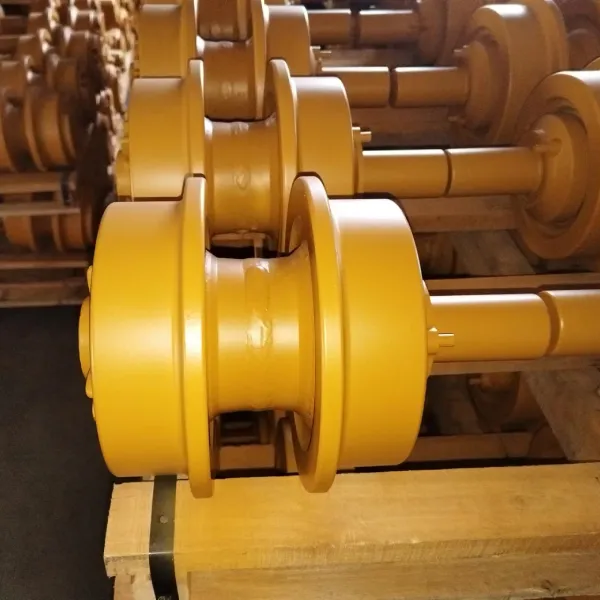
To truly appreciate the difference in manufacturing quality, it helps to visualize the life of a single component. Let's take a common but critical item: a track roller for a mini excavator's undercarriage. This part bears the entire weight of the machine, rolling along the track chain under immense pressure and in highly abrasive conditions. Its creation is a multi-stage endeavor.
The process begins with cutting. A large round bar of specified steel (perhaps a 40Cr or similar alloy) is cut into individual "blanks" of the correct length. A precision manufacturer will use an automated band saw with fine tolerances to ensure each blank is uniform in weight and size, which is the first step toward a balanced final product.
Next comes forgeage. The blank is heated to a precise temperature (often around 1200°C) and placed in a die. A powerful press then forms the hot steel into the rough shape of a track roller. As discussed previously, this forging process is not just about shaping; it's about refining the internal grain structure of the steel, imparting a strength and fatigue resistance that a cast or machined-from-bar part could never achieve.
After forging, the roller undergoes rough machining. Ici, excess material is removed, and the basic dimensions are established. This is followed by a crucial step: traitement thermique. For a track roller, this is often a sophisticated process of induction hardening. The roller shell's running surface is heated by an electromagnetic field and then rapidly quenched. This creates an extremely hard, wear-resistant outer layer while leaving the inner core of the roller tougher and more ductile to absorb shock loads without cracking. The depth and uniformity of this hardened layer are critical for the roller's lifespan.
Following heat treatment, the part enters finish machining. This is where the final, critical dimensions are cut. Using state-of-the-art Computer Numerical Control (CNC) lathes and mills, the bearing bores and sealing surfaces are machined to tolerances measured in microns (thousandths of a millimeter). The precision here is paramount; an improperly machined sealing surface will lead to oil leaks and premature bearing failure, which is a common fate for inferior rollers.
Enfin, assemblée. The roller shell is fitted with high-quality seals, bagues, and a central shaft. It is filled with a specific grade of lubricating oil and sealed. A quality-conscious manufacturer will conduct a leak test on every single roller, often by pressurizing the assembled unit and submerging it in water to look for tell-tale bubbles. The last step is painting, which is not just for aesthetics but also provides a crucial layer of corrosion protection.
When you ask a manufacturer to detail this process, listen for the specifics. Do they mention CNC machining? Do they talk about induction hardening and case depth? Do they perform 100% leak testing on sealed components? The more detailed and confident their explanation, the more likely it is that they have mastered the art of manufacturing.
The Role of Quality Control Checkpoints
A robust manufacturing process is one that is interwoven with constant verification. Quality is not something that is inspected into the part at the end; it is built in at every stage. A premier mini excavator parts manufacturer operates on this principle, establishing a series of quality control (QC) gates throughout the production line.
Incoming Material Inspection: As we've covered, this is the first and most vital checkpoint. It involves verifying the MTR and often performing independent spectroscopic or hardness tests on the raw steel. No material should enter the production floor without passing this gate.
In-Process Inspection: This is not a single event, but a continuous series of checks. After forging, a sample of parts might be cut open and etched to inspect the grain flow. After machining, critical dimensions are checked using calibrated instruments like calipers, micromètres, and Coordinate Measuring Machines (MMT). A CMM is a highly advanced device that can measure a part's geometry with incredible accuracy, comparing it to the original digital blueprint.
Heat Treatment Verification: This is a checkpoint deserving of its own focus. Après traitement thermique, parts must be tested to ensure the process was successful. This involves checking the surface hardness (using a Rockwell or Brinell hardness tester) et, for critical components, the "case depth"—the thickness of the hardened layer. This can be done by cutting a sample part, polishing it, and measuring the hardened layer under a microscope.
Contrôles non destructifs (CND): For high-stress components like buckets welds or ripper shanks, visual inspection is not enough. NDT methods are used to find flaws that are invisible to the naked eye. Magnetic Particle Testing (MPT), Par exemple, can reveal surface and near-surface cracks in ferromagnetic materials. Tests par ultrasons (Utah) uses sound waves to detect internal flaws like porosity in castings or incomplete fusion in welds. The use of NDT is a hallmark of a manufacturer dedicated to preventing field failures.
Final Assembly & Functional Testing: Before a part is painted and packed, a final inspection confirms all components are present and correctly assembled. For assemblies like track rollers or final drives, this includes functional tests like the leak testing mentioned earlier or checking the rotational torque to ensure bearings are correctly installed.
When you interview a manufacturer, ask them to map out their QC checkpoints for a specific product, comme un heavy duty excavator bucket. Where do they inspect? What do they measure? What instruments do they use? Que se passe-t-il lorsqu'une pièce s'avère non conforme? Leurs réponses dresseront un tableau clair de leur culture de qualité.
Comparaison des philosophies de fabrication: OEM VS. Marché secondaire
Le monde des pièces de machines est largement divisé en fabricants d'équipement d'origine (FEO) pièces et pièces de rechange. Cependant, le "marché secondaire" la catégorie est vaste, allant des fournisseurs qui rivalisent avec la qualité OEM à ceux qui produisent des composants dangereusement de qualité inférieure. Comprendre ces distinctions est essentiel pour faire un choix éclairé. Un fabricant de pièces de rechange de haute qualité offre une proposition de valeur convaincante, offrant souvent une qualité de niveau OEM sans le prix associé.
Voici un tableau pour clarifier les différences philosophiques et pratiques:
| Fonctionnalité | Fabricant OEM | Fabricant de pièces de rechange de haute qualité | Fabricant de pièces de rechange de faible qualité |
|---|---|---|---|
| Spécification matérielle | Suit strictement, proprietary standards developed through extensive R&ré. | Aims to match or exceed OEM specifications, often using industry-standard high-grade alloys. Transparent about material choices. | Often vague or misleading. May use cheaper, lower-grade steel substitutes to cut costs, leading to poor wear resistance and brittleness. |
| R&D Investment | Very high. Designs parts concurrently with the machine itself. | Moderate to high. Focuses on reverse engineering, material analysis, and process improvement. May innovate on OEM designs. | Minimal to none. Primarily focused on simple replication by visual copying, with no understanding of the underlying engineering. |
| Processus de fabrication | Highly automated and process-controlled. Significant investment in top-tier machinery (Par exemple, CNC, robotics). | Employs modern manufacturing techniques, including CNC machining and controlled heat treatment. Focuses on process consistency. | Often relies on older, less precise manual machinery. May skip or poorly execute critical steps like heat treatment. |
| Quality Control | Extremely rigorous, multi-stage QC integrated throughout the production line. Extensive use of CMM, CND, and lab analysis. | Rigorous, often certified to ISO 9001. Employs a system of QC checkpoints, in-process inspection, and final testing. | Inconsistent, often limited to a basic visual check at the end. Lacks traceability and proper measurement instrumentation. |
| Price Point | Le plus haut, reflecting brand name, R&D costs, and dealer network overhead. | Competitive, offering significant savings over OEM without compromising on core quality. Represents high value. | Le plus bas, achieved by cutting corners on materials, processus, et contrôle qualité. Represents high risk. |
| garantie & Soutien | Garantie complète soutenue par un réseau mondial de revendeurs. | Often offers a warranty comparable to OEM, with a clear claims process. Support is typically direct from the manufacturer. | Warranty is often limited, non-existent, or has prohibitive fine print. Support is minimal. |
Your goal as a buyer is to find a supplier firmly in that middle column: a high-quality aftermarket mini excavator parts manufacturer who has invested in the materials, processus, and quality systems to deliver reliable performance and genuine value.
Certifications de décodage: Quelle ISO 9001 Really Means
In your search, you will frequently encounter the "ISO 9001" certification. It is often presented as a badge of quality, but it is vital to understand what it represents. ISO 9001 is not a product certification; it is a certification of a company's Quality Management System (SGQ).
Think of it this way: ISO 9001 does not guarantee that every single part a company produces is perfect. Plutôt, it certifies that the company has a well-documented, consistent, and auditable system for managing quality. This system includes procedures for:
- Controlling documents and records.
- Managing resources, including personnel and equipment.
- The entire product realization process, from design to delivery.
- Measurement, analyse, and improvement, including handling non-conforming products, conducting internal audits, and implementing corrective actions.
Donc, why is an ISO 9001 certification a positive sign? Because it indicates that the manufacturer is serious about process control. It demonstrates that they have defined their procedures, trained their people, and have a mechanism for identifying and fixing problems. A company that has gone through the rigorous process of achieving and maintaining ISO 9001 certification is far less likely to have chaotic, inconsistent production processes than one that has not (Abisourour et al., 2021). It is a strong indicator of professionalism and a commitment to repeatable outcomes.
Cependant, it is only one piece of the puzzle. It tells you they have a system. Your detailed questions about their specific manufacturing and QC processes tell you how well they execute that system. The combination of a certified QMS and the ability to confidently answer your deep technical questions is the powerful one-two punch you are looking for in a top-tier mini excavator parts manufacturer.
3. Quelle est la portée de vos recherches, Développement, et capacités d'ingénierie?
The ability to accurately replicate a part is the baseline expectation for any aftermarket manufacturer. Cependant, the truly exceptional suppliers, the ones who become long-term strategic partners, do not stop at replication. They possess a deep-seated engineering curiosity and a robust capacity for research and development (R&ré). This capability transforms them from mere copyists into innovators who understand the why behind a part's design, not just the what. Inquiring into a manufacturer's R&D efforts is to probe their intellectual core. It reveals whether they are passively following the market or actively working to advance it, solving real-world problems for customers operating in challenging conditions from the frozen ground of Siberia to the abrasive sands of the Middle East.
Beyond Replication: The Value of In-House Engineering
A low-quality manufacturer might take an OEM part, measure it with calipers, and create a copy. A high-quality manufacturer with an in-house engineering team approaches the task from a completely different perspective. Their goal is not just to replicate the form, but to understand the function and, where possible, to improve upon it. This process is often called reverse engineering.
It begins with data acquisition. Instead of simple hand measurements, an engineering-driven company will use a 3D laser scanner or a Coordinate Measuring Machine (CMM) to create a highly precise digital model of the original part. This digital blueprint is far more accurate and detailed than any 2D drawing.
But the real engineering work happens next. The digital model is imported into Computer-Aided Engineering (CAE) software. Ici, engineers can perform Analyse par éléments finis (FEA). This is a powerful computational tool that allows them to simulate how the part will behave under real-world stresses. They can apply virtual loads, pressures, and vibrations to the digital model to see where stress concentrates. Think of it as a virtual stress test that can reveal the hidden weak points in a design.
Why is this important? An OEM might design a part to be "good enough" for a wide range of average conditions. Cependant, an FEA analysis might reveal that under the specific high-stress conditions of, Par exemple, constant rock breaking with a chisel, a certain area of the tool holder is prone to fatigue cracking. An engineering-led aftermarket manufacturer can use this insight to improve the design. They might add a reinforcing gusset, increase the radius of a sharp internal corner to distribute stress more evenly, or select a tougher steel alloy for that specific component. They are not just copying the part; they are solving a problem.
When you speak with a potential supplier, ask if they have an in-house engineering department. Do they use software for 3D modeling and FEA? Can they provide an example of how their engineering analysis led to a product improvement? A manufacturer who can share such a story is demonstrating a level of sophistication that goes far beyond simple imitation. They are showing that they think like problem-solvers.
Innovation in Wear Parts: Adapting to Modern Demands
The world of construction and excavation is not static. New techniques, more powerful machines, and increasingly demanding applications require that wear parts evolve as well. A manufacturer stuck in a purely replicative mindset will always be one step behind, producing parts for yesterday's challenges. A forward-thinking mini excavator parts manufacturer with a strong R&D focus is constantly looking ahead.
Consider the evolution of the excavator bucket. A standard-duty digging bucket is a versatile tool, but it is not optimal for every task. An innovative manufacturer will offer a diverse range of specialized buckets, each designed and engineered for a specific purpose:
- Heavy-Duty Rock Buckets: These are not just standard buckets made with thicker plate. They are engineered with a different profile (often a V-shape) for better penetration in rock. They feature extensive use of high-abrasion steel (comme AR450 ou AR500) on all wear surfaces, reinforced side-cutters, and robust lip shrouds to protect the leading edge.
- Seaux squelettes: Used for sorting rock from soil on a demolition site or in a quarry. The R&D here focuses on the spacing of the ribs. Too wide, and you lose valuable material; too narrow, and the bucket clogs constantly. Engineering analysis and field testing are required to find the optimal geometry for different material types.
- Godets de tranchée: These narrow buckets require careful design to ensure they have the strength to dig in tough conditions without the width to provide it. The engineering challenge is in the structural design of the bucket's "ears" and hanger, where all the force is concentrated.
- Tilt Buckets: These complex hydraulic attachments require a blend of mechanical and hydraulic engineering expertise to ensure they are both powerful and reliable.
Innovation also occurs at the micro level, in the Outils d'engagement au sol (OBTENIR)—the teeth, adaptateurs, and cutting edges. R&D in this area is heavily focused on metallurgy. Manufacturers are constantly experimenting with new steel alloys and heat treatment profiles to create teeth that offer a better balance of hardness (for wear) et la ténacité (pour la résistance aux chocs). They might develop new locking systems that make changing teeth faster and safer for operators in the field.
Ask a potential supplier: "What new products or product improvements have you introduced in the last two years?" Their answer will tell you if they are an active participant in the industry's evolution or a passive observer. Look for a supplier whose catalog of available parts shows a thoughtful diversity beyond just standard replacement items.
The Feedback Loop: How Customer Experience Drives Product Improvement
The most valuable R&D resource for any manufacturer is not in a lab; it's on the job sites of their customers. The daily experiences of operators in Korea, Australie, Russie, and Africa are a treasure trove of data on how parts perform and fail in the real world. A truly excellent manufacturer has a formal system for capturing, analyzing, and acting on this feedback.
This is the concept of the customer feedback loop. It works like this:
- Data Collection: The manufacturer actively seeks feedback. This can be through their sales team, technical support lines, warranty claims process, or by conducting regular visits to customer sites. They don't wait for complaints; they proactively ask, "How is the part performing? What challenges are you facing?"
- Analyse: The feedback, especially regarding failures or premature wear, is not just handled by a customer service agent. It is routed directly to the engineering department. A failed part might be requested back for a full failure analysis, including metallurgical testing and microscopic examination, to determine the root cause.
- Action: The insights gained from this analysis are then used to drive real change. If a specific model of track shoe is showing accelerated wear in the abrasive soils of a particular region, the engineers might decide to change the steel specification or modify the heat treatment profile for that part. If customers report difficulty installing a certain seal, the engineers might redesign the part or create a more detailed installation guide.
- Communication: The loop is closed when the manufacturer communicates back to the customer base. This could be through a technical bulletin explaining the improvement or simply by the improved product becoming the new standard.
This process transforms the customer-supplier relationship from a simple transaction into a partnership. The manufacturer is not just selling steel; they are selling a continuously improving solution. Lors de la vérification d'un fournisseur, ask them to describe their process for handling a field failure report. Who gets involved? What analysis is done? Can they give an example of a product improvement that was a direct result of customer feedback? A manufacturer who embraces this feedback loop is one who is committed to the long-term success of their clients. They understand that their own success is intrinsically linked to the performance and durability of their products in the diverse and demanding environments where they are put to the test.
4. Comment assurez-vous la compatibilité des pièces et l'ajustement sur différentes marques et modèles?
In an ideal world, every part would snap into place perfectly, every time. In the complex reality of heavy machinery, achieving this "perfect fit" is a significant engineering and logistical challenge. The mini excavator market is particularly fragmented, with dozens of manufacturers (like Kubota, Yanmar, Bobcat, chenille, Komatsu, Hitachi, et Doosan) each producing numerous models with unique specifications that can change from one production year to the next. For an aftermarket mini excavator parts manufacturer, guaranteeing fitment is not a trivial matter; it is a core competency that separates reliable suppliers from sources of frustration and downtime. This question probes the precision of their data, the rigor of their processes, and the strength of their guarantee.
The Challenge of a Fragmented Market
To grasp the scale of the challenge, consider the undercarriage of a single 5-ton mini excavator. It is a complex system of interlocking components: dozens of track links forming the chain, multiple track rollers and top rollers, a front idler, and a rear sprocket. Maintenant, imagine that the specifications for the pitch of the track chain (the distance from one pin to the next), le diamètre des rouleaux, the bore of the idler, and the tooth profile of the sprocket can all vary slightly between a machine made by Brand A and one made by Brand B, even if they are in the same weight class. Worse, Brand A might change the design of its sprocket between its 2023 model and its 2025 modèle.
A manufacturer attempting to serve the global market must contend with this enormous matrix of variations. A track chain that fits a Kubota KX057-4 will not fit a Yanmar ViO55-6A. A bucket linkage pin for a Bobcat E50 may be a millimeter different in diameter from one for a Cat 305. These small deviations are the difference between a smooth installation and a costly problem. An ill-fitting part can lead to:
- Installation Failure: The part simply won't go on, leading to immediate downtime while the correct part is sourced. This is especially painful for customers in remote locations, like mining sites in Africa or agricultural operations in Southeast Asia, where shipping can take weeks.
- Accelerated Wear: A sprocket with a slightly incorrect tooth profile might engage with the track chain bushings improperly. While it may seem to work initially, this mismatch will cause rapid, destructive wear to both the new sprocket and the existing track chain, turning a single component replacement into a full undercarriage rebuild.
- Catastrophic Failure: An improperly fitting pin or bolt can create unforeseen stress concentrations, leading to a sudden fracture of a component under load, which poses a serious safety risk.
This is why a casual approach to compatibility is unacceptable. A manufacturer cannot simply rely on old catalogs or visual comparisons. They must treat fitment as a discipline of precision.
Leveraging OEM Data and Precision Measurement
Donc, how does a top-tier manufacturer conquer this challenge? They build a "library of fitment," a vast and meticulously maintained database of OEM specifications. This is not something that can be bought off the shelf; it is a strategic asset built over years of painstaking work.
The foundation of this library is data acquisition. The process for a new part might look like this:
- Procure the OEM Part: The manufacturer obtains a genuine OEM component for the specific machine model they wish to support.
- 3D Digital Scanning: The part is scanned using a high-resolution 3D laser scanner. This non-contact method captures the complete external geometry of the part, creating a "point cloud" of millions of data points.
- CMM Measurement: For critical interface points—such as bearing bores, pin holes, mounting surfaces, and gear teeth—a Coordinate Measuring Machine (CMM) is used. The CMM's tactile probe can measure these features with sub-micron accuracy, capturing the precise dimensions and geometric tolerances (like concentricity and perpendicularity) that a laser scanner might miss.
- Create the "Golden" CAD Model: The scan data and CMM measurements are combined to create a highly accurate 3D Computer-Aided Design (GOUJAT) modèle. This is the manufacturer's "golden" reference, the digital master against which all production parts will be compared.
This data-driven approach is fundamentally different from simple copying. It captures the design intent of the original engineers. The manufacturer's engineering team will maintain this database, constantly updating it as new machine models are released. When you order a ripper for your specific mini excavator, they are not just pulling a generic part off the shelf. They are matching your machine's make, modèle, and serial number against their database to ensure the mounting bracket, pin dimensions, and hydraulic connections are an exact match.
Ask a potential supplier: "How do you obtain the dimensional data for the parts you manufacture? What technology do you use to measure and verify these dimensions?" Look for answers that include terms like "3D scanning," "CMM," and "CAD model database."
The "Fitment Guarantee": What to Look for in a Warranty
A manufacturer who is confident in their data and their production tolerances will stand behind their product with a clear and unambiguous fitment guarantee. This guarantee is one of the most powerful indicators of a supplier's quality and customer focus. Cependant, not all guarantees are created equal. Here is what to look for in the fine print:
- Clarity: The policy should be simple. It should state that if the part does not fit the specified machine for which it was sold, the manufacturer will rectify the situation.
- Scope of Remedy: What does the manufacturer promise to do? A good guarantee will offer a full refund or, more importantly, an expedited shipment of the correct part at their expense. The best policies may even offer some form of compensation for the downtime caused by their error, though this is less common.
- Cost Coverage: Who pays for shipping? A strong guarantee will state that the manufacturer covers the cost of shipping the incorrect part back and the cost of shipping the new part out. This is a major consideration for international customers, where shipping costs can be substantial.
- Simplicity of Process: How do you make a claim? It should be a simple process involving contacting their technical support, providing the machine details and photos of the fitment issue. Un alambiqué, multi-step process with excessive paperwork is a red flag.
The existence of a strong fitment guarantee tells you two things. D'abord, it shows that the manufacturer has invested heavily in their data and quality control, because they are financially confident that fitment issues will be rare. Deuxième, it shows that they respect their customers' time and business, and are prepared to take responsibility when an error does occur. It shifts the risk of an incorrect part from you, l'acheteur, back to them, the manufacturer.
A Second Comparison Table: Fitment Risk Factors
To summarize the key differentiators, consider this table when evaluating a potential supplier's approach to compatibility:
| Facteur | Low-Risk Manufacturer | High-Risk Manufacturer |
|---|---|---|
| Data Source | Meticulously maintained database built from OEM part scanning (3ré) and CMM measurement. | Relies on outdated catalogs, visual copying from photos, or simple hand measurements. |
| Ingénierie | In-house engineering team that creates and verifies detailed CAD models for every part. | No dedicated engineering for fitment. Production is based on simple drawings or physical copies. |
| Production Tolerances | Tightly controlled using CNC machining and regular calibration of equipment. | Loose tolerances due to manual processes or poorly maintained machinery, leading to part-to-part variation. |
| Vérification | Production parts are regularly checked against the "golden" CAD model using CMMs or precision fixtures. | Inspection is limited to basic go/no-go gauges or visual checks, if it happens at all. |
| Fitment Guarantee | Clair, complet, and customer-friendly. Covers return and replacement shipping costs. | Vague, full of exclusions, or non-existent. The buyer bears the risk and cost of an incorrect part. |
| Assistance technique | Staffed by knowledgeable technicians who can troubleshoot fitment issues based on serial numbers and machine specs. | Handled by sales staff who lack deep technical knowledge and cannot provide effective support. |
Finalement, a manufacturer's approach to fitment is a proxy for their overall attention to detail. A company that is meticulous about ensuring a part fits is also likely to be meticulous about the quality of their steel, the precision of their heat treatment, and the integrity of their welds.
5. Quelle est votre stratégie mondiale de la logistique et de la chaîne d'approvisionnement, Surtout pour ma région?
A perfectly manufactured component is of no use if it cannot be delivered to your job site in a timely, fiable, and cost-effective manner. For businesses operating in geographically diverse and often challenging markets—from the vast expanses of the Australian Outback to the bustling ports of Southeast Asia or the remote industrial zones of Russia—logistics is not an afterthought. It is a core element of the value proposition. When you question a mini excavator parts manufacturer about their supply chain, you are assessing their ability to operate on a global scale. You are gauging their understanding of your regional realities and their preparedness to be a dependable partner, not just a distant factory.
From Factory Floor to Job Site: Navigating Global Shipping
The journey of a heavy steel part, like an excavator bucket or a set of undercarriage tracks, from a factory in Asia to a customer in the Middle East is a complex ballet of transportation, documentation, and regulation. A sophisticated manufacturer understands and manages this complexity on behalf of their customers.
The primary mode of transport for such heavy goods is ocean freight. It is the most economical method, but it requires careful planning. A manufacturer must have strong relationships with freight forwarders and shipping lines to secure space on vessels and negotiate competitive rates. They should be able to provide you with clear estimates for transit times to your nearest port.
For more urgent needs, air freight is an option, but it comes at a significantly higher cost. A good supplier can provide quotes for both, allowing you to make an informed decision based on the urgency of your need versus the cost.
Beyond the transport itself lies the labyrinth of customs and documentation. Every country has its own set of rules for imports, including required documents (like the Bill of Lading, Facture commerciale, and Packing List), import duties, and taxes (like VAT or GST). A seasoned global supplier will have an export department that is expert in preparing this documentation accurately. Errors in paperwork can lead to lengthy and costly delays at customs. They should also be able to provide the correct HS (Harmonized System) codes for their products, which are essential for customs classification and duty calculation. Ask them: "What support do you provide for customs clearance in my country?" Their answer will reveal their level of international experience.
The Importance of Regional Distribution Hubs
For a customer in Dubai or Singapore, a manufacturer's promise of "fast shipping" is meaningless if the parts must first travel for four weeks on a ship from a single factory in Northeast Asia. Lead time—the total time from placing an order to receiving the goods—is a critical factor in managing your inventory and responding to unexpected machine failures.
This is why the most forward-thinking manufacturers adopt a hub-and-spoke model for their distribution. Instead of shipping every individual order directly from the factory (the spoke-to-customer model), they establish regional distribution centers or warehouses in strategic locations (the hubs). Par exemple:
- A hub in Dubai (Jebel Ali Free Zone) could efficiently serve the entire Middle East and parts of Africa.
- A hub in Singapore or Malaysia (Port Klang) could drastically reduce lead times for the booming construction markets across Southeast Asia (Indonesia, Thailand, Vietnam).
- A European hub, perhaps in Rotterdam or Antwerp, could serve Russia, the CIS countries, and North Africa.
- A presence in Australie (Par exemple, Perth or Brisbane) would be a massive advantage for serving the continent's sprawling mining and construction sectors.
By stocking high-volume parts in these regional hubs, a manufacturer can cut lead times from weeks to days. An order from a customer in Qatar could be fulfilled from the Dubai hub in 2-3 jours, rather than 3-4 weeks from the factory. This has a profound impact on your business. It allows you to operate with a leaner inventory, freeing up cash flow. It means a downed machine can be back up and running in days, not weeks, saving thousands in lost revenue.
Lors de la vérification d'un fournisseur, this is a powerful question: "Do you have any warehousing or distribution partners located in or near my region?" A "yes" to this question can be a significant competitive advantage and a strong reason to partner with that manufacturer.
Packaging and Preservation: Protecting the Investment
A track roller that arrives rusted or a bucket that is dented from shifting in a container is a failed delivery, regardless of how well it was manufactured. The final stage of the production process—packaging—is a critical quality step, especially for goods undertaking a long and arduous journey across the ocean.
Heavy steel parts present unique packaging challenges. They are dense, often have sharp edges, and are susceptible to both physical damage and corrosion. A quality-focused mini excavator parts manufacturer will have a detailed packaging protocol:
- Corrosion Protection: Steel parts traveling by sea are exposed to a humid, salty environment for weeks. Simply painting them is not always enough. Quality suppliers will apply a layer of anti-rust oil or wax. For finished, unpainted surfaces like bearing bores, they might use VCI (Vapor Corrosion Inhibitor) paper or bags, which emit a harmless vapor that creates a protective molecular layer on the metal surface.
- Physical Protection: Individual parts should be protected from banging against each other. Small components might be individually boxed. Larger items like rollers and idlers should have protectors on machined surfaces.
- Crating and Palletizing: The parts are then securely packed into custom-built wooden crates or strapped onto heavy-duty pallets. The goal is to create a solid, stable block that will not shift or break apart during handling or in rough seas. The wood used for these crates must often be fumigated and certified to ISPM 15 standards to comply with international quarantine regulations—another detail an experienced exporter will handle automatically.
Look at a manufacturer's product photos. Do they show parts neatly arranged in sturdy, well-built crates? Or are they just piled loosely on a pallet? Ask for photos of how their products are packaged for export. It is a small detail that speaks volumes about their professionalism and respect for the product you are purchasing.
Understanding Incoterms: Who is Responsible for What?
When you receive a price quote from an international supplier, it will be accompanied by a three-letter code like "FOB," "CIF," or "EXW." These are Incoterms, a set of globally recognized rules that define the responsibilities of the seller and the buyer in an international transaction. Understanding them is vital to knowing your total landed cost and your risks.
- EXW (Ex Works): This term places the maximum responsibility on you, l'acheteur. The price quoted is simply the price of the goods at the factory gate. You are responsible for arranging and paying for everything else: transport from the factory, export customs, ocean freight, insurance, import customs, and final delivery. This option gives you control but also requires significant logistical expertise.
- FOB (Free On Board): This is one of the most common terms. The manufacturer is responsible for all costs and processes to get the goods loaded onto the vessel at the designated port of origin. From that point forward, you are responsible for the ocean freight, insurance, and all subsequent costs and risks.
- CIF (Coût, Insurance, and Freight): With CIF, the manufacturer takes on more responsibility. They arrange and pay for the cost of the goods, the ocean freight to your destination port, and the insurance to cover the goods during transit. Your responsibility begins when the goods arrive at your country's port. You must handle customs clearance, import duties, and transport from the port to your location.
A good manufacturer will be flexible and able to quote you prices based on different Incoterms. They should also be able to clearly explain what each term means for you. This educational approach demonstrates that they are not just trying to make a sale, but are trying to build a transparent and understandable business relationship. It allows you to accurately calculate your total landed cost and avoid any surprise expenses, which is the foundation of a healthy and sustainable supply partnership.
6. Pouvez-vous fournir des preuves de performance et de durabilité par le biais d'études de cas et de témoignages?
Claims are easy to make. "Durable," "long-lasting," and "high-performance" are words that flow freely in marketing brochures. But for the discerning buyer of heavy equipment parts, these words are hollow without proof. The sixth crucial question you must ask a potential mini excavator parts manufacturer is for tangible evidence that their products perform as advertised in the unforgiving laboratory of the real world. This inquiry moves the conversation from the theoretical realm of specifications and processes to the practical domain of results. It demands that the manufacturer substantiate their claims with data, stories, and references that are relevant to your specific operational context.
Moving Beyond Marketing Claims: The Need for Proof
In any industry, there is a gap between what is promised and what is delivered. In the world of construction machinery, that gap can be measured in thousands of dollars of unplanned expenses and lost productivity. Your task as a buyer is to bridge that gap with information before you commit your capital. You must cultivate a healthy skepticism toward unsubstantiated marketing language and instead adopt an evidence-based approach.
Think of yourself as an investigator. The manufacturer is making a case that their product—be it a bucket, a ripper, or a set of undercarriage components—is a wise investment. Your job is to cross-examine their evidence. This evidence can take several forms, but it must always be specific and verifiable. A vague statement like "our parts last longer" is not evidence. A documented report showing that their track links achieved 4,500 hours of operation in abrasive silica sand before needing replacement, while a competitor's product lasted only 3,000 hours under the same conditions, is evidence. It is your right and your responsibility to ask for this level of proof.
Analyzing a Meaningful Case Study
A well-constructed case study is one of the most powerful forms of evidence a manufacturer can provide. It is a narrative of performance, a story with a beginning (the problem), a middle (the solution), and an end (the result). Cependant, not all case studies are created equal. Here is how to dissect a case study to determine its value:
Context is Key: A meaningful case study will begin by setting the scene in detail.
- Machine: What was the exact make and model of the mini excavator? (Par exemple, a Caterpillar 308 CR)
- Application: What was the machine doing? (Par exemple, tranchées, démolition, bulk earthmoving, rock breaking).
- Operating Conditions: This is the most important element. Was the environment highly abrasive (Par exemple, sand and gravel quarry in the UAE)? Was it high-impact (Par exemple, demolition of reinforced concrete in Seoul)? Was it low-impact but highly corrosive (Par exemple, working in swampland in Indonesia)? The conditions dictate the wear patterns and failure modes.
- Emplacement: Knowing the geographic location helps you assess its relevance to your own operations.
The Comparison: A case study is most powerful when it includes a direct comparison. This could be a "before and after" scénario, comparing the performance of the manufacturer's part against the part it replaced (which could be an OEM part or a competitor's aftermarket part). The metric for comparison must be clear. For wear parts, the universal metric is cost per hour.
- Coût par heure = (Purchase Price of Part) / (Total Service Hours Achieved)
The Data: The results should be presented with quantifiable data, not just qualitative descriptions.
- Service Life: How many hours did the part last? This should be measured using the machine's hour meter.
- Maintenance Interventions: Were there any unexpected maintenance needs during the part's life?
- Measurements: For wear parts, a great case study might include wear measurements taken at set intervals, showing the rate of material loss over time.
Let's imagine a case study for a set of bucket teeth. A weak case study would say: "A customer in Australia used our teeth and was very happy with the long life." A strong case study would state: "A gold mining operation near Kalgoorlie, Western Australia, fitted our X-400 series teeth to their 8-ton excavator used for clearing abrasive, quartz-rich overburden. The previous OEM teeth had an average service life of 350 hours at a cost of $80 per tooth, resulting in a cost per hour of $0.23. Our X-400 teeth, under identical conditions, achieved an average service life of 500 heures. At a purchase price of $90 per tooth, our cost per hour was $0.18. This represents a 22% reduction in operating costs for bucket teeth." This level of detail is credible, compelling, and allows you to perform your own analysis.
The Value of Regional-Specific Testimonials
While case studies provide hard data, testimonials offer a human perspective. They speak to the qualitative aspects of a supplier relationship: facilité d'installation, customer service, and overall satisfaction. Cependant, just like with case studies, the relevance of a testimonial is highly dependent on its context.
For a construction company in Johannesburg, Afrique du Sud, a glowing review from a contractor in Norway is of limited value. Their operating environments—climate, soil conditions, labor practices, and supply chain realities—are completely different. What that South African company needs is to hear from another business operating in the high-altitude, rocky conditions of the Highveld.
A globally astute mini excavator parts manufacturer understands this. They will not just have a generic "Testimonials" page on their website. They will be able to provide you with references or testimonials from customers in your specific region.
- If you are in Russie, you want to hear from someone who has used their undercarriage parts through a Siberian winter.
- If you are in the Moyen-Orient, you want a testimonial from a company that can attest to how the seals and hydraulic components stand up to extreme heat and fine, poussière abrasive.
- If you are in Asie du Sud-Est, you want to know how their paint and coatings resist the corrosion of a hot, humid, and salt-laden atmosphere.
When you ask for testimonials, be specific: "Can you provide me with a reference or a testimonial from a customer in my country, or in a country with a similar operating environment?" A manufacturer with a deep and diverse global customer base will be able to fulfill this request. Their ability to do so is strong proof that their products are not just designed in a lab but are proven to work across the varied and demanding job sites of the world.
How to Spot a Fake or Low-Value Testimonial
In the digital age, it is easy to fabricate positive reviews. As a savvy buyer, you should learn to recognize the signs of inauthentic or low-value feedback.
- Overly Generic Language: Phrases like "Great product, expédition rapide!" or "Five stars, highly recommend!" without any specific detail are often signs of low-effort or fake reviews.
- Lack of Verifiable Detail: Authentic testimonials usually include specifics. The person might mention their machine type, the job they were doing, ou une caractéristique particulière de la pièce qu'ils ont appréciée. Ils nomment souvent leur entreprise et leur emplacement. Un témoignage de "John S." est beaucoup moins crédible que celui de "John Smith, Chef de site, ABC Construction, Perth, De."
- "Photo stock" Ambiance: Be wary of testimonials accompanied by generic stock photos of excavators rather than real pictures from the customer's job site.
- Exclusivement positif: Une collection de rien d'autre que sans faille, Les critiques cinq étoiles peuvent être suspectes. De vraies expériences de produit sont nuancées. A credible manufacturer might even share a story about how they resolved a customer's problem, qui peut être plus puissant qu'une simple revue brillante.
Votre quête de preuves est une étape de diligence raisonnable critique. Il vous protège contre les promesses de marketing gonflées et fonde votre décision dans le fondement des performances du monde réel. A manufacturer who willingly and transparently provides detailed case studies and relevant testimonials is a manufacturer who is confident in their product and respects your need for verifiable proof.
7. Quel niveau de soutien après-vente et d'expertise technique proposez-vous?
The relationship with a mini excavator parts manufacturer should not end when your payment is processed or when the shipment arrives at your port. The delivery of the component marks the beginning of a new, long-term phase of the partnership. The quality of this post-purchase relationship is defined by the manufacturer's after-sales support and technical assistance. This final question probes the supplier's commitment to your success long after the initial transaction. It explores their warranty policies, the accessibility and knowledge of their technical team, and the resources they provide to ensure their products are used correctly and deliver maximum value. A superior manufacturer views the sale as the start of a collaboration, not the conclusion of a deal.
The Partnership Begins After the Sale
Imagine this scenario: a new, aftermarket final drive arrives for a mini excavator that is down on a critical job. Your mechanic begins the installation but finds that the hydraulic hose fittings are slightly different from the old unit. The installation manual is a poorly translated, single-page document. The machine is losing money every hour it sits idle. Vous appelez le fournisseur. Maintenant, you face a critical juncture that reveals the true character of the manufacturer.
- Scenario A (Poor Support): You are routed to a generic call center. The agent does not understand what a final drive is and can only read from a script. They promise someone will call you back. Hours or days pass.
- Scenario B (Excellent Support): You are connected directly to a technical support department. The person on the line is an experienced technician or engineer. You explain the issue, providing the machine's model and serial number. They immediately recognize the problem, explaining that for that specific serial number range, an adapter fitting is required, which they had included in the shipment. They guide your mechanic to the small, separately bagged part, and within minutes, the installation is back on track.
This is the difference between a simple supplier and a true partner. A partner understands that their responsibility extends to ensuring the part is installed correctly and performs as expected. They have invested in a support infrastructure to solve problems quickly and efficiently because they understand that your uptime is their ultimate measure of success.
Assessing the Technical Knowledge of the Support Team
The effectiveness of an after-sales support system hinges entirely on the knowledge and empowerment of its people. When vetting a potential mini excavator parts manufacturer, you need to assess the depth of their technical bench.
A key differentiator is the separation of sales and technical support. While a salesperson is expert in pricing and logistics, they are rarely equipped to diagnose a complex mechanical or hydraulic issue. A premier manufacturer maintains a dedicated technical support team composed of individuals with hands-on experience: former mechanics, field service technicians, or engineers.
When you have a technical question—either before or after a purchase—you should have a direct line to these experts. Their role is not to sell you something, but to solve your problem. Ils devraient pouvoir:
- Answer detailed installation questions.
- Help troubleshoot a performance issue (Par exemple, "Why is my new bucket not curling with full force?").
- Assist in failure analysis, understanding wear patterns to offer advice on extending component life.
- Provide technical specifications that may not be in the general catalog, such as bearing preload values or hydraulic pressure settings.
A simple way to test this is to call the manufacturer with a hypothetical technical question before you ever place an order. Par exemple: "I am considering your chisel for my Doosan DX63-3. What is the recommended operating pressure, and what are the signs that the accumulator needs recharging?" The quality of the answer you receive—its accuracy, clarity, and the confidence with which it is delivered—will tell you everything you need to know about their commitment to technical excellence.
Warranty Policies: The Fine Print Matters
A warranty is a manufacturer's written promise about the quality of their product. It is a form of insurance for you, l'acheteur. Cependant, the value of that insurance is determined entirely by the terms and conditions—the "fine print." A "12-Month Warranty" banner can hide a multitude of exclusions that render it nearly useless.
When evaluating a warranty policy, look for the answers to these questions:
- What is the Warranty Period? Is it measured in months, années, or service hours? For wear parts, a warranty based on hours is often more relevant than one based on time.
- What is Covered? Does the warranty cover only "defects in materials and workmanship"? This is a standard and reasonable limitation. Be wary of warranties that have long lists of specific exclusions.
- What is Not Covered? Pay close attention to the exclusions. Common and fair exclusions include improper installation, lack of routine maintenance, application overload (using the part beyond its design limits), and normal wear. Unfair exclusions might be overly broad, such as "void if used in abrasive conditions," ce qui disqualifierait la plupart des utilisations réelles pour un creuseur.
- Quel est le remède? Si une pièce échoue sous garantie, Que fera le fabricant? Vont-ils réparer la pièce, Remplacez-le, ou offrir un crédit? Une bonne garantie fournit une pièce de remplacement.
- Les coûts consécutifs sont-ils couverts? C'est un différenciateur majeur. Une garantie standard ne couvrira que le coût de la pièce elle-même. Il exclura explicitement le coût de la main-d'œuvre pour retirer l'ancienne partie et installer le nouveau, le coût des temps d'arrêt de la machine, et tout dommage que la partie échouée peut avoir causée à d'autres composants. Alors que la couverture des dommages consécutives complète est rare en dehors des garanties OEM, Certains fabricants de greffiers de rechange de haut niveau peuvent offrir une contribution aux coûts de main-d'œuvre en signe de bonne volonté.
- Quel est le processus de réclamation? Est-ce simple? Typiquement, it should involve contacting the technical support team, providing proof of purchase, the machine's service hours, and evidence of the failure (photos, videos, or sometimes returning the part for inspection). A process that requires excessive bureaucracy is a red flag.
A transparent, équitable, and easily understood warranty policy is a sign of a manufacturer that stands behind its product with integrity.
Proactive Support: Installation Guides, Videos, and Training
The best manufacturers do not just wait for you to have a problem. They proactively provide resources to prevent problems from occurring in the first place. This demonstrates a deep-seated culture of customer success. This proactive support can take many forms:
- Detailed Installation Manuals: Not just a single sheet, but a comprehensive, well-written guide with clear diagrams or photos for every major step. For complex components, this might include torque specifications for bolts and tips for seating seals correctly.
- Video Tutorials: In today's visual world, a short video showing the correct procedure for changing an undercarriage roller or replacing bucket teeth can be far more effective than a written manual. A manufacturer who invests in creating a library of these videos is investing in their customers' success.
- Technical Bulletins: When an improvement is made or a common issue is identified, a proactive manufacturer will issue a technical bulletin to its dealer network and customers, providing valuable information.
- Maintenance Recommendations: Beyond just selling the part, they provide guidance on how to maintain it to achieve the longest possible service life. This could include information on proper track tensioning to extend undercarriage life or tips on welding techniques for repairing a bucket.
This library of resources is a powerful indicator of a manufacturer's maturity and expertise. It shows that they have accumulated a wealth of knowledge and are committed to sharing it for the benefit of their customers. When you choose a supplier, you are not just buying their parts; you are also gaining access to their ecosystem of knowledge and support. Choosing a manufacturer with a rich ecosystem of proactive support is a strategic move that pays dividends in reduced maintenance costs, increased uptime, and a more knowledgeable team.
Questions fréquemment posées (FAQ)
T1: What is the main difference between OEM and high-quality aftermarket mini excavator parts? The primary differences lie in price and, sometimes, innovation. FEO (Fabricant d'équipement d'origine) parts are made by or for the machine's brand and guarantee perfect fitment, but come at the highest price. High-quality aftermarket parts are produced by third-party manufacturers who aim to meet or exceed OEM specifications in material, ajuster, et performances, but at a more competitive price point. Dans certains cas, these manufacturers innovate on the original design, offering improvements based on field data from a wide range of applications.
T2: How can I be sure an aftermarket part will fit my specific mini excavator model? A reputable aftermarket manufacturer guarantees fitment through a rigorous process of reverse engineering. They use 3D laser scanners and CMMs (Coordinate Measuring Machines) Pour créer des modèles numériques précis des pièces OEM d'origine. Ils maintiennent une vaste base de données qui transforme les numéros de pièce avec la machine, modèles, et les gammes de numéros de série. Always provide your machine's full details when ordering and ask about their fitment guarantee, qui devrait couvrir les frais de remplacement et d'expédition en cas d'erreur.
Q3: La partie la moins chère est-elle généralement la pire option? Dans le domaine des pièces de machines lourdes, Un prix exceptionnellement bas est presque toujours un drapeau rouge. Ces économies sont généralement réalisées en compromettant les facteurs critiques: Utilisation d'acier de qualité inférieure, sauter des étapes de fabrication essentielles comme un traitement thermique approprié, ou avoir un contrôle de qualité inexistant. Les économies initiales sont souvent rapidement effacées par une défaillance prématurée, conduisant à des temps d'arrêt coûteux, Coûts de main-d'œuvre supplémentaires, et des dommages potentiels à d'autres composants. La meilleure valeur se trouve dans les pièces qui offrent un faible coût total de possession, Pas le prix d'achat le plus bas.
Q4: Qu'est-ce que ISO 9001 Certification Parlez-moi d'un mini fabricant de pièces de excavatrice? ISO 9001 La certification indique que le fabricant a un système de gestion de la qualité documenté et vérifié (SGQ). Il ne certifie pas la qualité du produit lui-même, mais plutôt les processus que l'entreprise utilise pour les produire et les livrer. C'est un signe positif que le fabricant s'engage à cohérence, contrôle des processus, et amélioration continue. Cela signifie qu'ils ont des systèmes de traçabilité, Manipulation de produits non conformes, and implementing corrective actions, ce qui réduit la probabilité de problèmes de qualité aléatoire.
Q5: Quelle est l'importance du pays d'origine pour les mini-excavations? The country of origin is less important than the manufacturer's specific quality systems, material choices, and engineering capabilities. High-quality and low-quality manufacturing can be found in almost any country. Instead of focusing on the "Made in" label, focus on the manufacturer's transparency, their technical expertise, their investment in modern machinery (like CNC and CMM), and their ability to provide verifiable proof of performance through case studies and robust warranties.
Q6: What are the most common wear parts on a mini excavator undercarriage? The undercarriage is a system of moving components that experiences the most wear. The most frequently replaced parts are the sprockets (which drive the track), the track chains (composed of links, épingles, et les bagues), les galets de roulement (which support the machine's weight on the track), and the front idlers (which guide the track and hold tension). The rate of wear depends heavily on the application, operator technique, and ground conditions.
Conclusion
Navigating the global market for mini excavator components requires a mindset that transcends the simple act of purchasing. It is an exercise in strategic sourcing, where the objective is not to find the cheapest part, but to identify the most valuable partner. The framework of seven questions outlined in this guide provides a logical pathway for this investigation. It encourages a shift in focus from the price tag on a bucket or a ripper to the fundamental character of the manufacturer who produces it.
By inquiring into the nuances of metallurgy, you assess their commitment to a foundation of quality. By scrutinizing manufacturing processes and quality control, you gauge their dedication to precision and consistency. Probing their R&D capabilities reveals their capacity for innovation and problem-solving. Questioning their approach to fitment, logistique, and after-sales support illuminates their understanding of your operational realities. Enfin, demanding empirical evidence of performance ensures that your decision is grounded in fact, not just marketing prose.
Finalement, selecting a mini excavator parts manufacturer is an investment in your own fleet's reliability and profitability. A partnership with a supplier who can confidently and transparently answer these questions is a partnership that will yield returns far beyond the initial cost of a component. It delivers reduced downtime, enhanced machine performance, and the peace of mind that comes from knowing your equipment is supported by a foundation of engineering excellence and unwavering support.
Références
Abisourour, A., Mhamdi, A., Abid, M. R., & Sghir, UN. (2021). The impact of ISO 9001 quality management system on operational performance. International Journal of Quality & Reliability Management, 38(1), 183–204. https://doi.org/10.1108/IJQRM-11-2019-0358
Juli Machines. (s.d.). Qu'est-ce qu'un galet de roulement? Retrieved June 10, 2025, de https://www.julimachinery.com/what-is-a-track-roller/
Effrayant, I., & Dailertas, M. UN. (2017). The influence of different heat treatment methods on the mechanical properties and wear behavior of a boron steel. Materials Testing, 59(5), 455-460. https://doi.org/10.3139/120.111022
Kumar, S., & Phrommathed, P.. (2005). New product development: an empirical study of the effects of innovation strategy, organization learning and market conditions. Journal of Engineering and Technology Management, 22(4), 350-353.
Lofsten, H. (2016). New product development in the process industry: A study of the effects of project, firm, and market characteristics. Journal of Engineering and Technology Management, 41, 30-46.
Rane, S. B., & Thakker, S. V. (2021). An integrated approach for risk management in a global heavy engineering supply chain. Journal of Engineering, Design and Technology, 19(1), 193-219. https://doi.org/10.1108/JEDT-01-2020-0015
Sarma, ré. K., & Kumar, R. (2020). Failure analysis of an excavator bucket tooth. Engineering Failure Analysis, 118, 104886.
Süer, g. A., Arikan, F., & Babayigit, C. (2011). A fuzzy logic based approach to the design of cellular manufacturing systems. Computers & Industrial Engineering, 61(4), 932-940.
Trebuna, P., Kliment, M., & Petrik, J.. (2014). Using finite element method for optimization of digging process. Procedia Engineering, 96, 464-468.
Zhang, Y., Liu, J., & Chen, H. (2019). A study on wear resistance of excavator bucket teeth based on bionic design. Journal of Bionic Engineering, 16(2), 336-346. https://doi.org/10.1007/s42235-019-0027-6