
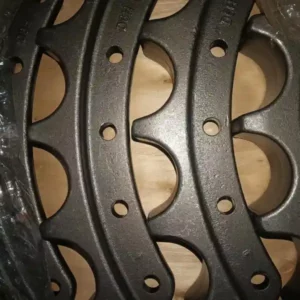
Abstrait
La longévité opérationnelle et l'efficacité économique des engins de construction lourds sont profondément influencées par l'intégrité du système de train de roulement., avec des chaussures de piste représentant un composant d'une importance primordiale. Ces éléments constituent l'interface directe entre un engin de plusieurs tonnes et le sol souvent hostile., les soumettre à une usure abrasive intense, charges à fort impact, et contraintes de flexion. La sélection de chaussures de piste à forte usure appropriées n'est donc pas une décision d'achat triviale mais un exercice analytique complexe.. Cela nécessite une compréhension nuancée des propriétés métallurgiques, méthodologies de fabrication, géométries spécifiques à l'application, et l’impact profond des pratiques opérationnelles. Cet article examine les considérations à multiples facettes essentielles au choix des bonnes chaussures de piste.. Il présente un cadre systématique pour évaluer les conditions du sol, science des matériaux, dimensions des composants, influence de l'opérateur, and maintenance protocols. By adopting this holistic perspective, equipment managers and operators can significantly mitigate premature undercarriage failure, reduce long-term operating costs, and maximize machine availability and productivity across diverse global environments.
Plats clés à retenir
- Match track shoe grouser type and width directly to your primary ground conditions.
- Prioritize through-hardened boron steel for superior strength and wear resistance.
- Use the narrowest shoe possible that provides adequate flotation for the job.
- Proper operator training significantly reduces abnormal wear on undercarriage parts.
- Implement a regular inspection schedule to catch wear on high wear track shoes early.
- Understand that the initial purchase price is only one part of the total cost of ownership.
- Une vision globale de la maintenance de l’ensemble du système de train de roulement est nécessaire pour assurer la longévité.
Table des matières
- Déconstruire le terrain: Faire correspondre le type de chaussure aux conditions du sol
- La science des substances: Comprendre la composition et la fabrication des matériaux
- La géométrie de la performance: Largeur de chaussure, Pas, et considérations relatives au profil
- Discipline opérationnelle: Le facteur humain dans la prolongation de la durée de vie des chaussures de piste
- Une philosophie de maintenance holistique: Inspection, Réparation, et remplacement
- Questions fréquemment posées (FAQ)
- Conclusion
- Références
Déconstruire le terrain: Faire correspondre le type de chaussure aux conditions du sol
Le dialogue entre une machine et la terre qu'elle traverse est médiatisé par le patin de chenille. C'est un langage de pression, friction, et impact. Choisir un patin de chenille sans procéder au préalable à une analyse rigoureuse des conditions du sol équivaut à choisir un pneu pour un véhicule sans savoir s'il roulera sur un circuit ou sur un terrain boueux.. Le sol n'est pas uniforme, surface passive; c'est un agent actif qui dicte les termes de l'engagement. Le caractère du sol, osciller, ou granulat – son abrasivité, teneur en humidité, et cohésion – détermine fondamentalement le taux et la nature de l'usure de tous les composants du train de roulement, surtout les chaussures. Une erreur dans cette évaluation initiale peut précipiter une cascade d’échecs coûteux, transformer un actif productif en un passif stationnaire. Par conséquent, le premier principe dans la sélection rationnelle des chaussures de piste à forte usure est une profonde, compréhension empirique de l'environnement dans lequel la machine vivra et travaillera.
La primauté des conditions du sol: Une analyse fondamentale
Chaque chantier possède une signature géologique unique. Les sables soufflés par le vent de la péninsule arabique sont composés de, particules de quartz pointues qui agissent comme un abrasif implacable, grinding away steel with surprising speed. The lateritic soils of Western Australia, rich in iron and aluminum oxides, can be deceptively hard and abrasive, particularly when dry. En revanche, the peaty, saturated grounds of Southeast Asian construction sites present a challenge not of abrasion, but of flotation and traction. A machine that sinks becomes immobile, its power useless. The frozen tundra of Siberia introduces another variable: low-temperature brittleness, where impact loads that might be absorbed in temperate climates can cause catastrophic fractures.
A proper analysis begins with classifying the terrain. Is it high-impact, like a quarry floor littered with blasted rock? Is it high-abrasion, like a sandy desert? Or is it low-traction, like a muddy swamp? Souvent, it is a combination. Par exemple, excavation work might involve removing soft topsoil (requiring flotation) to reach abrasive bedrock below (requiring wear resistance). The operator must consider the percentage of time the machine will spend in each condition. This analysis should not be a casual observation but a deliberate evaluation, perhaps involving soil sampling or consultation with geotechnical reports. The economic consequence of this evaluation is direct and significant. Choosing a shoe optimized for high-impact rock when the machine spends 90% of its time on soft soil leads to unnecessary ground disturbance, excessive fuel consumption, and premature wear on the entire drivetrain as the grousers churn the earth inefficiently.
Soft Ground Operations: The Case for Single Grouser Shoes
In conditions of soft soil, boue, or clay, the primary challenge is achieving sufficient traction to propel the machine forward without it becoming mired. This is where the single grouser track shoe demonstrates its inherent superiority. A grouser is the protruding bar or profile on the outer surface of the shoe that penetrates the ground. The single grouser design features one dominant, tall protuberance running across the shoe's width.
Think of it as a paddle. Its tall, sharp profile allows it to dig deep into the soft material, providing a large surface area to push against. This results in maximum tractive effort. The large space between the single grousers on adjacent shoes also facilitates self-cleaning. As the track chain goes around the sprocket and idler, the bending action helps to shed mud and debris that would otherwise pack between the shoes. Packed material is a serious problem; it effectively transforms the carefully designed track system into a smooth, tractionless belt, while also increasing track tension and accelerating wear on all moving parts. The single grouser's ability to penetrate and clean makes it the standard choice for bulldozers and other machines whose primary function is to push large loads in a relatively straight line on yielding surfaces. The deep penetration offers excellent grip, maximizing the machine's pushing power.
Hard and Rocky Surfaces: Why Double and Triple Grouser Shoes Excel
When the operating environment shifts to hard, rocheux, or mixed surfaces, the logic of the single grouser shoe begins to break down. Un grand, un seul crampon agressif ne peut pas pénétrer dans la roche dure. Plutôt, tout le poids de la machine se concentre sur la pointe étroite de la crampon. Cela crée un immense chargement de points, ce qui non seulement accélère l'usure de la crampon elle-même, mais soumet également le patin de chenille à de fortes contraintes de flexion. La chaussure peut fléchir et éventuellement se fissurer. En outre, une machine fonctionnant sur des arêtes simples sur une surface dure connaîtra un rude, tour vibrant, ce qui est fatiguant pour l'opérateur et transmet les charges de choc dans toute la machine.
C'est le domaine des chaussures de piste à double et triple crampons.. Au lieu d'un grand râleur, la charge est répartie sur deux ou trois courts, des râleurs moins agressifs.
Chaussures à double arête: Ceux-ci offrent un compromis entre la traction d'une simple arête et la capacité de virage et une conduite plus douce d'une triple arête.. They have more contact area with the ground than a single grouser, which reduces the bending stress on the shoe and provides better wear life on abrasive or hard surfaces. They are a common choice for crawler loaders and excavators that need a balance of traction and maneuverability.
Chaussures à triple arête: These are the most common type of track shoe found on excavators and are considered the "standard" shoe for general-purpose use. The three (or sometimes more) grousers are shorter and provide a larger contact area with the ground. This significantly reduces ground pressure, minimizes surface disturbance, and offers a much smoother ride. The key advantage of the triple grouser is its superior turning capability. When a tracked machine turns, the shoes must pivot and slide against the ground. The lower profile of the triple grouser reduces the amount of resistance, or "scrubbing," during a turn. This lessens the lateral stress on the entire undercarriage, from the shoe itself to the pins, bagues, et des liens. For a machine like an excavator, which is constantly pivoting and repositioning, this is a profound advantage in extending the life of its undercarriage parts.
Specialized Applications: Plat, Caoutchouc, and Swamp Shoes
Au-delà des types de râleurs courants, a range of specialized shoes exists for specific, demanding applications.
Flat Shoes: Comme son nom l'indique, these shoes have no grousers. They are used on hard, flat surfaces like concrete or asphalt where traction is not an issue, but surface damage is a major concern. Paving operations or industrial applications inside large warehouses often utilize flat shoes to prevent them from destroying the working surface.
Rubber Shoes (or Rubber Pads): For even greater surface protection, rubber pads can be bolted onto a standard triple grouser shoe, or the shoe itself can be a solid rubber block bonded to a steel frame. These are ubiquitous in urban construction, where an excavator might need to cross public roads or work on decorative pavement. They offer excellent surface protection and reduce noise, but they are susceptible to cuts and chunking in demolition or rocky environments.
Chaussures des marais (ou chaussures à faible pression au sol): In extreme soft-ground conditions, such as swamps, marais, or dredging operations, standard shoes may not provide enough surface area to prevent the machine from sinking. Swamp shoes are typically extra-wide, sometimes triangular or trapezoidal in shape, to maximize the contact area and distribute the machine's weight. This principle of flotation is the same one used by snowshoes. By increasing the surface area, the pressure per square inch (PSI) is reduced, allowing the machine to "float" on top of the unstable ground. These are highly specialized and would wear out very quickly on any hard, abrasive surface.
A Comparative Analysis of Grouser Designs
Pour prendre une décision éclairée, it is helpful to visualize the trade-offs inherent in each design. The choice is never about finding a "perfect" shoe, but the most appropriate shoe for a given set of operational priorities.
| Shoe Type | Demande principale | Traction | Turning Ability | Usure sur des surfaces dures | Ground Disturbance |
|---|---|---|---|---|---|
| Un seul râleur | Soft soil, boue, high-traction needs (dozers) | Excellent | Pauvre | Pauvre | Haut |
| Double épicier | Mixed soils, moderate-traction/turning needs | Bien | Modéré | Modéré | Modéré |
| Producteurs triples | Usage général, hard surfaces, frequent turning | Modéré | Excellent | Excellent | Faible |
| Chaussure plate | Paved surfaces (asphalte, béton) | Pauvre | Excellent | Excellent | Très faible |
| Swamp Shoe | Extremely soft ground (marais, swamps) | Modéré | Pauvre | Very Poor | Faible (due to flotation) |
La science des substances: Comprendre la composition et la fabrication des matériaux
Une fois que la géométrie correcte du patin de chenille a été déterminée par les conditions du sol, l'accent doit être mis sur la qualité intrinsèque de la chaussure elle-même. De quoi est-il fait, et comment a-t-il été fait? Deux chaussures d'athlétisme peuvent paraître identiques à l'œil nu mais fonctionner de manière radicalement différente sur le terrain.. On pourrait fournir des milliers d’heures de service fiable, tandis que l'autre échoue prématurément, se fracturant sous charge ou s'usant à une vitesse décevante. Cette différence est cachée à la vue, au niveau microscopique, dans la chimie de l'acier et les processus thermiques qu'il a subis. Comprendre les principes fondamentaux de la métallurgie et de la fabrication n'est pas un exercice académique; c'est une nécessité pratique pour quiconque recherche ou spécifie des chaussures de piste à forte usure. It is the ability to discern true quality from a superficial resemblance, a distinction that has huge financial implications.
The Role of Metallurgy: Beyond Simple Steel
Le terme « acier" is a broad descriptor for an alloy of iron and carbon. Cependant, the performance characteristics of steel can be dramatically altered by the addition of small quantities of other elements and by the application of heat. The steel used for high wear track shoes is a sophisticated material, carefully engineered to balance two competing properties: dureté et de la ténacité.
- Dureté is the material's resistance to scratching, abrasion, and indentation. A harder surface will better resist the grinding effect of sand, gravier, et du rock.
- Dureté is the material's ability to absorb energy and deform without fracturing. A tough material can withstand the sudden shock loads of hitting a rock or dropping the machine's bucket.
These two properties are often in opposition. A very hard material, comme du verre, is often very brittle (not tough). A very tough material, like soft copper, is not very hard. The art of the metallurgist is to create a steel alloy and a heat treatment process that optimizes both. This is typically achieved through the use of alloy steels. For high wear track shoes, the most significant alloying element is boron.
Boron Steel and Quenching: Le cœur de la durabilité
Boron is a remarkable element. When added to steel in minuscule amounts—often less than 0.003%—it has an outsized effect on the steel's "hardenability." Hardenability is not hardness itself, but the ability of the steel to be hardened to a significant depth during heat treatment.
The key heat treatment process is called quenching and tempering.
- Austénitisant: D'abord, the steel track shoe is heated to a very high temperature, typically around 850-950°C. A cette température, the iron and carbon atoms arrange themselves into a specific crystal structure called austenite.
- Éteinte: The red-hot shoe is then rapidly cooled, usually by plunging it into a bath of water, huile, or polymer solution. This sudden cooling does not give the atoms time to rearrange themselves back into their slower-cooled structures. Plutôt, they are trapped in a highly stressed, needle-like crystal structure called martensite. Martensite is extremely hard and strong, which is exactly what is needed for wear resistance. La présence de bore permet à cette structure martensitique dure de se former non seulement à la surface immédiate, mais profondément au cœur de la chaussure de piste. C'est ce qu'on appelle le "durcissement à coeur"." Une chaussure entièrement durcie conserve sa dureté même lorsque la surface s'use, offrant une durée de vie beaucoup plus longue qu'une chaussure qui est uniquement « cémentée »" ou "durci en surface"."
- Tremper: Après trempe, l'acier est extrêmement dur mais aussi cassant et rempli de contraintes internes. Pour redonner un peu de solidité, la chaussure est réchauffée à une température beaucoup plus basse (Par exemple, 200-500°C) et détenu pendant une durée précise. Ce processus, appelé trempe, soulage les contraintes internes et permet un léger réarrangement de la structure cristalline. Il réduit légèrement la dureté mais augmente considérablement la ténacité, resulting in a final product that is both highly resistant to wear and resilient enough to withstand high-impact shocks without cracking. A properly quenched and tempered boron steel track shoe is the gold standard for demanding applications.
Forgeage vs. Fonderie: An Examination of Manufacturing Processes
There are two primary methods for forming a track shoe into its final shape: casting et forge.
Fonderie involves pouring molten steel into a mold shaped like the track shoe. It is a relatively inexpensive process that can create complex shapes easily. Cependant, as the metal cools and solidifies in the mold, it can develop a coarse, non-uniform grain structure. There is also a risk of porosity (tiny bubbles) or other internal defects, which can become initiation points for cracks under stress.
Forgeage starts with a solid billet of steel that is heated and then shaped by immense pressure from a hammer or a press. This process has a profound effect on the internal structure of the steel. The intense pressure forces the grains of the steel to align with the shape of the part, creating a continuous, oriented grain flow. Think of the difference between a piece of particle board (like a casting) and a solid piece of wood with a long, continuous grain (like a forging). The forged part is generally denser, plus fort, and more resistant to impact and fatigue. Forging is a more expensive process, but for critical, high-stress applications, it often produces a superior, more reliable part. Most high-quality track shoes for demanding environments are forged to ensure maximum strength and toughness.
Surface Hardness versus Core Toughness: A Delicate Balance
The ideal high wear track shoe is not uniformly hard throughout. Comme indiqué, extreme hardness often comes with brittleness. The ideal state is a component with an extremely hard outer surface to resist abrasion, supported by a slightly softer, tougher core that can absorb shock and prevent the part from snapping in two. The through-hardening capability imparted by boron steel, combined with a precisely controlled quenching and tempering process, allows manufacturers to achieve this differential hardness profile.
The surface hardness is typically measured on the Rockwell C scale (HRC). A high-quality track shoe might have a surface hardness of 45-55 HRC, while the core hardness might be a few points lower. This gradient is intentional. The hard "case" handles the wear, while the tough "core" handles the load. Lors de l'évaluation d'un fournisseur, it is reasonable to ask about their target hardness specifications and how they achieve and verify them. A reputable manufacturer will have tight control over their heat treatment processes and will be able to provide data on the hardness profiles of their products. This attention to detail is a hallmark of a quality supplier, such as those who understand the intricate balance required for durable composants du train de roulement.
Assessing Manufacturer Quality: Que rechercher
Given that the most important qualities of a track shoe are invisible, how can a buyer make an informed choice? One must look for proxies of quality.
- Spécification matérielle: Does the manufacturer explicitly state the material used (Par exemple, 23MnB, 25MnB, 35MnB – all common boron steel grades)? Vague descriptions like "high-strength steel" sont un signal d'alarme.
- Heat Treatment Process: A quality manufacturer will be proud of their heat treatment capabilities. Look for information about their quenching and tempering processes. Do they talk about "through-hardening"?
- Manufacturing Method: Is the part forged or cast? While good castings exist, forging is generally a sign of a premium product intended for severe duty.
- Traçabilité et contrôle qualité: Can the manufacturer provide quality control documentation? Do they have lot numbers or serial numbers on their parts that allow for traceability back to a specific production batch? This is a sign of a mature and accountable manufacturing process.
- Reputation and Warranty: Une entreprise avec une longue histoire et une solide garantie met sa propre santé financière au service de la qualité de ses produits.. Learning about a potential supplier's history and commitment to quality, que l'on retrouve souvent sur des pages comme un À propos de nous section, peut être très révélateur.
Choosing a track shoe is an act of trust in the manufacturer's unseen processes. En posant les bonnes questions et en recherchant ces indicateurs de qualité, un acheteur peut améliorer considérablement ses chances d'acquérir un produit qui offrira une véritable valeur à long terme.
La géométrie de la performance: Largeur de chaussure, Pas, et considérations relatives au profil
Les dimensions physiques d'un patin de piste : sa largeur, son pitch, et la forme spécifique de son profil ne sont pas des caractéristiques arbitraires. Il s'agit de paramètres soigneusement conçus qui ont un impact direct et mesurable sur les performances de la machine., efficacité énergétique, and the longevity of the entire undercarriage system. Selecting the correct geometry requires a departure from simplistic assumptions and an embrace of a more nuanced, systems-level thinking. It involves balancing the need for support on soft ground (flottation) with the need for maneuverability and durability on hard ground. An incorrect choice in this domain can lead to a host of problems, from excessive soil disturbance to catastrophic stress on track links and pins.
The "Wider is Better" Fallacy: Understanding Flotation vs. Maneuverability
There is a common and intuitive assumption among some equipment owners and operators that a wider track shoe is always better. The logic seems simple: a wider shoe provides a larger footprint, which should reduce ground pressure and make the machine more stable. While this is true to a point, this belief is a dangerous oversimplification. It fails to account for the significant downsides of using a shoe that is wider than necessary.
Imagine walking on soft snow. A pair of wide snowshoes (high flotation) is invaluable, distributing your weight so you don't sink. Maintenant, imagine trying to walk through a dense, rocky forest with those same snowshoes. They would be clumsy, constantly getting caught on obstacles, and requiring immense effort to turn. The same principle applies to construction machinery.
A wider shoe increases the machine's flotation, which is its ability to stay on top of soft, yielding surfaces. This is measured in pounds per square inch (PSI) or kilopascals (kPa) of ground pressure. For work in swamps or on very loose sand, a wide, low-ground-pressure shoe is indispensable.
Cependant, on firm or rocky ground, that extra width becomes a significant liability. The wider the shoe, the more effort is required to turn the machine. During a turn, the outer edge of the shoe has to travel farther than the inner edge, causing the shoe to scrub and pivot against the ground. A wider shoe increases this scrubbing action, generating immense leverage and lateral stress that is transferred directly into the track pins, bagues, et des liens. This twisting force is a primary driver of a wear pattern known as "pin and bushing wear." En outre, the unsupported portion of a wide shoe that overhangs the track link is more susceptible to bending and cracking if it encounters a rock or stump.
The Principle of "As Narrow as Possible, As Wide as Necessary"
The guiding principle for selecting track shoe width, donc, should be to use the narrowest shoe that provides adequate flotation for the machine to perform its job without becoming bogged down. This principle optimizes the trade-off between flotation and durability.
- Benefits of a Narrower Shoe:
- Easier Turning: Less stress on pins and bushings during turns.
- Less Wear: Reduced scrubbing action on hard surfaces.
- Better Maneuverability: The machine feels more agile and responsive.
- Increased Durability: Less leverage on the shoe, reducing the risk of bending or cracking.
- Improved Packing Resistance: In sticky materials, a narrower track has less room for mud to accumulate.
To apply this principle, an operator or fleet manager must have an honest assessment of their typical working conditions. If a machine spends 80% of its life on hard-packed dirt or rock and only 20% in soft mud, it should be equipped with a narrower shoe appropriate for the hard ground. For the occasional muddy section, operational techniques (like laying down mats or taking a different route) are a better solution than compromising the machine's undercarriage health for the majority of its working life.
A Decision Matrix for Shoe Sizing
The following table provides a general framework for thinking about shoe width. The specific recommendations will vary based on the machine's weight and model, but the underlying logic remains constant.
| Ground Condition | Primary Requirement | Recommended Shoe Width | Raisonnement |
|---|---|---|---|
| Hard Rock, Carrière | Durabilité, Maneuverability | Narrow | Minimizes turning stress and risk of shoe bending/cracking. |
| Packed Soil, Gravier | But général | Standard/Narrow | Balances wear life and turning ability. Standard OEM width is often optimal. |
| Mixed Soft/Hard | Versatility | Standard | A compromise. Évite les pénalités majeures des chaussures très larges ou très étroites. |
| Argile molle, Saleté | Flottation, Traction | Standard/Large | La largeur doit être suffisante pour éviter de couler, mais pas plus large.. |
| Sable meuble | Haute flottaison | Large | Maximise la surface pour rester au-dessus du matériau non cohésif. |
| Marais, Marais | Flottation extrême | Extra-large (LGP) | Necessary to reduce ground pressure below the soil's bearing capacity. |
Pas de piste et sa relation avec l'ensemble du système de train de roulement
Le pas de piste est la distance entre le centre d'une broche de piste et le centre de la suivante.. C'est une dimension fondamentale de l'ensemble du système de train de roulement. Le pas de la chenille doit correspondre précisément au pas des dents du pignon qui entraînent la chaîne et à la géométrie des galets de chenille et des rouleaux qui la soutiennent..
Lors de la sélection de patins de piste à forte usure de remplacement, it is absolutely imperative that the pitch of the new shoes matches the pitch of the existing track chain. Using a shoe with an incorrect pitch is not possible; the bolt holes simply will not align with the track links. Cependant, this highlights a deeper concept: the undercarriage is a system of interlocking, interdependent parts. The wear on one component directly affects the wear on all others.
As pins and bushings wear, the track pitch effectively lengthens. This "pitch extension" causes the track chain to ride higher and higher on the sprocket teeth, accelerating wear on the tips of the teeth. Inversement, as the sprocket teeth wear, they become thinner and change their profile, which can accelerate bushing wear. The track shoes, liens, épingles, bagues, patin à roulettes, fainéants, and sprockets are all designed to wear together as a cohesive system. Attempting to replace just one component in a heavily worn system (Par exemple, putting new shoes on a stretched-out chain) can often accelerate the wear of the new part and the remaining old parts. A holistic view is needed, which is why sourcing a full range of compatible undercarriage products from a single, reliable supplier can be advantageous.
The Impact of Shoe Shape on Turning and Scrubbing Wear
Beyond a simple classification of single, double, or triple grouser, the specific profile of the shoe and grouser matters. Some manufacturers offer shoes with "clipped" or "beveled" corners. This small modification can have a noticeable effect on turning. By removing the sharp corner of the shoe, there is less material to dig into the ground during a pivot, reducing turning resistance and the associated scrubbing forces. This is particularly beneficial for machines that do a lot of spot-turning, like excavators.
De la même manière, the height and sharpness of the grouser profile contribute to the wear dynamic. A brand-new, sharp grouser provides maximum traction but also creates maximum stress when turning on hard surfaces. As the grouser wears down, its height decreases, and its tip becomes more rounded. This actually reduces turning stress but also reduces traction. Understanding this life cycle is part of managing the undercarriage. There is a point where the grouser is so worn that it no longer provides adequate traction, and the shoe must be replaced or re-grousered. This decision point should be based on performance requirements, not just visual appearance.
Discipline opérationnelle: Le facteur humain dans la prolongation de la durée de vie des chaussures de piste
In the complex equation of undercarriage longevity, il existe une variable qui l'emporte souvent sur la métallurgie et la géométrie combinées: l'opérateur de la machine. Un opérateur compétent, discipliné, et en tenant compte de la sympathie mécanique peut prolonger considérablement la durée de vie d'un ensemble de patins de chenille à forte usure et de l'ensemble du train de roulement. Inversement, un opérateur agressif ou imprudent peut détruire les mêmes composants en une fraction de leur durée de vie prévue. Les forces générées par un engin de construction de plusieurs tonnes sont immenses. Comment ces forces sont appliquées – de manière fluide et réfléchie, ou brusquement et négligemment – fait toute la différence. Investir dans la formation des opérateurs et favoriser une culture de préservation mécanique est l’un des investissements les plus rentables qu’un gestionnaire de flotte puisse faire.. Il transforme une dépense importante en un coût gérable.
Technique de l'opérateur: The Unseen Force on Undercarriage Wear
The levers and pedals inside the cab are direct inputs into the wear rate of the undercarriage. Smooth, gradual inputs are always preferable to sudden, jerky movements.
Smooth Acceleration and Deceleration: Jackrabbit starts and slamming stops send shock loads through the entire drivetrain, from the engine to the final drives and into the track chain. This stresses pins, bagues, and the track shoe-to-link connections. A gentle application of power allows the track to engage the ground and build momentum smoothly.
Minimizing Unnecessary Movement: An efficient operator plans their movements. Instead of constantly shuttling back and forth, they position the machine optimally to minimize the total distance traveled. Pour une excavatrice, this means setting up within a swing radius that allows it to dig and load trucks without constantly repositioning the undercarriage. Every meter traveled is a meter of wear. Reducing travel, especially on abrasive surfaces, directly translates to longer undercarriage life.
Working Up and Down Slopes: Whenever possible, operators should be trained to drive straight up or straight down a slope, rather than traversing it sideways. Traversing a slope places a continuous, heavy side-load on the downhill track rollers, fainéants, and track chain. This accelerates wear on the sides of these components. Working up and down the slope keeps the load distributed more evenly. When working on a side slope is unavoidable, the operator should try to alternate the direction of work periodically to even out the wear.
Les coûts cachés du fonctionnement inversé à grande vitesse
La plupart des machines à chenilles sont conçues pour que leur travail principal soit effectué à l'avenir.. La chaîne de chenilles, épingles, et les bagues sont conçues dans cet esprit. La bague est conçue pour tourner contre la dent du pignon sous charge vers l'avant..
Faire marche arrière à grande vitesse est l'une des choses les plus dommageables qu'un opérateur puisse faire à un train de roulement.. Pendant le fonctionnement inverse, la charge est concentrée sur le côté marche arrière de la bague, une zone de contact plus petite qui n'est pas optimisée pour les charges élevées. Cela entraîne un taux d'usure beaucoup plus élevé à la fois sur la bague et sur le pignon.. Certaines études suggèrent que le fonctionnement en marche arrière à grande vitesse peut entraîner un taux d'usure jusqu'à trois à quatre fois supérieur à celui de la marche avant..
Operators should be trained to minimize reverse travel distance and to always use a lower speed when moving in reverse. If a long repositioning move is required, it is often better to make a wide, sweeping turn and travel forward rather than simply backing up the entire distance. This simple piece of operational discipline can save thousands of dollars in premature undercarriage repair over the life of a machine.
Turning Techniques: Minimizing Lateral Stress on Track Links and Shoes
Turning a tracked machine is inherently a high-stress maneuver. One track slows down or reverses while the other maintains or increases speed, forcing the machine to pivot. This creates the scrubbing and lateral forces discussed earlier. Cependant, the way an operator turns can greatly influence the magnitude of these forces.
Spot Pivots (Counter-Rotation): This is the most aggressive type of turn, where one track moves forward and the other reverses, causing the machine to spin in place. While sometimes necessary in tight quarters, it should be avoided whenever possible. It generates the maximum amount of ground disturbance and places the highest possible stress on the track shoes and links.
Gradual Turns: A much gentler method is to make wider, more gradual turns, like driving a car around a curve. This reduces the speed differential between the tracks and minimizes the amount of scrubbing. Operators should be encouraged to plan their work to allow for these wider turns.
Three-Point Turns: When a sharp change in direction is needed, executing a three-point turn (forward, back, forward) is often less stressful on the undercarriage than a single, aggressive spot pivot. Each individual movement is less severe.
The choice of track shoe type interacts strongly with turning technique. A machine with single grouser shoes will experience immense resistance to turning on hard ground, and an operator who frequently spot-pivots such a machine will cause rapid and destructive wear.
The Importance of Site Maintenance and Debris Management
The operator's responsibility extends beyond the machine itself to the environment it works in. A poorly maintained job site is a minefield for undercarriages.
Keeping the Work Area Clean: Allowing rocks, demolition debris (like rebar), or other sharp objects to litter the work area is a direct invitation for damage. A track shoe can be bent or cracked by a single encounter with a large rock. Steel debris can get caught in the track chain, causing catastrophic damage. Operators should be encouraged to use the machine's bucket or blade to clear a clean, smooth path for themselves.
Managing Mud and Packing: In wet, sticky conditions, material can pack into the track chain. As this packed material is carried around the sprocket, it can become incredibly dense and hard, effectively tightening the track chain. This "over-tensioning" puts a massive load on all moving components and can literally push the track apart. Operators should make it a habit to periodically "walk out" the tracks (alternately moving forward and reverse) to try and shed packed material. At the end of a shift, they should take the time to properly clean the undercarriage with a spade or pressure washer. A few minutes of cleaning can prevent thousands of dollars in repairs.
Training and Incentivizing Operators for Undercarriage Preservation
Recognizing the operator as a key player in undercarriage management is the first step. The next is to provide them with the knowledge and motivation to act on it.
- Training Programs: Formal training should be a part of any new operator's onboarding. This should not just cover how to make the machine dig or push, but also the "why" behind best practices for undercarriage care. Using visual aids to show how reverse operation wears bushings or how side-loading affects rollers can be very effective.
- Incentive Programs: Some companies have successfully implemented programs that reward operators or crews for achieving better-than-average undercarriage life. This could be a bonus or other form of recognition. It aligns the operator's financial interests with the company's goal of cost reduction and creates a culture where everyone takes ownership of machine health.
Finalement, the human element is not a problem to be eliminated but a resource to be cultivated. A well-trained and motivated operator is the best defense against premature failure of even the highest quality high wear track shoes.
Une philosophie de maintenance holistique: Inspection, Réparation, et remplacement
The final pillar supporting the long and productive life of a track system is a philosophy of proactive, systematic maintenance. It is a mindset that rejects the "run to failure" approche, which inevitably leads to catastrophic breakdowns, unscheduled downtime, and exorbitant repair costs. Plutôt, it embraces a regimen of regular inspection, informed measurement, and strategic intervention. This holistic philosophy understands that the undercarriage is a complex ecosystem of wear parts. The health of the high wear track shoes is inextricably linked to the condition of the pins, bagues, liens, patin à roulettes, et pignons. Effective maintenance, donc, is not about focusing on a single part in isolation but about managing the entire system's life cycle to achieve the lowest possible cost per hour of operation.
Establishing a Proactive Inspection Regimen
The foundation of any maintenance program is frequent and consistent inspection. Wear happens gradually, and small problems, if caught early, can be corrected before they cascade into major failures. An operator should be trained to perform a brief walk-around inspection at the beginning of every shift. This is not a time-consuming task, but a quick visual and tactile check.
Daily Walk-Around: L'opérateur doit rechercher des signes évidents de problème:
- Loose or missing hardware: Are all the track shoe bolts tight? A loose shoe can damage the track link and eventually break free.
- Obvious cracks or breaks: Check the track shoes, especially around the bolt holes and at the base of the grousers.
- Heavy packing: Is the undercarriage clean, or is it packed with mud, rochers, or debris?
- Abnormal oil leaks: Check around the final drives, patin à roulettes, and idlers for any sign of leaking lubricant, which indicates a seal failure.
- Tension de la chenille (Sag): Visually check the track sag between the carrier roller and the idler. While not a precise measurement, an experienced operator can spot a track that is obviously too tight or too loose.
Periodic Detailed Inspections: In addition to the daily check, a more thorough inspection should be scheduled at regular service intervals (Par exemple, every 250 ou 500 heures). This should be performed by a trained technician. This inspection involves cleaning the undercarriage and using specialized tools to measure the wear on various components.
Measuring Wear: Tools and Techniques for Accurate Assessment
Relying on visual appearance alone to judge wear can be deceptive. What looks "worn out" might still have significant service life remaining, and what looks "okay" might be on the verge of a critical wear limit. Accurate measurement is key to making cost-effective decisions.
- Ultrasonic Thickness Gauge: This tool can measure the remaining material thickness on track shoes and links without having to remove them from the machine. It is invaluable for tracking the wear rate of the shoe body.
- Calipers and Depth Gauges: These are used to measure the height of the grousers on the track shoes, the outside diameter of the track bushings, and the height of the track links.
- Track Pitch Measurement: To measure pitch extension (extensible), a specific procedure is used, often involving putting tension on the track and measuring the distance over a set number of links (Par exemple, 4 liens). This measurement is compared to the new specification and the manufacturer's wear limits.
These measurements should not be one-off events. They should be recorded in a log for each machine. By plotting the measurements over time, a fleet manager can establish a wear rate for each machine in its specific application. This data is incredibly powerful. It allows for predictive maintenance, enabling the manager to forecast when components will reach their wear limits and to schedule repairs or replacements proactively, avoiding in-field failures. Reputable equipment manufacturers and component suppliers provide detailed wear charts and specifications that define the "new" dimensions and the "100% worn" limits for all undercarriage parts.
The Economics of Rebuilding and Re-Grousing
As track shoes wear, the grousers become shorter, reducing traction. Cependant, the main body of the shoe may still have considerable life left. In such cases, rebuilding the shoe can be a cost-effective option.
Re-Grousing: This involves welding new grouser bar stock onto the worn-down grousers of the existing track shoes. This restores the shoe's original height and traction capabilities for a fraction of the cost of a new shoe. This process is particularly common for dozers, where traction is paramount. The economics of re-grousing depend on the cost of labor, the cost of the grouser bar, and the remaining life in the shoe body and the rest of the undercarriage. It makes little sense to put a newly re-grousered shoe back onto a track chain with worn-out pins and bushings.
Pin and Bushing Turn: Another common mid-life maintenance procedure is the "pin and bushing turn." In a traditional track chain, wear occurs primarily on one side of the pin and one side of the bushing. Before they reach their wear limit, the track chain can be disassembled, and the pins and bushings can be rotated 180 diplômes pour présenter un nouveau, surface non portée du pignon. This can effectively double the life of these components and significantly extend the life of the entire track system.
Knowing When to Replace: The Point of Diminishing Returns
All components eventually reach a point where repair is no longer economical or safe. The measurement data gathered during inspections is what informs this decision. Continuing to run components past their 100% wear limit is a false economy.
- Risk of Failure: A worn-out component is more likely to fail catastrophically. A broken track chain on a remote job site can lead to days of downtime and a complex, expensive recovery operation.
- Accelerated Wear of Mating Parts: Running a stretched chain on a good sprocket will quickly destroy the sprocket. Running worn rollers can cause damage to the track links. The cost of replacing the entire system later will be much higher than the cost of a timely, planned replacement of the worn-out group of components.
- Sécurité: A failed undercarriage component can lead to a loss of machine control, creating a serious safety hazard for the operator and anyone nearby.
The goal is to replace the components when they have delivered the maximum amount of their useful life, but before they risk causing a major failure or collateral damage. This is the essence of managing to the lowest total cost of ownership, not just the lowest initial purchase price.
Integrating Shoe Maintenance with Total Undercarriage Care
The central theme of this holistic philosophy is integration. The decision to repair or replace high wear track shoes should never be made in a vacuum. It must be considered in the context of the entire undercarriage system's condition. If the shoes are 75% worn, but the pins and bushings are 90% worn, it makes little sense to invest in re-grousing the shoes. A better strategy would be to run the entire system to its wear limit and then perform a complete undercarriage replacement.
Inversement, if a set of high-quality, high wear track shoes is being installed, it is the perfect time to ensure the rest of the system is in good condition to give those new shoes the best possible chance at a long life. This systems-level approach, which considers how all the different heavy machinery parts interact, is the hallmark of a sophisticated and cost-effective maintenance program. It moves beyond simply reacting to breakdowns and into the realm of strategically managing a valuable asset.
Questions fréquemment posées (FAQ)
What is the main cause of premature track shoe failure?
The most common cause is a mismatch between the track shoe type and the application. Using single grouser shoes on hard rock, par exemple, creates immense bending stress and impact loads that can lead to cracking. De la même manière, using an unnecessarily wide shoe on hard ground generates high turning forces that accelerate wear on the entire undercarriage and can cause the shoe itself to bend or break.
How often should I inspect my track shoes?
A visual inspection should be part of the operator's daily walk-around check, looking for loose bolts, fissures, or heavy debris packing. A more detailed inspection, involving cleaning and measurement with tools like calipers or ultrasonic gauges, should be performed by a technician at every regular service interval, typically every 250 à 500 heures d'ouverture, to track wear rates accurately.
Can I use different types of track shoes on the same machine?
It is strongly discouraged. Mixing shoe types (Par exemple, half single grousers and half triple grousers) on the same track chain will create an imbalance. The different grouser heights and profiles will cause uneven loading, a rough ride, and unpredictable traction. This puts abnormal stress on all undercarriage components and can accelerate wear. Always use a complete, matched set of shoes.
Are more expensive high wear track shoes always better?
Pas nécessairement, but there is often a strong correlation between price and quality. The cost is driven by the quality of the steel alloy (Par exemple, acier au bore), the manufacturing process (forging is more expensive than casting), and the precision of the heat treatment. A cheaper, lower-quality shoe may save money upfront but will likely wear out much faster or fail prematurely, leading to higher lifetime costs due to more frequent replacements and increased machine downtime. The key is to seek the best value, not the lowest price.
What is "track scalloping" and how can I prevent it?
Track scalloping is a wave-like wear pattern that can appear on the surface of track links. It is typically caused by running the machine with worn-out track rollers. As the rollers wear, they develop flat spots or lose their roundness, and this uneven surface imparts a corresponding wear pattern onto the track links as they pass over. The best way to prevent it is through regular inspection and measurement of the rollers and replacing them before they reach their wear limits.
How does machine weight affect track shoe selection?
Machine weight is a fundamental factor. It determines the base ground pressure that the track shoes must manage. A heavier machine requires a larger total track footprint to achieve the same ground pressure (PSI ou kPa) as a lighter machine. When selecting a shoe width, the goal is to provide enough surface area to support the machine's weight in the given soil conditions without being excessively wide. Manufacturer recommendations for shoe width are always specific to a machine's weight class.
Is it okay to weld on track shoes for repair?
Welding can be a valid repair method, but it must be done correctly. Re-grousing, which is welding new bar stock onto worn grousers, is a common and accepted practice. Cependant, attempting to repair cracks in the body of a heat-treated track shoe is very risky. The intense heat from welding can ruin the original heat treatment, creating soft spots and brittle zones that may lead to a catastrophic failure right next to the repair. Any weld repair on a structural component should only be undertaken by a skilled welder following a specific, approved procedure.
Conclusion
The selection and management of high wear track shoes is a discipline that marries geological observation with material science, and mechanical engineering with operational diligence. It demonstrates that in the world of heavy machinery, there are no small details. A component as seemingly straightforward as a track shoe is, in reality, a crucible where decisions about material, geometry, and operation are tested by the unforgiving physics of friction and impact. A simplistic approach, focused solely on initial price or guided by outdated rules of thumb, is a direct path to diminished productivity and inflated operating costs.
A more enlightened approach, comme nous l'avons exploré, views the track shoe not as a commodity but as a critical investment in the machine's uptime and efficiency. It begins with a thoughtful examination of the ground itself, acknowledging the earth as an active partner in the wear process. It insists on a deeper inquiry into the substance of the shoe—its metallurgical DNA and the thermal history that imbues it with strength and resilience. It respects the elegant geometry of a well-designed undercarriage, understanding that width and profile are not matters of preference but of performance. Le plus profondément, it recognizes the immense power of the human operator and the maintenance technician to act as stewards of the machine's mechanical health. By embracing this holistic, knowledge-based framework, fleet managers and operators can move beyond the cycle of premature failure and reactive repair, instead achieving a state of optimized performance, enhanced durability, and true long-term economic value.
Références
chenille. (2018). Guide du train de roulement Caterpillar (15l'éd.). Caterpillar Inc..
Joseph, T. g. (2010). Undercarriage management and crawler tractor undercarriage developments. Journal of the Southern African Institute of Mining and Metallurgy, 110(10), 573-579. Récupéré de
Komatsu. (s.d.). Undercarriage handbook. Komatsu America Corp.
Kumar, S., & Panneerselvam, K. (2017). A review on wear and tribological characteristics of steel. Journal of Materials Science & Surface Engineering, 5(2), 795-801.
Llewellyn, ré. T., & Hudd, R. C. (1998). Steels: Metallurgy and applications (33e éd.). Butterworth-Heinemann. https://doi.org/10.1016/B978-0-7506-3757-3.X5000-0
Mousavi, M. A., & Bodin, UN. (2020). Wear of excavator track shoes in abrasive rock. Wear, 458-459, 203429.
Société des ingénieurs automobiles. (2012). Undercarriage test procedure (SAE J313). SAE International.
Totten, g. E. (Éd.). (2006). Manuel de traitement thermique de l'acier (2nd ed.). Presse CRC.