
Abstrak
Keberkesanan operasi dan daya maju ekonomi jentera pembinaan berat sangat bergantung kepada integriti sistem bawah tanah mereka. Dokumen ini memberikan pemeriksaan komprehensif kriteria pemilihan untuk rantaian trek dan bahagian kasut trek, Komponen yang membentuk hubungan mobiliti dan kestabilan untuk penggali dan jentolak. Ia menavigasi pertimbangan rumit sains material, termasuk komposisi aloi keluli dan teknik pengerasan maju, yang asas untuk memakai rintangan dan ketahanan. Analisis ini meliputi morfologi fungsi kasut trek, Menilai bagaimana reka bentuk gunting yang berbeza mempengaruhi daya tarikan dan pengapungan di seluruh kawasan geologi dan operasi yang pelbagai. Tambahan pula, Wacana meneliti mekanik dalaman rantai trek, memberi tumpuan kepada peranan pin, bushings, dan anjing laut dalam mengurangkan pakaian dalaman. Rangka kerja perbandingan ditubuhkan untuk menilai pengeluar peralatan asal (OEM) versus komponen selepas pasaran, bergerak melampaui kos awal dengan jumlah pemilikan yang lebih holistik (Tco) analisis. Dokumen ini mensintesis dimensi teknikal ini, Menawarkan rangka kerja intelektual yang mantap untuk pemilik, pengendali, dan pengurus perolehan membuat keputusan yang bijak, dengan itu meningkatkan umur panjang mesin dan mengoptimumkan prestasi operasi di 2025.
Takeaways utama
- Match material hardness and toughness to your specific job site's abrasion and impact levels.
- Pilih jenis Grouser dan lebar kasut berdasarkan keadaan tanah untuk mengoptimumkan daya tarikan dan pengapungan.
- Mengutamakan trek yang dimeteraikan dan dilincirkan (Garam) rantai untuk kehidupan komponen yang jauh lebih lama.
- Menganalisis jumlah kos pemilikan, Bukan hanya harga awal rantaian trek dan bahagian kasut trek.
- Melaksanakan jadual penyelenggaraan yang ketat, memberi tumpuan kepada ketegangan dan kebersihan trek yang betul.
- Memahami bahawa teknik pengendali mempunyai kesan langsung dan besar pada kadar pakaian bawah tanah.
- Bekerjasama dengan pembekal yang berpengetahuan yang dapat memberikan sokongan teknikal dan jaminan kualiti.
Jadual Kandungan
- Anatomi asas sistem bawah tanah
- Faktor 1: Komposisi bahan dan proses pembuatan
- Faktor 2: Reka bentuk gunting dan pengaruhnya di kawasan
- Faktor 3: Peranan kritikal pin, Bushings, dan anjing laut
- Faktor 4: Persekitaran operasi dan tuntutan khusus aplikasi
- Faktor 5: OEM, tulen, dan perdebatan selepas pasaran
- Faktor 6: Diagnostik Lanjutan dan Pemantauan Pakai
- Faktor 7: Penyelenggaraan yang betul, Pembaikan, dan prosedur pemasangan
- Soalan yang sering ditanya (Soalan Lazim)
- Kesimpulan
- Rujukan
Anatomi asas sistem bawah tanah
Untuk benar -benar memahami cabaran memilih komponen yang betul, seseorang mesti terlebih dahulu membangunkan pemahaman yang mendalam tentang sistem secara keseluruhan. Think of a heavy machine's undercarriage not as a collection of brute-force parts, tetapi sebagai kompleks, rangka artikulasi. Ia adalah sistem pergerakan yang menterjemahkan kuasa enjin yang besar kepada pergerakan terkawal merentasi permukaan yang paling tidak boleh dimaafkan di bumi. Setiap bahagian mempunyai tujuan, and every interaction between parts dictates the machine's performance, jangka hayatnya, dan akhirnya, keuntungannya. Rantai trek dan bahagian kasut trek adalah nadi dan jiwa sistem ini, antara muka langsung antara mesin 50 tan dan tanah yang ingin dikuasainya. Kegagalan di sini bukan hanya kegagalan komponen; ia adalah satu bencana kehilangan mobiliti. Sebelum kita bijak memilih, kita mesti faham sedalam-dalamnya.
Menyahmistikan Rantaian Trek: The Machine's Backbone
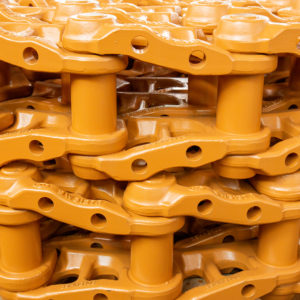
Bayangkan dua selari, rantai basikal tugas berat, ditingkatkan ke tahap yang sangat besar. Ini adalah intipati rantaian trek. Ia bukan satu, gelung monolitik keluli. Sebaliknya, ia adalah siri pautan yang saling bersambung yang dipasang dengan teliti, pin, dan sesendal. Setiap segmen, atau "pautan," adalah karya agung keluli tempa, direka untuk berputar menentang jirannya. "pin" bertindak sebagai pin engsel, rod keluli yang dikeraskan yang membolehkan sendi untuk bersendi. "Sendal" ialah silinder berongga yang muat di atas pin, menyediakan yang besar, permukaan pakai korban. Seluruh perhimpunan mencipta fleksibel, powerful loop that engages with the machine's drive sprocket to propel it forward or backward.
Rantaian trek melakukan lebih daripada sekadar menghantar kuasa. Ia membawa keseluruhan berat mesin, diedarkan melalui penggelek trek. Ia membimbing mesin, mengekalkannya di jalan yang lurus atau membenarkannya berpusing. Ia mesti menahan ketegangan yang berterusan, beban kejutan akibat terkena batu, dan pengisaran tanpa henti bahan yang melelas. Integriti setiap pin dan sesendal individu menentukan integriti keseluruhan rantai. Apabila anda mendengar jurutera bercakap tentang "pitch," ia merujuk kepada jarak tepat dari pusat satu pin ke pusat seterusnya. Apabila rantai itu dipakai, nada ini meningkat, pemanjangan halus yang mempunyai akibat yang mendalam tentang cara rantai berinteraksi dengan bahagian bawah pengangkutan yang lain, terutamanya sproket. Rantaian trek ialah, oleh itu, instrumen ketepatan, walaupun rupanya lasak.
Memahami Kasut Trek: The Machine's Footprint
Jika rantai trek adalah rangka, kasut trek adalah kaki. Diketatkan terus ke permukaan luar pautan rantai trek, ini adalah komponen yang membuat sentuhan langsung dengan tanah. Fungsi mereka kelihatan mudah: untuk menyediakan permukaan untuk mesin berehat dan menjana daya tarikan. Namun, realitinya jauh lebih bernuansa. Reka bentuk kasut trek adalah keseimbangan halus prinsip fizikal yang bersaing. It must be wide enough to distribute the machine's weight, mewujudkan tekanan tanah rendah untuk "terapung" di atas tanah lembut—prinsip yang dikenali sebagai pengapungan. Fikirkan perbezaan antara cuba berjalan di atas salji dalam dengan but biasa berbanding dengan kasut salji. Kasut salji menyebarkan berat badan anda ke kawasan yang lebih besar, menghalang anda daripada tenggelam. Kasut trek lebar melakukan perkara yang sama untuk jengkaut berat di atas lumpur.
Secara serentak, kasut trek mesti mempunyai ciri yang menggigit ke dalam tanah untuk memberikan cengkaman, atau daya tarikan. Ciri-ciri ini dipanggil "grousers" atau "bar grouser." Ia adalah tulang rusuk keluli yang dinaikkan yang menjadi ciri trek. Ketinggian, bentuk, dan bilangan grousers ini menentukan keberkesanan mesin boleh menolak atau menarik. Terlalu banyak ketinggian grouser pada batu keras boleh menyebabkan mesin menunggang pada hujung grousers, membawa kepada ketidakstabilan dan getaran yang tinggi. Ketinggian grouser yang terlalu kecil dalam lumpur lembut mengakibatkan trek berputar tanpa guna. Oleh itu, pemilihan kasut trek yang betul bukan soal memilih yang "terkuat" satu, tetapi memilih yang mempunyai geometri yang betul untuk tugas dan persekitaran tertentu.
Hubungan Simbiotik: Bagaimana Rantai dan Kasut Berfungsi Bersama
Seseorang tidak boleh menganggap rantai trek secara berasingan daripada kasut trek, atau sebaliknya. Mereka bujang, unit berfungsi. Selak kasut trek pada pautan rantai, mengukuhkannya dan menyediakan permukaan yang melibatkan tanah. Rantaian ini menyediakan struktur yang diartikulasikan yang membolehkan siri kasut rata untuk membentuk berterusan, laluan fleksibel di sekeliling penggelek, pemalas, dan gegancu. Pemilihan kasut secara langsung memberi kesan kepada hayat rantai. Contohnya, menggunakan kasut yang terlalu lebar dalam berimpak tinggi, rocky environment increases the mechanical leverage on the chain's joints. Apabila mesin berputar atau beroperasi di atas tanah yang tidak rata, tepi luar kasut lebar boleh mengalami tekanan yang besar, yang kemudiannya dipindahkan terus ke pin dan sesendal, mempercepatkan pemakaian mereka.
Ini adalah konsep yang dipanggil "peraturan kasut." Ia menetapkan bahawa seseorang harus sentiasa menggunakan kasut yang paling sempit yang masih memberikan pengapungan yang mencukupi untuk pekerjaan itu.. Melangkah lebih lebar daripada yang diperlukan menambah berat badan, meningkatkan ketegangan pada keseluruhan bahagian bawah pengangkutan, dan meningkatkan penggunaan bahan api. Ia adalah pertukaran kejuruteraan klasik. Rantai trek dan bahagian kasut trek berfungsi dengan halus, keseimbangan simbiotik. Mereka mesti dipilih bersama, sebagai satu sistem, dengan penuh penghayatan bagaimana reka bentuk satu bahagian akan mempengaruhi prestasi dan jangka hayat bahagian yang lain. Ia adalah perkongsian mekanikal di mana pilihan yang salah dalam satu kawasan pasti menjejaskan keseluruhannya.
Sejarah Ringkas: Evolusi Pendorongan Dijejaki
Konsep trek berterusan bukanlah ciptaan moden. Keturunan intelektualnya boleh dikesan kembali ke abad ke-18. Namun begitu, kenderaan jejak pertama yang benar-benar praktikal dan berjaya secara komersial muncul pada awal abad ke-20, dipelopori oleh syarikat seperti Holt Manufacturing, pendahulu kepada Caterpillar. Sistem awal ini adalah asas, sering dirujuk sebagai "kering" rantai. Ia terdiri daripada pin dan pautan ringkas tanpa pengedap, bermakna bahan-bahan yang melelas seperti pasir dan pasir boleh memasuki sendi dengan bebas. Kadar kehausan adalah astronomi, dan undercarriages diperlukan tetap, penyelenggaraan dan penggantian yang mahal.
Satu-satunya inovasi paling ketara dalam sejarah rantaian trek ialah pembangunan Trek Tertutup dan Berlincir (Garam) pada pertengahan abad ke-20. Reka bentuk revolusioner ini diperbadankan kecil, pengedap yang berkesan pada setiap hujung sesendal. Pengedap ini direka bentuk untuk menyimpan takungan minyak di dalam pin dan sambungan sesendal sambil pada masa yang sama menghalang bahan cemar yang melelas keluar. Hasilnya ialah pengurangan dramatik dalam haus dalaman. Tiba-tiba, padang "" rantaian itu kekal konsisten untuk lebih lama, dan jangka hayat keseluruhan sistem undercarriage boleh diukur dalam ribuan jam dan bukannya ratusan. Inovasi ini, lebih daripada yang lain, dibuat moden, jentolak kuasa kuda tinggi dan jengkaut boleh dilaksanakan secara ekonomi. Ia mengubah rantaian trek daripada yang mudah, komponen brute-force menjadi sofistikated, sendi mekanikal tertutup, meletakkan asas untuk reka bentuk lanjutan yang kita lihat 2025.
Faktor 1: Komposisi bahan dan proses pembuatan
At the very core of a component's ability to withstand the brutal reality of an earthmoving operation lies its material DNA. Pilihan keluli, the method of its formation, and the thermal treatments it undergoes are not minor details; they are the fundamental determinants of its service life. A track link that shatters under impact or a track shoe that wears away like soap in a matter of weeks is a failure not just of design, but of metallurgy. To select durable track chain and track shoe parts, one must become a student of materials science, appreciating the subtle yet profound differences that separate a premium component from a premature failure.
Hati Ketahanan: Steel Alloys and Hardening Techniques
The steel used for undercarriage components is not the simple iron-carbon mixture one might imagine. It is a sophisticated alloy, a carefully crafted recipe where elements like manganese, kromium, molybdenum, and boron are added in precise quantities. Mangan, contohnya, is a key ingredient that significantly increases the hardenability of the steel. This means that upon quenching (rapid cooling), a deeper and more uniform layer of hardness can be achieved. Boron, even in minuscule amounts—parts per million—has a powerful effect on hardenability, allowing for the use of less-expensive alloys while still achieving superior properties (Kilic, 2021). These alloying elements work by altering the crystalline structure of the steel as it cools, creating a fine-grained martensitic structure that is exceptionally hard and resistant to abrasive wear.
Kekerasan, Walau bagaimanapun, is only one side of the coin. A material that is extremely hard is often also very brittle, seperti kaca. It might resist scratching, but it will shatter under a sharp impact. The undercarriage needs "toughness"—the ability to absorb energy and deform without fracturing. This is where thermal treatments become an art form. The process of "through-hardening" involves heating the entire component to a critical temperature and then quenching it, followed by a "tempering" proses (Pemanasan semula ke suhu yang lebih rendah). Tempering relieves internal stresses and imparts toughness, creating a balance between hardness (untuk rintangan haus) dan ketangguhan (untuk rintangan hentaman). A more targeted approach is "induction hardening," where only the specific wear surfaces, like the rail of a track link or the bore of a bushing, are rapidly heated by an electromagnetic field and then quenched. This creates an extremely hard outer "case" while leaving the inner "core" of the component tougher and more ductile to absorb shock loads. A superior track link is one where the case depth and core hardness are perfectly optimized for its intended application.
Memalsukan vs. Pemutus: A Comparative Analysis of Strength and Cost
How a component is shaped from raw steel is just as important as the steel itself. The two dominant methods for producing track links and shoes are casting and forging. In casting, molten steel is poured into a mold of the desired shape and allowed to solidify. It is a relatively inexpensive process, well-suited for complex shapes. Namun begitu, as the metal cools, it forms a crystalline structure with relatively large, randomly oriented grains. This can sometimes lead to internal porosity or inconsistencies that can become points of failure under high stress.
Menempa, Sebaliknya, involves taking a solid billet of steel and shaping it under immense pressure using a hammer or a press. This process does not melt the steel. Sebaliknya, it forces the internal grain structure of the metal to align with the shape of the part. Think of it like kneading dough; the process refines the grain structure, making it finer and more uniform. This continuous grain flow gives forged components superior tensile strength, rintangan keletihan, and impact toughness compared to their cast counterparts. A forged track link is less likely to crack under the repeated shock loads experienced in a rocky quarry. The trade-off is cost. The tooling for forging is expensive, and the process is generally slower than casting. Selama bertahun -tahun, this made forging a premium, high-cost option. Namun begitu, as global manufacturing technologies have advanced, the cost gap has narrowed, making high-quality forged undercarriage parts more accessible. For a truly robust undercarriage, especially for machines over 30 tons operating in severe conditions, forged track chain and track shoe parts are often the more prudent long-term investment.
| Ciri | Menempa | Pemutus |
|---|---|---|
| Struktur bijirin | Fine, uniform, and directional | Coarser, non-directional, berpotensi berliang |
| Tensile Strength | Superior | Baik |
| Impact Toughness | Cemerlang | Fair to Good |
| Fatigue Resistance | Superior | Baik |
| Shape Complexity | Limited to less intricate shapes | Excellent for complex shapes |
| Manufacturing Cost | Higher initial tooling and process cost | Lower tooling and process cost |
| Typical Use | High-stress components (pautan jejak, pin) | Components with complex geometry (sproket) |
The Role of Boron and Other Alloying Elements
Let's delve deeper into the microscopic world of steel. The addition of alloying elements is akin to a chef adding spices to a base recipe. Each one imparts a unique characteristic. Seperti yang disebutkan, boron is a potent hardening agent. Its atoms, being very small, diffuse into the grain boundaries of the steel's crystalline lattice, effectively slowing down the transformation from austenite to softer ferrite and pearlite during cooling. This gives the desired hard martensitic structure more time to form, even in thicker sections of a component. The result is a deeper, more consistent hardness profile.
Chromium is another vital player. It not only increases hardenability but also contributes significantly to corrosion resistance, a factor that is often overlooked. For machines operating in wet, saline, or acidic environments, like those in coastal regions or certain mining applications, a higher chromium content can dramatically slow the degradation of the components. Molybdenum works in synergy with chromium, enhancing toughness at high temperatures and improving resistance to "temper embrittlement," a phenomenon where steel can become brittle after being held at certain temperatures. Nickel is another key element for toughness, particularly at low temperatures. For machinery destined for the freezing winters of Russia or Northern Asia, a track chain with a higher nickel content will be far more resistant to brittle fracture in sub-zero conditions. A knowledgeable supplier, like the team at Jentera Juli, understands these metallurgical nuances and can help match the specific alloy composition of their undercarriage parts to the unique environmental challenges of a customer's region.
Surface Treatments: Carburizing, Nitriding, and their Impact on Wear Life
Beyond the bulk properties of the steel, advanced surface treatments can provide an extra layer of defense against wear. These are not coatings like paint; they are processes that diffuse elements into the surface of the steel, fundamentally changing its chemistry and properties. "Carburizing" is a process where a component, like a bushing, is heated in a carbon-rich atmosphere. Carbon atoms diffuse into the surface, creating a "case" with a very high carbon content. When this case is quenched, it becomes extremely hard, with hardness values exceeding 60 on the Rockwell C scale. This super-hard surface is exceptionally resistant to the grinding, abrasive wear that occurs between the pin and the bushing.
"Nitriding" is a similar process but uses nitrogen instead of carbon. It is typically performed at lower temperatures than carburizing, which results in less distortion of the part. A nitrided surface is also extremely hard and offers excellent resistance to wear and fatigue. Some of the most advanced track pins and bushings on the market in 2025 utilize a combination of these techniques—a through-hardened, tough core made from a boron alloy steel, which is then carburized or nitrided on its surface to create the ultimate combination of a wear-proof exterior and a shock-resistant interior. When evaluating track chain and track shoe parts, it is worth inquiring about these advanced surface treatments. They represent a significant investment in manufacturing but pay substantial dividends in the form of extended service life, particularly in high-abrasion applications like sand or granite.
Faktor 2: Reka bentuk gunting dan pengaruhnya di kawasan
The track shoe, with its distinctive grousers, is the machine's direct handshake with the earth. It is a tool of engagement, and like any tool, its form must be exquisitely matched to its function. Selecting the wrong track shoe is like trying to drive a screw with a hammer; you might eventually get it in, but the process will be inefficient, damaging, and ultimately frustrating. The geometry of the track shoe—its width, the number of its grousers, and their shape—dictates the machine's ability to generate traction, its stability on slopes, its impact on the ground surface, and even the rate at which the entire undercarriage system wears out. A thoughtful consideration of grouser design moves the selection process from a simple purchase to a strategic operational decision.
Bujang, Ganda, Triple: Choosing the Right Grouser Bar Count
The number of grousers on a track shoe is the most immediate and defining characteristic. The choice between a single, ganda, or triple grouser shoe is a fundamental one, driven entirely by the primary application of the machine.
A single grouser shoe features one tall, aggressive grouser bar running across its width. This design provides the maximum possible penetration into the ground. It is the shoe of choice for applications requiring extreme traction and drawbar pull, such as a bulldozer ripping hard-packed earth or climbing steep grades. The deep penetration provides an anchor, allowing the machine to apply its full power without track slippage. Namun begitu, this aggressiveness comes with downsides. The focused pressure on a single bar creates high impact when traveling over hard surfaces like rock, leading to a rough ride and high stress on the undercarriage. Tambahan pula, the deep ground penetration makes turning difficult. The machine has to work much harder to pivot, which accelerates wear on all steering components and can tear up the ground surface.
A triple grouser shoe is the polar opposite and the most common type found on excavators. With three shorter grousers, the shoe has more surface area in contact with the ground at any given time. This provides good all-around performance, offering a balance of traction, pengapungan, dan kebolehgerakan. The lower grouser height reduces ground penetration, which makes turning significantly easier and smoother. This is vital for an excavator, which is constantly repositioning itself while digging. The triple grouser design also provides a smoother ride and less vibration when traveling, reducing wear on the undercarriage and improving operator comfort.
A double grouser shoe occupies the middle ground. It offers better traction and penetration than a triple grouse but is less aggressive and easier to turn than a single grouser. This makes it a popular choice for the front of track loaders and for dozers that need a compromise between straight-line pushing power and maneuverability. The choice is a direct reflection of the machine's job. A dozer that spends 90% of its time pushing material in a straight line will benefit from single grousers. An excavator that is constantly digging, swinging, and repositioning will live a longer, more productive life on triple grousers.
| Jenis Grouser | Permohonan utama | Daya tarikan | Kebolehgerakan | Gangguan tanah |
|---|---|---|---|---|
| Grouser tunggal | Dozers, Rippers (High Drawbar Pull) | Maximum | Miskin | Tinggi |
| Double kasar | Pemuat trek, Dozers (Versatility) | Tinggi | Sederhana | Sederhana |
| Triple lebih besar | Jengkaut (All-Purpose) | Baik | Cemerlang | Rendah |
| Paya (Low Ground Pressure) | Soft Mud, Marshland | Rendah (Flotation is key) | Baik | Sangat rendah |
| Rubber Pad | Asphalt, Concrete, Finished Surfaces | Sederhana | Cemerlang | Minimal / Tiada |
| Chopper / Self-Cleaning | Landfills, Waste Handling, Sticky Clay | Baik | Baik | Tinggi (Designed to break up material) |
Specialized Shoes: Pad paya, Rubber Pads, and Chopper Shoes
Beyond the standard configurations, a fascinating world of specialized track shoes exists, each designed to solve a unique environmental problem. Swamp pads, also known as Low Ground Pressure (LGP) shoes, are a perfect example. These shoes are extremely wide, sometimes looking almost like planks of steel. Their purpose is not high traction in the conventional sense, but maximum flotation. By dramatically increasing the surface area of the machine's footprint, they reduce the ground pressure to a point where a massive machine can work on soft, saturated ground—like swamps, rawa, or dredging sites—without sinking.
On the other end of the spectrum are rubber pads. These can be either bolt-on pads attached to a standard steel shoe or a complete "roadliner" shoe where the rubber is bonded directly to a steel core. Their purpose is to allow a heavy tracked machine to operate on sensitive surfaces like asphalt, konkrit, or landscaped areas without causing damage. They are indispensable for urban construction, road work, and any job site where preserving the existing surface is a priority. While they offer less traction than steel grousers, especially in wet or muddy conditions, they provide a quiet, low-vibration ride and unmatched surface protection.
Another interesting variant is the "chopper" or self-cleaning shoe. These are often found on machines working in landfills or with extremely sticky materials like clay. They feature cutouts in the shoe plate and sometimes have a more aggressive, angled grouser design. The purpose of these features is to break up and eject material that would otherwise pack into the undercarriage. Material packing is a serious problem; it adds immense weight, increases track tension to dangerous levels, and can cause the tracks to seize, leading to catastrophic failure. Chopper shoes are a purpose-built solution to this specific and destructive problem.
The Physics of Traction: How Grouser Height and Shape Affect Performance
The interaction between a grouser and the ground is a study in soil mechanics. When a grouser penetrates the soil, it creates a shear plane. The traction, atau usaha traktif, that can be generated is a function of the soil's shear strength and the surface area of that shear plane. A taller grouser creates a deeper shear plane, thus increasing the potential for traction. This is why single grousers are so effective in cohesive soils.
Namun begitu, the story changes on hard, non-penetrative surfaces like rock or compacted gravel. Di sini, a tall grouser is a liability. The machine ends up riding on the sharp tips of the grousers, drastically reducing the contact area with the ground. This leads to instability, high vibration, and intense point-loading on both the grouser tips and the rock surface. In these conditions, a lower, wider grouser profile is superior, as it maximizes the contact area and relies on friction rather than shear strength for grip.
The shape of the grouser also matters. Most grousers are trapezoidal, which provides a good balance of strength and penetration. Some specialized shoes might use a more curved or angled profile to improve self-cleaning properties or to provide better grip when turning. The key takeaway is that there is no universally "best" grouser. The optimal design is a direct function of the geotechnical properties of the material the machine will be working on.
Matching Shoe Width to Ground Conditions: Flotation vs. Kebolehgerakan
We have touched upon the "rule of the shoe": use the narrowest shoe that provides adequate flotation. Let's formalize this with some physics. Ground pressure is calculated as the machine's weight divided by the total contact area of its tracks. A 20-ton (44,000 lb) excavator with standard 600mm shoes might have a ground pressure of around 6.5 Psi. If that same machine is fitted with wider 800mm shoes, the contact area increases, and the ground pressure might drop to around 5.0 Psi. This difference is what allows the machine to work on softer ground without getting bogged down.
But this benefit is not free. The wider shoe acts as a longer lever. As the machine turns or travels over uneven terrain, the stresses are magnified. The extra weight of the wider shoes also adds to the inertia of the system, requiring more energy to move and placing more strain on the pins and bushings of the track chain. The risk of "throwing a track" (derailment) also increases with wider shoes, especially when working on slopes or turning sharply. Oleh itu, the selection of shoe width is a critical balancing act. One must accurately assess the typical ground conditions of the job site. If the machine will spend most of its time on firm, stable ground, a standard-width shoe is the most economical and mechanically sound choice. Only when soft conditions are the norm, not the exception, should wider LGP shoes be considered. This single decision has a cascading effect on the entire cost and reliability of the machine's undercarriage system.
Faktor 3: Peranan kritikal pin, Bushings, dan anjing laut
If the track links and shoes are the visible, external armor of the undercarriage, then the pins, bushings, and seals are its internal, vital organs. Hidden from view, these components facilitate every movement, absorb every shock, and bear the full brunt of the system's internal wear. The slow, grinding degradation of these internal joints is the primary factor that dictates the lifespan of a track chain. A failure in this hidden world is not gradual; it is often sudden and total, bringing a multi-ton machine to a grinding halt. An appreciation for the design and function of these small but mighty components is therefore not just technical knowledge; it is the key to predicting, managing, and extending the life of your most expensive wear item.
Trek Tertutup dan Berlincir (Garam) vs. Grease-Lubricated Chains
To understand the genius of modern track chains, we must first appreciate what came before. Early "dry" track chains were simple assemblies of pins and links. With every articulation, kotoran, pasir, and grit would enter the joint, forming a grinding paste that rapidly wore away both the pin and the inside of the link's bore. The rate of wear was so high that undercarriage life was measured in a few hundred hours.
The first major improvement was the "grease-lubricated" rantai. Dalam reka bentuk ini, the pin was drilled with a channel, allowing grease to be pumped into the joint to provide lubrication and, lebih penting lagi, to flush out contaminants. This was an improvement, but it required daily, diligent maintenance. Forgetting to grease even a single joint could lead to its rapid failure.
The true revolution was the advent of the Sealed and Lubricated Track (Garam) sistem. In a SALT chain, the joint between the pin and bushing is protected by a pair of sophisticated seals. These seals are designed to perform two functions simultaneously: they keep a reservoir of liquid oil permanently sealed inside the joint, and they prevent any external contaminants from entering. The pin and bushing are therefore constantly bathed in a clean, lubricating film of oil. This eliminates the metal-on-metal, grit-infused grinding that destroyed older chains. The reduction in internal wear is not incremental; it is an order-of-magnitude improvement. A SALT chain can last thousands of hours with minimal maintenance, making it the undisputed standard for virtually all modern excavators and bulldozers. When sourcing bahagian undercarriage berkualiti tinggi, ensuring they are designed for a SALT system is one of the most fundamental checks of quality and modernity.
The Anatomy of a Pin and Bushing Joint
Let's dissect this critical joint. "pin" is a solid, cylindrical rod of highly hardened steel. It passes through the interlocking ends of two adjacent track links. "Sendal" is a hollow, hardened steel cylinder that fits over the pin. The bushing sits within the bore of the "inner" pautan jejak, while the pin is press-fitted into the ends of the "outer" pautan jejak. This seems complex, but the arrangement is clever. When the chain bends, the pin rotates inside the bushing. The wear is designed to occur between the outer diameter of the pin and the inner diameter of the bushing.
This is a crucial design choice. It concentrates the internal wear on two specific, replaceable components. As the chain operates, the constant articulation under immense load slowly wears away the material on the pin and bushing. This wear is what causes the chain's "pitch" untuk meningkat, or "stretch." The chain isn't actually stretching; the material loss in each of the dozens of joints is creating a tiny amount of extra play, which adds up over the length of the chain. This pitch elongation is the primary measurement used to determine the wear level of a track chain. A well-designed system ensures that the pin and bushing wear at a predictable rate, allowing for planned maintenance before they wear through and cause a catastrophic failure of the link itself.
Polyurethane Seals: The Unsung Heroes of Longevity
The component that makes the entire SALT system possible is the seal. These are not simple rubber o-rings. A modern track seal is a high-tech component, often consisting of two parts: a resilient rubber "load ring" and a durable polyurethane "seal ring." The load ring acts like a spring, pushing the seal ring firmly against the polished faces of the bushing and the link. The seal ring itself is made from a special grade of polyurethane, a material chosen for its incredible toughness, abrasion resistance, and resistance to oil and heat.
The geometry of the seal is critical. It must be able to accommodate a small amount of axial movement and misalignment without losing its seal. It must maintain its sealing pressure across a wide range of temperatures, from the cold of a winter morning start-up to the high heat generated by continuous operation. The two-part design, often called a "duo-cone" or "toric" seal, creates a highly reliable labyrinth seal that is exceptionally effective at its dual task of keeping oil in and dirt out. The quality of this tiny, often-overlooked component is paramount. A premature seal failure leads to the loss of oil from the joint. Once the oil is gone, the joint effectively reverts to being a "dry" joint, and the pin and bushing will destroy themselves in a fraction of their expected lifespan. When evaluating track chain and track shoe parts, the quality and design of the seals are a direct indicator of the overall quality of the chain.
Understanding Pitch and its Effect on Wear and Sprocket Engagement
"Pitch" is the center-to-center distance between two adjacent pins in a track chain. When a chain is new, this dimension is manufactured to a very precise specification, contohnya, 216 mm. This pitch is designed to perfectly match the distance between the teeth on the machine's drive sprocket. Semasa sproket berputar, its teeth engage the bushings of the chain, pushing the machine along. The fit is snug and efficient, with the load distributed evenly.
Namun begitu, as internal wear occurs on the pins and bushings, the effective pitch of the chain begins to increase. Even a minuscule amount of wear in each of the 40+ joints on a chain adds up. A chain that is 50% worn might have a pitch that has "stretched" by 3-4 mm. Sekarang, when this elongated chain tries to wrap around the sprocket, the teeth no longer align perfectly with the bushings. The sprocket tooth will engage the bushing higher up on its surface, and as the sprocket rotates, it will slide or "scrub" down the bushing. This scrubbing action dramatically accelerates the wear on both the outside of the bushing and the teeth of the sprocket. This is why you will often see sprockets with a "hunted tooth" or pointed wear pattern on machines with worn chains. It is a tell-tale sign of pitch mismatch. Managing and monitoring pitch elongation is the cornerstone of professional undercarriage management. It allows for planned interventions, like a "pin and bushing turn," long before the mismatched components begin to destroy each other at an accelerated rate.
Faktor 4: Persekitaran operasi dan tuntutan khusus aplikasi
A machine's undercarriage does not exist in a vacuum. It is in a constant, violent dialogue with its environment. The geological composition of the ground, the moisture content, the chemical makeup of the soil, and the ambient temperature all conspire to attack the steel of the track chain and track shoe parts. An undercarriage that provides 5,000 hours of service life in sandy loam might be completely destroyed in 1,500 hours in a granite quarry. Recognizing and quantifying the specific challenges of the operating environment is not an academic exercise; it is a fundamental prerequisite for making a cost-effective component selection. To choose wisely, one must become a forensic analyst of the job site.
High-Impact vs. High-Abrasion Environments: A Tale of Two Wear Patterns
All wear is not created equal. It is vital to distinguish between two primary modes of destruction: impact and abrasion.
A high-impact environment is characterized by hard, unyielding surfaces, typically large rocks, blasted stone, or demolition debris. In these conditions, the dominant failure mode is not a slow grinding away of material. Sebaliknya, it is fracture, retak, and spalling. When a track shoe slams down on a sharp piece of granite, the immense force is concentrated on a small area. This can cause the grouser to chip, the shoe to bend or crack, or the shock to be transmitted through the chain, placing immense stress on the pins and links. For these environments, the most desirable material property is keliatan. The steel must be able to absorb this shock energy and deform slightly without fracturing. A through-hardened steel with a slightly lower surface hardness but a tough, ductile core will outperform an extremely hard but brittle component in a high-impact quarry.
A high-abrasion environment, sebaliknya, is defined by the presence of small, hard, sharp particles, seperti pasir, pasir, or fine gravel. Di sini, the primary wear mechanism is a continuous scratching and gouging action that slowly grinds away the surfaces of the components. Think of it as being constantly attacked by sandpaper. The sand packs into the undercarriage, works its way between moving parts, and relentlessly scours the steel. In these conditions, the most desirable material property is hardness. A very hard surface, like that created by induction hardening or carburizing, will be much more resistant to this abrasive wear. A track link with a high surface hardness will maintain its rail height for longer, and a hardened bushing will better resist the grinding from sandy soil. Most job sites present a mix of both impact and abrasion, but one is usually dominant. Correctly identifying the dominant wear mechanism is the first step toward selecting a component with the right metallurgical properties.
The Corrosive Challenge: Saline, Acidic, and Wet Conditions
Mechanical wear is not the only enemy. Chemical attack, or corrosion, can be an equally potent, if more insidious, force of destruction. Machines operating in coastal areas are constantly exposed to salt spray and saline soil, which dramatically accelerates the rusting process. Rust is not just a cosmetic issue; it is the conversion of strong steel into a weak, flaky iron oxide. It pits the surface of components, creating stress risers that can lead to fatigue cracks. It can also seize moving parts, like the track-adjuster mechanism.
Begitu juga, certain industrial or mining environments can have highly acidic or alkaline soils. These chemicals can aggressively attack the steel of the undercarriage, especially if protective coatings are worn away. Even seemingly benign wet conditions can accelerate wear. Water can act as a lubricant for abrasive particles, creating a slurry that can be pumped into even the tightest crevices, accelerating wear. It can also wash away the grease that protects external pivot points.
For these corrosive environments, material selection again becomes key. Steels with a higher percentage of chromium and nickel offer inherently better corrosion resistance. Some premium track chain and track shoe parts may also feature special coatings or surface treatments designed to provide a barrier against chemical attack. When selecting parts for a machine that will work in a known corrosive environment, it is not enough to ask about hardness and toughness; one must also inquire about the alloy's resistance to corrosion.
Suhu melampau: From Siberian Frost to Middle Eastern Heat
The ambient operating temperature has a profound effect on the performance and reliability of undercarriage components. In the extreme cold of a Siberian winter or northern Canada, where temperatures can plummet below -40°C, the primary concern is patah rapuh. At these low temperatures, the toughness of steel can decrease dramatically. A steel alloy that is perfectly tough and resilient at room temperature can become as brittle as glass when it is deep-frozen. An impact from a frozen rock that would normally be absorbed without issue can cause a cold track link to shatter catastrophically. Untuk memerangi ini, undercarriage parts destined for cold-weather regions must be made from special steel alloys, often with a higher nickel content, which are specifically formulated to retain their toughness at low temperatures. The quality of the seals in the SALT chain is also tested to its limit, as the rubber and polyurethane components can become stiff and less compliant, increasing the risk of leakage.
Sebaliknya, in the scorching heat of the Middle East or parts of Africa, where ambient temperatures can exceed 50°C, the challenge is different. The primary concern is the viscosity and integrity of the lubricant inside the sealed joints. High operating temperatures, combined with the heat generated internally by the flexing of the chain, can cause the oil in the SALT joints to thin out, reducing its lubricating effectiveness. The seals are also placed under immense thermal stress, which can accelerate their aging and lead to premature failure. In these hot climates, using track chains filled with a high-quality, high-viscosity synthetic lubricant that is designed to maintain its properties at elevated temperatures can significantly extend the life of the pins and bushings.
A Case Study: Undercarriage Selection for a Quarry in Australia vs. a Pipeline Project in Russia
To synthesize these ideas, let's consider two hypothetical scenarios.
Scenario 1: A granite quarry in Western Australia. The environment is hot, dry, and extremely high-impact and high-abrasion. The ground is a mix of sharp, blasted granite and abrasive dust. For a large dozer working here, the ideal undercarriage specification would be:
- Kasut Trek: Single grouser for maximum traction on uneven benches, but not excessively tall to avoid instability. They must be made from a through-hardened, high-toughness alloy to resist cracking from impact.
- Rangkaian Jejak: Forged links for maximum strength and fatigue resistance. The links, penggelek, and idlers should have deep induction hardening on their wear surfaces to combat the abrasive dust. The pins and bushings should be of the highest quality, with a tough core and a heavily carburized surface. The entire system is built to prioritize impact resistance and surface hardness.
Scenario 2: A pipeline construction project in Siberia, Rusia. The environment involves long-distance travel over varied terrain, including frozen tundra, muskeg (bog), and rocky soil, in winter temperatures that are consistently far below freezing. For an excavator laying pipe here, the ideal specification would be:
- Kasut Trek: Wide, triple grouser LGP (Low Ground Pressure) shoes. The width is for flotation on the soft muskeg, and the triple grouser design allows for better maneuverability and a smoother ride during travel.
- Rangkaian Jejak: The steel alloy for all components must be a high-nickel, low-temperature grade to prevent brittle fracture. The seals must be specified for extreme cold, retaining their flexibility to prevent oil loss. The oil within the SALT joints should be a low-viscosity synthetic that will not thicken and fail to lubricate on cold starts. The focus here is on low-temperature toughness and flotation.
These two examples illustrate that there is no single "best" set of track chain and track shoe parts. The optimal choice is a carefully reasoned response to the specific challenges posed by the machine's intended work and environment.
Faktor 5: OEM, tulen, dan perdebatan selepas pasaran
The decision of where to source replacement undercarriage parts is one of the most contentious and financially significant choices a machine owner faces. The market is broadly divided into three categories: Pengilang peralatan asal (OEM), tulen, dan Aftermarket. Selama bertahun -tahun, the choice was portrayed as a simple trade-off between OEM quality and aftermarket price. Namun begitu, the global manufacturing landscape of 2025 is far more complex and nuanced. A sophisticated understanding of these categories, combined with a focus on Total Cost of Ownership (Tco), is necessary to navigate this debate intelligently and profitably.
Defining the Terms: OEM, tulen, and Aftermarket Parts
Clarity of terminology is the first step.
- Pengilang peralatan asal (OEM) bahagian: These are components produced by or for the manufacturer of the machine itself (Mis., Caterpillar, Komatsu, Volvo). They are sold in packaging bearing the machine manufacturer's brand. When a machine is assembled at the factory, it is built with OEM parts. The primary assurance here is that the part is guaranteed to meet the machine manufacturer's original design specifications and quality control standards.
- Bahagian Tulen: This term can be confusing. Selalunya, it is used interchangeably with OEM. Namun begitu, it can also refer to parts made by the very same factory that supplies the OEM, but sold in the component manufacturer's own packaging rather than the machine brand's. Sebagai contoh, a company like Berco might manufacture track chains for a major machine brand (OEM) and also sell the identical chain under its own Berco brand (tulen). The part is physically the same, but the supply chain and branding are different.
- Bahagian selepas pasaran: This is the broadest category. It includes any part manufactured by a company that is not the original equipment supplier. Pasaran selepas itu luas, ranging from highly respected manufacturers with decades of engineering experience to small, low-cost producers. Kualiti, bahan, and engineering of aftermarket parts can vary dramatically, from components that meet or even exceed OEM specifications to those that are dangerously substandard.
The simplistic notion that "OEM is always best" and "aftermarket is always a risky compromise" is an outdated one. The reality is that many reputable aftermarket companies have invested heavily in reverse engineering, materials science, dan kawalan kualiti. They may use the same steel suppliers, the same forging houses, and the same heat treatment facilities as the OEMs. The challenge for the buyer is to distinguish these high-quality aftermarket suppliers from the low-quality ones.
A Nuanced View on Quality: When Aftermarket Meets or Exceeds OEM Standards
How can an aftermarket part possibly be as good as, or even better than, an OEM part? There are several pathways. Pertama, a dedicated aftermarket manufacturer focuses solely on a specific range of products, like undercarriage parts. This specialization can lead to deep expertise. They may identify a common failure mode in an OEM design and engineer a solution. Sebagai contoh, they might use a superior alloy, a deeper hardening profile, or a more robust seal design for a specific high-wear application. They are not constrained by the original design and can innovate to solve real-world problems observed in the field.
Kedua, the global supply chain for heavy components is interconnected. The number of foundries and forges in the world capable of producing high-quality, large-scale steel components is limited. It is not uncommon for an OEM and a top-tier aftermarket company to be sourcing their raw forgings or castings from the very same supplier. The difference in quality then comes down to the subsequent machining, rawatan haba, and quality control processes. A reputable aftermarket company will invest in its own metallurgical labs, ultrasonic testing equipment, and coordinate measuring machines (CMM) to ensure that its finished products meet exacting standards. Learning about a potential supplier is a good first step; a company that is transparent about its manufacturing and quality control processes, like the information available when you learn about us, is a positive sign. They are not just selling a part; they are selling confidence in their engineering.
Cost-Benefit Analysis: Jumlah Kos Pemilikan (Tco) vs. Harga pembelian awal
The most common mistake in purchasing undercarriage components is focusing solely on the initial purchase price. A set of aftermarket track shoes might be 30% cheaper than the OEM equivalent, which seems like a significant saving. Namun begitu, if those cheaper shoes wear out in 2,000 Jam, while the OEM shoes would have lasted 3,500 Jam, the decision was a false economy.
The correct way to evaluate the choice is by calculating the Total Cost of Ownership (Tco), which is typically expressed as cost per hour of operation. The formula is simple:
TCO = (Harga pembelian awal + Installation Labor Cost) / Service Hours Achieved
Let's run an example.
- OEM Chain: $10,000 harga + $1,000 installation = $11,000 total. Achieves 4,000 service hours.
- TCO = $11,000 / 4,000 hours = $2.75 setiap jam.
- Low-Cost Aftermarket Chain: $7,000 harga + $1,000 installation = $8,000 total. Achieves 2,000 service hours.
- TCO = $8,000 / 2,000 hours = $4.00 setiap jam.
In this scenario, the "cheaper" chain is actually 45% more expensive to run. This calculation doesn't even include the cost of the additional downtime required for the extra change-out, nor the accelerated wear the prematurely worn chain may have caused to the sprockets and rollers. A high-quality aftermarket part, sebaliknya, might offer a TCO that is competitive with or even better than the OEM. Contohnya:
- High-Quality Aftermarket Chain: $8,500 harga + $1,000 installation = $9,500 total. Achieves 3,800 service hours.
- TCO = $9,500 / 3,800 hours = $2.50 setiap jam.
This is the goal: to find the component that delivers the lowest cost per hour. This requires diligent record-keeping and a partnership with a supplier who can provide reliable data on the expected service life of their track chain and track shoe parts in your specific application.
Warranty and Supplier Support: The Hidden Value
A part is more than just a piece of steel; it comes with a promise. The warranty offered by the supplier is a direct reflection of their confidence in their product. A comprehensive warranty that covers not just the part itself but also potential consequential damage in the event of a premature failure is a powerful indicator of quality.
Beyond the warranty, the technical support and expertise of the supplier are invaluable. A good supplier does not just take your order. They ask questions. What machine is it for? What is your primary application? What are your ground conditions? They act as consultants, helping you select the optimal component configuration for your needs. They can provide technical bulletins, wear charts, and installation guidelines. They can help you diagnose a wear problem and recommend a solution. This level of partnership transforms a simple transaction into a long-term relationship focused on reducing your operating costs. When choosing between OEM and aftermarket, the quality of the supplier is often a more important variable than the label on the box.
Faktor 6: Diagnostik Lanjutan dan Pemantauan Pakai
An undercarriage is a system in a constant state of decay. From the first hour of operation, the forces of impact and abrasion begin their relentless work. To manage the cost of this decay, one must be able to accurately measure and predict its trajectory. Simply running components until they fail is the most expensive strategy possible, leading to catastrophic failures, extensive downtime, and damage to associated parts. Professional undercarriage management in 2025 is a proactive discipline, blending traditional inspection techniques with modern diagnostic technology. It is about transforming wear from an unpredictable threat into a manageable, forecastable expense.
The Art of Visual Inspection: Reading the Signs of Wear
Long before any specialized tools are brought out, a trained eye can gather a wealth of information from a simple walk-around inspection. This is not a casual glance but a systematic examination of the entire undercarriage system. What should one look for?
- Scalloping on Rollers: Are the track rollers wearing evenly across their surface, or are they developing a "scalloped" or concave profile? This can indicate a problem with the roller's internal bearings or improper track alignment.
- Pointed Sprocket Teeth: Seperti yang dibincangkan, sprocket teeth that are wearing to a sharp, pointed shape are a classic symptom of a chain with elongated pitch. It's a clear signal that the chain and sprockets are no longer meshing correctly and are destroying each other.
- Leaking Components: Look for signs of oil leakage around the track rollers, pemalas, or from the ends of the track pins. A leak indicates a seal failure, which is a death sentence for the component if not addressed.
- Cracked or Bent Shoes: Carefully inspect each track shoe for cracks, especially around the bolt holes, and for any signs of bending. A single broken shoe can catch on the machine or other undercarriage parts, causing immense damage.
- Hardware Integrity: Are all the track shoe bolts tight? A loose bolt can lead to the shoe becoming loose, which can damage the bolt holes in the track link, komponen yang jauh lebih mahal untuk diganti.
This visual inspection is a fundamental skill. It costs nothing but a few minutes of time and can provide the earliest warnings of developing problems, allowing for intervention before they become critical.
Ultrasonic Measurement and Other Nondestructive Testing (Ndt) Methods
To move from qualitative observation to quantitative data, technicians use specialized tools. The most common and powerful of these is the ultrasonic wear measurement tool. This device works on the same principle as medical ultrasound. A probe is placed on the wear surface of a component, like a track bushing or a roller. It sends a high-frequency sound wave through the material. The wave travels to the back wall of the part and reflects back to the probe. By measuring the precise time it takes for this echo to return, and knowing the speed of sound in steel, the tool can calculate the remaining thickness of the part with incredible accuracy, often to within a fraction of a millimeter.
This technology is transformative. Instead of guessing how much life is left in a bushing, a technician can measure its wall thickness and compare it to the manufacturer's specifications for a new part. Dengan menjejaki pengukuran ini dari masa ke masa, one can calculate the exact wear rate (Mis., millimeters per 100 Jam) and accurately predict when the component will reach its wear limit. This allows for maintenance to be scheduled for a convenient time, rather than being dictated by an unexpected failure. Other NDT methods, such as magnetic particle inspection or dye penetrant testing, can also be used to check for surface cracks on critical components like links and idlers, especially after a known high-impact event.
The 100% Wear Life Rule: Planning for Pin and Bushing Turns
The data gathered from wear measurements is used to manage the components according to established wear life rules. The most important of these concerns the track chain's pins and bushings. The wear occurs in a predictable sequence. Pada mulanya, the machine moves forward most of the time, so the wear on the bushing occurs on one side—the side that contacts the sprocket tooth. The wear on the pin also occurs on one side.
The "100% wear life" mark is not the point of failure. It is the point at which the internal wear on the pin and bushing has reached a specific, predetermined limit (Mis., as measured by pitch elongation or ultrasonic testing). Pada ketika ini, the components are not worn out; they are simply worn on one side. This is where the "pin and bushing turn" masuk. The track chain is removed from the machine and taken to a workshop with a large hydraulic press. Each pin and bushing is pressed out of the links, berputar 180 darjah, and pressed back in.
The result is that a fresh, unworn surface is now presented to the high-wear contact zones. This single procedure can nearly double the life of the track chain for a fraction of the cost of a new one. Namun begitu, timing is everything. If the turn is performed too late—if the components are allowed to wear beyond the 100% limit—the structural integrity of the bushing wall may be compromised, and the turn will not be effective. The pin may even wear through the bushing wall, destroying the link. Proactive measurement is the only way to ensure this critical, cost-saving procedure is performed at the optimal moment.
Telematics and Predictive Maintenance in 2025: The Future is Now
The latest frontier in undercarriage management is the integration of telematics and predictive analytics. Many modern machines are equipped with telematics systems that report a vast array of data back to the owner or dealer, including hours of operation, fuel consumption, and fault codes. Dalam 2025, advanced systems are beginning to incorporate undercarriage-specific data.
Imagine sensors embedded within the undercarriage that can measure vibration, suhu, and even track tension in real-time. This data, combined with the machine's GPS data (which can indicate how much time is spent turning vs. traveling straight, or working on a slope), can be fed into a predictive maintenance algorithm. The system learns the specific wear patterns for that machine in its unique application. Instead of relying solely on periodic manual measurements, the system can generate a continuous, real-time estimate of wear. It could send an alert to a fleet manager's phone stating, "Excavator 12's left-hand track chain is projected to reach its 100% wear limit in 150 waktu operasi. Recommend scheduling a pin and bushing turn." This is the holy grail of maintenance: moving from a reactive or even proactive schedule to a truly predictive one, where maintenance is performed at the last possible moment before efficiency is lost or damage occurs. While still an emerging technology, it points the way to a future of even greater control over undercarriage costs.
Faktor 7: Penyelenggaraan yang betul, Pembaikan, dan prosedur pemasangan
Even the highest quality, most perfectly selected track chain and track shoe parts can have their lives cut tragically short by improper maintenance and installation. The undercarriage system is not a "fit and forget" component. It requires regular, disciplined attention. The practices of the operator in the cab and the technician in the field have a direct, measurable, and profound impact on how long these expensive components will last. Mastering these fundamental procedures is the final, and perhaps most important, piece of the puzzle in achieving the lowest possible total cost of ownership.
The Cardinal Sin: Improper Track Tension and its Consequences
If there is one single maintenance error that is responsible for more premature undercarriage failures than any other, it is improper track tension. Every manufacturer provides a specific procedure for measuring and setting the track "sag." This is not an arbitrary number. It is a carefully calculated specification designed to allow the undercarriage to function with the minimum possible stress.
A track that is too tight is under constant, immense tension. This tension creates a huge frictional load between the pins and bushings, and between the link rails and the rollers and idlers. It is like driving a car with the parking brake partially engaged. This friction generates heat, robs the machine of horsepower (peningkatan penggunaan bahan api), and dramatically accelerates the wear rate of every single moving part in the system. A track that is just a little too tight can easily cut the life of an undercarriage in half.
A track that is terlalu longgar, while generally less destructive than one that is too tight, brings its own set of problems. A loose chain will flap and whip around, creating an unstable and rough ride. More seriously, it can fail to engage the sprocket teeth correctly, causing slippage and accelerated wear. The biggest danger of a loose track is derailment, or "throwing a track." When the chain comes off the rollers and idlers, it can cause catastrophic damage, bending idlers, breaking rollers, and sometimes even cracking the main track frame. It also results in hours of dangerous and difficult work to get the heavy chain back on. Checking and adjusting track tension should be a daily or, at the very least, weekly ritual. The procedure is simple, typically involving pumping grease into or releasing it from a hydraulic adjuster cylinder, and it pays enormous dividends in component life.
Best Practices for Installation: Torque Specs and Alignment
When a new set of track chain and track shoe parts is installed, the procedure must be performed with the care of a surgeon, not the brute force of a blacksmith. Every bolt, especially the track shoe bolts that fasten the shoes to the links, has a specific torque specification. This specification is designed to stretch the bolt slightly, creating the correct clamping force to hold the joint securely. Under-torquing the bolts will allow the shoe to work itself loose, which can damage the bolt holes and lead to failure. Over-torquing can stretch the bolt beyond its yield point, permanently weakening it and making it likely to snap under load. Using a properly calibrated torque wrench is not optional; it is a fundamental requirement of a professional installation.
Alignment is another critical factor. The idlers and rollers must be properly aligned with the track frame. Misalignment will cause the chain to run crooked, placing heavy side-loads on the link rails and roller flanges, leading to a specific wear pattern known as "flanging." This not only wears out the components prematurely but also increases the risk of derailment.
The "Turn": Extending Life by Rotating Pins and Bushings
As we've discussed, the pin and bushing turn is a cornerstone of economic undercarriage management. It is a process that requires specialized equipment—a large hydraulic track press—and should be performed by a qualified workshop. The decision of when to perform the turn is data-driven, based on the wear measurements taken in the field. But the value is immense. For roughly 15-20% of the cost of a new track chain, this procedure can deliver an additional 60-80% of life. It is one of the best returns on investment available in heavy equipment maintenance. Ignoring this opportunity and simply running the chain to destruction is a significant financial error.
Rebuilding vs. Replacing: An Economic Calculation
Many undercarriage components are designed to be rebuildable. Track rollers and idlers, contohnya, can often have their worn shells built back up with automated welding processes and then re-machined to their original factory profile. A worn sprocket can sometimes have a new "rim" or "segment" welded or bolted on, saving the cost of replacing the entire hub assembly.
The decision to rebuild versus replace is, once again, a TCO calculation. One must compare the cost of the rebuild with the cost of a new replacement part, and critically, the expected service life of the rebuilt component versus the new one. A high-quality rebuild, performed by a reputable shop using the correct welding consumables and procedures, can often provide a service life that is 70-90% of a new part for only 40-60% of the cost. This can be a very effective cost-saving measure. Namun begitu, a poor-quality rebuild that fails prematurely is a waste of money. The key is to work with a trusted partner whose rebuild quality is proven and warrantied.
The Importance of a Clean Undercarriage
This may seem like a trivial, housekeeping issue, but it is not. Membenarkan lumpur, tanah liat, batu, or debris to pack into the undercarriage is incredibly destructive. This packed material has several negative effects:
- Increases Tension: As the space between the rollers and around the sprocket fills with hard-packed debris, it effectively tightens the track, creating all the problems of over-tensioning.
- Adds Weight: Caked-on mud can add hundreds or even thousands of kilograms to the machine's weight, increasing fuel consumption and strain on all components.
- Causes Abrasive Wear: The packed material holds abrasive particles against the moving components, accelerating wear.
- Hides Problems: A layer of dried mud can hide leaks, bolt longgar, and cracks, preventing them from being spotted during visual inspections.
Operators should make a habit of cleaning out the undercarriage at the end of each shift, especially when working in sticky or packing conditions. Using a shovel or pressure washer to remove the buildup is not just about keeping the machine looking good; it is a fundamental maintenance task that directly extends the life of the track chain and track shoe parts.
Soalan yang sering ditanya (Soalan Lazim)
How often should I inspect my track chain and track shoe parts? A daily visual walk-around is recommended to spot obvious issues like loose bolts, leaks, or visible damage. A more thorough, quantitative measurement of wear using ultrasonic tools should be performed as part of a scheduled preventive maintenance program, typically every 250 kepada 500 waktu operasi, depending on the severity of the application.
What causes "snaking" in a track chain? "Snaking" is the side-to-side movement of a track chain as it runs, which can lead to uneven wear on roller and idler flanges. It is most often caused by worn pin and bushing joints that have developed excessive lateral play. As the joints become loose, they no longer hold the links in rigid alignment, allowing the entire chain to wander.
Can I mix and match different brands of undercarriage components? While it is sometimes possible, it is generally not recommended. Different manufacturers may have slight variations in their dimensions, tolerances, and material hardness specifications. Mixing a track chain from one brand with a sprocket from another could lead to a poor fit, Pakaian dipercepatkan, and potential warranty disputes. For optimal performance, it is best to use a complete, matched system from a single, pembekal yang bereputasi.
What is the difference between a standard and a heavy-duty track chain? A heavy-duty track chain is engineered for more demanding applications. The differences are typically in the material and dimensions. It may feature track links with more material (a taller rail height), larger diameter pins and bushings, and improved heat treatment processes to provide greater strength and wear resistance compared to a standard chain.
Bagaimanakah teknik pengendalian mempengaruhi hayat undercarriage? Operator technique is a massive factor. Habits like making wide, gradual turns instead of sharp, pivot turns; minimizing high-speed travel, terutamanya secara terbalik; and avoiding unnecessary spinning of the tracks can dramatically reduce wear and extend the life of all components. A skilled operator who treats the undercarriage with mechanical sympathy can save a company thousands of dollars in replacement costs.
Are rubber track pads a good option for my excavator? Rubber pads are an excellent choice if the machine frequently works on finished surfaces like asphalt or concrete where damage is a concern. They provide good protection and a smooth ride. Namun begitu, they offer less traction than steel grousers, are more susceptible to damage from sharp rocks, and have a higher cost per hour in abrasive conditions. The choice depends entirely on balancing the need for surface protection against the demand for traction and durability.
Why is correct track tension so vital? Correct track tension is arguably the most critical maintenance adjustment. A track that is too tight creates immense friction and load throughout the system, drastically accelerating wear on pins, bushings, penggelek, dan sproket. A track that is too loose can cause track derailment and damage. Checking and maintaining the manufacturer-specified track sag is the single most effective action you can take to maximize undercarriage life.
Kesimpulan
The selection and management of track chain and track shoe parts is a complex but masterable discipline. It requires a departure from simplistic thinking focused on initial price and an embrace of a more holistic, intellectual approach centered on Total Cost of Ownership. It demands an appreciation for the subtleties of material science, a nuanced understanding of the physics of traction and wear, and a disciplined commitment to proactive maintenance. The optimal choice is not a universal constant but a tailored solution, a carefully reasoned response to the unique symphony of challenges presented by the machine's application, its operating environment, and the skill of its operator. By viewing the undercarriage as a complete, interconnected system and by partnering with knowledgeable suppliers who can provide not just parts but also expertise, machinery owners can transform their largest maintenance expense into a managed, predictable, and optimized investment, ensuring their equipment remains productive and profitable for years to come.
Rujukan
Caterpillar. (2018). Caterpillar undercarriage guide (13th ed.). Caterpillar Inc.
Kilic, O. (2021). The effects of boron on hardenability and wear behavior of excavator bucket pins and bushings. Materials Testing, 63(4), 361–368. https://doi.org/10.1515/mt-2020-0056
Komatsu. (n.d.). Undercarriage & service guide. Komatsu America Corp. Diambil dari
Verma, R. K., & Rana, R. S. (2021). A comprehensive review on wear of excavator teeth. Journal of Engineering Tribology, 235(11), 2211-2230. https://doi.org/10.1177/13506501211006526
Worth, D. (2019). Undercarriage management. Digger Worth's Heavy Equipment Field Guide. Diambil dari