
Resumo
A viabilidade operacional e a eficiência económica das máquinas de construção pesada dependem fundamentalmente da durabilidade dos seus sistemas de material rodante. Este documento apresenta uma análise abrangente dos fatores críticos envolvidos na seleção de peças forjadas de precisão do material rodante. Ele examina a intrincada relação entre a ciência dos materiais, metodologias de fabricação, e engenharia específica de aplicação. A investigação investiga as propriedades metalúrgicas das ligas de aço, contrastando as vantagens microestruturais do forjamento sobre a fundição. Além disso, explora o profundo impacto dos processos de tratamento térmico, como têmpera e revenimento, em alcançar o equilíbrio necessário entre dureza e tenacidade. A análise estende-se à importância das considerações de design adaptadas a diversos ambientes operacionais, desde terrenos desérticos de alta abrasão até pedreiras de alto impacto. O papel de protocolos rigorosos de garantia de qualidade e o cálculo do custo total de propriedade são articulados como elementos essenciais na tomada de uma decisão de aquisição informada. Este guia serve como um recurso essencial para gestores de frota, oficiais de compras, e engenheiros de manutenção que buscam maximizar o tempo de atividade das máquinas e prolongar a vida útil dos ativos por meio de uma seleção superior de componentes.
Takeaways -chave
- Priorize a composição do material; ligas de aço superiores aumentam diretamente a longevidade dos componentes.
- Entenda que o processo de forjamento produz um produto mais forte, estrutura de grãos mais durável do que fundição.
- Combine o design dos componentes e o tratamento térmico com seu ambiente operacional específico.
- Selecione fornecedores com garantia de qualidade transparente e suporte de garantia robusto.
- Avalie o custo total de propriedade, não apenas o preço inicial das peças.
- Investir em peças de material rodante forjadas com precisão e qualidade minimiza o dispendioso tempo de inatividade do equipamento.
- Verifique as certificações do fabricante para garantir a adesão aos padrões internacionais de qualidade.
Índice
- A Fundação do Desempenho: Por que a integridade do material rodante é importante
- Fator 1: Ciência dos Materiais e Composição Metalúrgica
- Fator 2: O processo de forjamento de precisão e suas implicações
- Fator 3: Design e Engenharia para Aplicações Específicas
- Fator 4: Garantia de qualidade e reputação do fabricante
- Fator 5: Valor de longo prazo e custo total de propriedade (TCO)
- Um exame mais aprofundado dos principais componentes do material rodante
- Perguntas frequentes (Perguntas frequentes)
- Conclusão
- Referências
A Fundação do Desempenho: Por que a integridade do material rodante é importante
O material rodante de uma escavadeira ou trator é sua própria conexão com a terra. É um sistema complexo de componentes móveis que suporta todo o peso da máquina, juntamente com as imensas forças dinâmicas geradas durante a escavação, empurrando, e atravessando terrenos acidentados. Pense nisso não como um mero conjunto de rodas, but as the machine's foundation, estrutura esquelética, e sistema muscular, tudo em um. A falha de um link de trilha única, rolo, ou roda dentada não para apenas uma parte; pode trazer uma tonelada, equipamento multimilionário paralisado. Os custos subsequentes nunca se limitam ao preço de uma peça de reposição. Eles ondulam para fora, abrangendo a perda de produtividade, atrasos no projeto, salário do operador por tempo ocioso, e as despesas logísticas de reparos de campo.
Em regiões com ritmos operacionais exigentes, como os setores mineiros da Austrália, os expansivos projetos de construção no Oriente Médio, ou as indústrias de extração de recursos na Rússia e na África, o material rodante está sujeito a punições implacáveis. A saúde financeira e operacional de uma empresa pode estar diretamente ligada à resiliência desses componentes. Por esta razão, a escolha de peças de reposição transcende uma simples tarefa de aquisição; torna-se uma decisão estratégica. Optando por mais barato, peças fundidas de qualidade inferior podem parecer uma economia prudente a curto prazo, mas muitas vezes revela-se um erro dispendioso a longo prazo. O foco deve estar na durabilidade, resiliência, e desempenho, quais são as características das peças de material rodante forjadas com precisão. Compreender o que diferencia esses componentes superiores é o primeiro passo para construir uma frota mais confiável e lucrativa.
Fator 1: Ciência dos Materiais e Composição Metalúrgica
O desempenho de qualquer componente mecânico começa no nível atômico. Antes que uma peça seja moldada, seu potencial de força, resistência ao desgaste, e a tenacidade é determinada pelos seus elementos constituintes. Para peças de material rodante forjadas com precisão, a escolha do aço não é uma questão trivial; é a própria essência do seu desempenho futuro. Uma profunda apreciação pela metalurgia envolvida permite distinguir um componente verdadeiramente robusto de um inferior que apenas se parece com a peça.
O papel das ligas de aço
A base de ferro simplesmente não é forte o suficiente para suportar as forças que um trator ou material rodante de escavadeira suporta.. A magia acontece através da liga – o processo de adição de elementos específicos ao ferro para criar um aço com propriedades personalizadas.
- Carbono (C): Este é o elemento de liga mais fundamental do aço. Increasing the carbon content increases the steel's hardness and its ability to be hardened through heat treatment. No entanto, muito carbono pode tornar o aço quebradiço. Para peças de material rodante, um teor médio de carbono é normalmente procurado, fornecendo uma boa base para dureza sem sacrificar muita tenacidade.
- Manganês (Mn): O manganês é um elemento vital que serve múltiplos propósitos. Melhora a temperabilidade do aço, o que significa que uma seção mais espessa pode ser endurecida de maneira mais uniforme. Também contribui para a resistência e atua como desoxidante durante a produção de aço, limpando impurezas.
- Cromo (Cr): Quando se pensa em resistência ao desgaste, cromo deve vir à mente. É um poderoso formador de carboneto. Carbides are extremely hard micro-constituents within the steel's structure that act like microscopic armor against abrasive wear. O cromo também aumenta significativamente a resistência à corrosão e a temperabilidade.
- Molibdênio (Mo): O molibdênio é um poderoso aliado do cromo. It greatly increases the steel's toughness at a given hardness level, preventing the part from becoming brittle after heat treatment. It also improves strength at elevated temperatures and helps prevent temper embrittlement, a phenomenon that can weaken parts during certain heat treatment cycles.
- Boro (B): Even in minuscule amounts, boron has a dramatic effect on increasing the hardenability of steel. This allows manufacturers to achieve desired hardness levels in heavy-duty components with less severe quenching, reducing the risk of cracking. Steels like 35MnB or 42CrMo are common choices for high-quality precision forged undercarriage parts, selected for their excellent balance of these properties.
Understanding Hardness vs. Toughness
It is a common misconception to think of hardness and toughness as the same thing. In metallurgy, they are distinct and often opposing properties, and the balance between them is paramount for undercarriage components.
- Dureza: This is the material's ability to resist surface indentation and abrasion. A high surface hardness is necessary for parts like track links and rollers to resist the grinding wear from sand, cascalho, and rock. Hardness is often measured on the Rockwell C scale (HRC).
- Toughness: This is the material's ability to absorb energy and deform without fracturing. A part with low toughness is brittle, como vidro. It might be very hard, but a sharp impact will cause it to shatter. The core of an undercarriage component needs to be tough to absorb the shock loads from the machine dropping, hitting obstacles, or turning sharply.
A perfect undercarriage part, portanto, has a dual personality. It has a very hard outer "case" to fight wear and a tougher, more ductile inner "core" to resist impact and shock. Achieving this dual nature is the primary goal of the heat treatment process, que exploraremos mais tarde. Choosing a steel alloy with good hardenability is the first step to making this dual-personality possible.
The Specter of Impurities
Just as important as the elements that are intentionally added are the ones that must be rigorously excluded. Sulfur (S) and Phosphorus (P) are the two most detrimental impurities in steel for this application.
- Sulfur: Leads to the formation of manganese sulfides, which create weak points within the steel's grain structure. This can severely reduce the material's ductility and impact toughness, making it more prone to cracking under load.
- Phosphorus: Can cause a phenomenon known as "temper embrittlement," where the steel becomes brittle after being held at or slowly cooled through a specific temperature range. It also reduces overall toughness.
Reputable steel mills and forging houses go to great lengths to produce "clean" steel with extremely low levels of sulfur and phosphorus. When evaluating a supplier of precision forged undercarriage parts, inquiring about their steel sourcing and their standards for elemental purity is a mark of a discerning buyer. The presence of these impurities is an invisible flaw that can lead to catastrophic and premature failure in the field.
Fator 2: O processo de forjamento de precisão e suas implicações
If material selection is the choice of the clay, the manufacturing process is the work of the sculptor's hands. The method used to shape the steel from a raw billet into a finished track link or roller has a profound effect on its internal structure and, consequently, its strength and lifespan. This is where the distinction between casting and forging becomes not just a technical detail, but a fundamental divide in quality and performance.
Forjando vs.. Fundição: A Tale of Two Microstructures
Imagine a block of wood. It is far stronger along its grain than against it. Forging works on a similar principle, but with the microscopic grain structure of steel. Fundição, por outro lado, is a very different process.
| Recurso | Fundição | Precision Forging |
|---|---|---|
| Processo | Molten metal is poured into a mold and solidifies. | A solid steel billet is heated and shaped under immense pressure using dies. |
| Estrutura de grãos | Random, isotropic (same properties in all directions). Often contains porosity. | Grains are refined and oriented to follow the shape of the part, creating continuous grain flow. |
| Internal Defects | Prone to porosity (gas bubbles), shrinkage cavities, and cold shuts. | Eliminates internal voids and porosity through compressive force. |
| Strength & Toughness | Generally lower tensile strength and fatigue resistance. More brittle. | Superior tensile strength, fatigue life, and impact toughness. |
| Confiabilidade | Less predictable; hidden internal defects can lead to unexpected failure. | Highly reliable and consistent part-to-part due to refined structure. |
Fundição is like making an ice cube. You pour liquid water into a tray and it freezes into shape. The resulting crystal structure is random. De forma similar, in casting, molten steel is poured into a mold. As it cools, the grains form in a random, non-uniform pattern. This can lead to microscopic voids and a structure that is inherently weaker and more susceptible to cracking under stress.
Forjamento, in contrast, is a process of refinement. A solid billet of high-quality steel is heated to a malleable temperature (but not melted) and then pressed, hammered, or squeezed into shape between two custom dies under thousands of tons of pressure. This immense force does something remarkable to the steel's internal grain structure. It forces the grains to align and flow along the contours of the part, much like the fibers in a muscle. This "grain flow" eliminates internal voids and creates a continuous, dense structure that is exceptionally strong and resistant to fatigue and shock. A precision forged undercarriage part is, portanto, inherently superior in its ability to withstand the brutal working life of heavy machinery.
The Nuances of Heat Treatment: Quenching and Tempering
Forging creates the ideal grain structure, but heat treatment unlocks its full potential. This is a carefully controlled thermal process designed to create that dual personality of a hard surface and a tough core.
- Austenitizing: The forged part is heated to a precise temperature (typically around 850-950°C) where its internal crystal structure transforms into a phase called austenite. This is the starting point for hardening.
- Têmpera: Immediately after austenitizing, the part is rapidly cooled by submerging it in a medium like water, óleo, ou uma solução de polímero. This rapid cooling forces the austenite to transform into martensite, an extremely hard but also very brittle crystal structure. The speed of the quench is critical; too slow and the part won't achieve full hardness, too fast and it can crack or warp. The specific quench medium is chosen based on the steel alloy and the part's geometry.
- Temperamento: A part that is only quenched is too brittle for service. It would shatter at the first significant impact. Tempering is the process of reheating the quenched part to a lower temperature (Por exemplo, 200-500°C) and holding it for a specific time. This process relieves the internal stresses from quenching and allows some of the brittle martensite to transform into more ductile structures. Tempering reduces the overall hardness slightly but dramatically increases the part's toughness.
The art and science of heat treatment lie in finding the perfect tempering temperature and time to achieve the optimal balance of surface hardness for wear resistance and core toughness for impact resistance. For components like track rollers or idlers, a process called endurecimento por indução is often used. Aqui, only the outer surface of the part is rapidly heated with an induction coil and then quenched. This creates a very deep, very hard outer case while leaving the core of the part in its original, tougher state—the ultimate expression of the dual-personality principle.
Dimensional Accuracy and Surface Finish
The "precision" in precision forging is not just a marketing term. The use of advanced, computer-machined dies and powerful hydraulic presses allows for the creation of parts with very tight dimensional tolerances. This means the part is made very close to its final shape, requiring minimal post-forging machining. This has several benefits:
- Consistency: Every part is virtually identical, ensuring proper fit and function within the undercarriage assembly.
- Strength: Less machining means the beneficial grain flow created during forging is preserved, especially on critical surfaces.
- Custo-benefício: Reduced machining time and material waste contribute to a more efficient production process.
A smooth surface finish, free from the scale and roughness often associated with older forging methods, is also a hallmark of quality. A smoother surface reduces friction and provides a better foundation for seals, leading to longer life for components like rollers and idlers.
Fator 3: Design e Engenharia para Aplicações Específicas
A track link is not just a track link. A component designed for a dozer working in the sandy, abrasive soils of the United Arab Emirates has different requirements from one on an excavator breaking rock in a South Korean quarry or one operating in the permafrost of Siberia. True excellence in precision forged undercarriage parts comes from engineering that acknowledges these diverse and hostile environments. The geometry, mass, and specific heat treatment profile of a part should be a direct response to its intended application.
High-Abrasion Environments (Mining in Australia, Middle Eastern Deserts)
Em ambientes dominados por areia, fine grit, and abrasive rock, the primary enemy is wear. The constant grinding action acts like sandpaper on every moving component of the undercarriage.
- Engineering Focus: The design priority here is maximizing surface hardness. The goal is to create a part that can withstand this relentless abrasion for as long as possible.
- Material & Tratamento térmico: This calls for steel alloys with high chromium content to form hard chromium carbides. The heat treatment process will be tailored to produce a very high surface hardness (often in the range of 52-58 HRC) and a deep hardened case. Induction hardening is particularly effective for track rollers and idlers in these conditions, creating a deep, wear-resistant shell.
- Design Considerations: The geometry of the parts may be optimized to shed material and reduce contact areas where grit can become trapped. The design of the seals on rollers and idlers is also of paramount importance, as preventing the ingress of fine, abrasive particles is key to preventing internal destruction.
High-Impact Conditions (Quarrying, Demolition)
In a quarry or on a demolition site, the undercarriage is subjected to constant, severe shock loads. The machine may be driving over sharp, broken rock, or the entire chassis may shudder from the impact of a hydraulic hammer or a large bucket of rock being dropped.
- Engineering Focus: Aqui, the priority shifts from pure hardness to toughness and impact resistance. A part that is too hard (and therefore brittle) will fail catastrophically under these shock loads.
- Material & Tratamento térmico: While a hard wearing surface is still needed, the core toughness is the star of the show. Alloys containing molybdenum and nickel are favored for their excellent impact properties. The tempering process will be adjusted to a slightly higher temperature, sacrificing a few points of hardness to gain a significant increase in ductility and toughness. The goal is a part that can flex and absorb energy without fracturing.
- Design Considerations: Part geometries may feature more generous radii and fillets in high-stress areas to distribute loads and prevent stress concentrations where cracks could initiate. The overall mass and cross-section of the part might be increased to provide more bulk to absorb impact energy.
Extreme Temperature Operations (Siberian Frost, African Heat)
Temperature introduces another dimension of stress on the material. Steel behaves differently when it is very cold or very hot.
- Cold Weather (-20°C to -50°C): The primary risk in extreme cold is brittle fracture. Many steels undergo a "ductile-to-brittle transition" as the temperature drops. A part that is perfectly tough at 20°C could become as brittle as glass at -40°C.
- Engineering Solution: This requires selecting steel alloys with a very low ductile-to-brittle transition temperature. The addition of nickel is particularly effective in improving low-temperature toughness. Rigorous quality control to eliminate impurities like phosphorus, which can raise this transition temperature, is absolutely vital. Every batch of steel intended for these applications must be tested for its low-temperature impact strength.
- Hot Weather (40°C+ and High Operating Temps): In hot climates, the challenge is different. The steel itself can lose some of its strength and hardness as its temperature rises from ambient heat combined with the heat generated by friction.
- Engineering Solution: Molybdenum and vanadium are key alloying elements here. They help the steel retain its hardness and strength at elevated temperatures, a property known as "hot hardness." The lubrication and sealing systems are also under greater stress, so designs that promote cooling and protect seals from overheating become more important.
An insightful supplier of high-quality excavator components will not offer a one-size-fits-all solution. They will engage in a dialogue about your specific application, location, and the type of work your machines perform. This consultative approach is a strong indicator of a manufacturer who understands the deep engineering principles behind their precision forged undercarriage parts.
Fator 4: Garantia de qualidade e reputação do fabricante
Even with the best materials and the most advanced forging processes, the final quality of an undercarriage part is only as good as the systems in place to verify it. Quality assurance (QA) is not a single step but a pervasive culture that should permeate every stage of production, from raw material inspection to final packaging. A manufacturer's reputation is built not on marketing claims, but on the verifiable consistency and reliability of its products, backed by robust support systems.
Decoding Certifications
Certifications are a way of independently verifying that a manufacturer adheres to globally recognized standards for quality management. They are a baseline indicator of a company's commitment to process control and customer satisfaction.
- ISO 9001: This is the most fundamental and widely recognized quality management standard. Uma ISO 9001 certification indicates that the manufacturer has a documented and audited Quality Management System (QMS). It implies processes are in place for things like document control, corrective actions, internal audits, and a focus on continual improvement. While it doesn't guarantee the quality of a specific part, it ensures that a framework for achieving quality exists.
- Other Relevant Standards: Depending on the industry, other certifications like ISO/TS 16949 (for automotive suppliers, which has very stringent quality requirements) or specific OEM (Fabricante de equipamentos originais) supplier qualifications can be strong indicators of a top-tier manufacturer. A company that serves as a supplier to major machinery brands has likely passed rigorous and demanding quality audits.
When considering a supplier, ask for their certifications. A reputable company will be proud to share them. Be wary of suppliers who are vague or dismissive about their quality management credentials.
The Importance of Traceability and Batch Testing
How can you be sure that the track link you receive today was made with the same care and the same quality of steel as the one you bought six months ago? The answer is traceability and batch testing.
- Traceability: A robust traceability system allows a manufacturer to track a single component all the way back through its production history. Each part, or at least each batch of parts, should be marked with a code. This code links to records detailing the specific heat of steel it came from (with its chemical analysis report), the date it was forged, the parameters of its heat treatment cycle, and the results of its dimensional and hardness tests. This is invaluable. Should a problem ever arise in the field, traceability allows the manufacturer to quickly identify the root cause and determine if other parts from the same batch might be affected.
- Batch Testing: It is not feasible to test every single part to destruction. Em vez de, manufacturers rely on systematic batch testing. From each production run, representative samples are taken and subjected to a battery of tests:
- Spectrographic Analysis: To verify the chemical composition of the steel.
- Teste de dureza: To check both surface hardness and the hardness at various depths (case depth profile).
- Tensile Testing: To measure the material's ultimate strength and ductility.
- Impact Testing (Por exemplo, Charpy test): To measure the material's toughness, often performed at various temperatures for parts intended for cold climates.
- Microstructural Analysis: Um metalúrgico vai cortar, polonês, e gravar uma amostra para examinar sua estrutura de grãos sob um microscópio, procurando a multa, grão uniforme de forjamento adequado e tratamento térmico.
Um fornecedor transparente será capaz de fornecer relatórios de testes e explicar a frequência e os procedimentos dos testes.. Esses dados são a prova objetiva que está por trás de suas reivindicações de qualidade.
Avaliando políticas de suporte e garantia do fornecedor
O relacionamento com um fornecedor de peças não deve terminar quando a fatura for paga. The post-sale support and warranty policy are a direct reflection of the manufacturer's confidence in their own product.
- garantia: Leia atentamente a política de garantia. O que isso cobre, e por quanto tempo? É baseado no horário de funcionamento ou em um período de tempo? Qual é o processo para fazer uma reclamação? Um claro, abrangente, and fair warranty is a sign of a manufacturer that stands behind their precision forged undercarriage parts. A vague or non-existent warranty is a major red flag.
- Suporte Técnico: Can you speak to someone who understands the product technically? If you have a question about installation, or if you experience an unusual wear pattern, is there an expert available to provide guidance? Access to knowledgeable technical support can be just as valuable as the part itself, especially when diagnosing complex issues.
- Availability and Logistics: A great part is useless if you cannot get it when you need it. Evaluate the supplier's inventory levels and their logistical capabilities, especially for your region. Do they have distribution centers that can serve markets in Australia, Rússia, or Southeast Asia efficiently? A supplier with a strong global logistics network can significantly reduce your downtime when a critical part is needed.
Fator 5: Valor de longo prazo e custo total de propriedade (TCO)
No mundo das máquinas pesadas, the most dangerous number on a quote is often the lowest one. A procurement strategy focused solely on minimizing the initial purchase price of undercarriage parts is a recipe for long-term financial pain. A more sophisticated and ultimately more profitable approach is to evaluate the Total Cost of Ownership (TCO). TCO is a financial estimate that helps buyers determine the direct and indirect costs of a product over its entire lifecycle. It reveals that the true cost of a component is far more than its sticker price.
Beyond the Initial Purchase Price
The initial cost of a set of precision forged undercarriage parts will almost certainly be higher than that of their cast counterparts. The more complex manufacturing process, higher quality raw materials, and extensive quality control all contribute to this higher upfront investment. No entanto, this initial price is only one piece of a much larger puzzle. The TCO calculation forces us to consider all the other associated costs that a cheaper, inferior part will inevitably generate.
A TCO analysis for undercarriage parts should include:
- Preço inicial de compra: The cost of the components themselves.
- Installation Labor Cost: The cost of the mechanics' time to remove the old parts and install the new ones.
- Custo do tempo de inatividade: The revenue lost for every hour the machine is out of service.
- Expected Lifespan: The number of operating hours the part is expected to last.
- Future Replacement Costs: The price of the next set of parts and the labor to install them.
When you factor in a longer lifespan, the cost-per-hour of a premium part often turns out to be significantly lower than that of a cheap one.
Calculating the Cost of Downtime
The cost of downtime is the most significant and often the most underestimated factor in the TCO equation. It is not a soft, abstract number; it is hard cash evaporating from the company's bottom line. How does one begin to quantify it?
Consider a 40-ton excavator working on a critical path of a construction project.
- Lost Revenue: If the machine generates, por exemplo, $200 per hour in revenue for the company, every hour it sits idle is a direct loss of $200.
- Operator & Support Costs: The operator is likely still being paid, as are any support personnel (Por exemplo, truck drivers waiting for the excavator to load them). Let's say this is another $50 por hora.
- Project Penalties: Many large contracts have penalty clauses for delays. If the failure of this one machine delays the entire project, the costs can escalate into thousands or tens of thousands of dollars per day.
- Reputational Damage: Consistently failing to meet deadlines due to equipment breakdowns damages a company's reputation, making it harder to win future bids.
Let's imagine a cheap set of track chains fails after 2,500 horas, while a premium set of precision forged track chains lasts 4,000 horas. The cheap set might have saved $2,000 on the initial purchase. But it requires an extra replacement cycle within that 4,000-hour window. That extra cycle might involve 16 hours of labor ($1,200) e 16 hours of machine downtime ($3,200 in lost revenue alone). The total cost of that "saved" $2,000 is now an actual loss of $2,400 ($1,200 + $3,200 – $2,000), and that's before even considering project penalties. The premium part, despite its higher initial cost, delivers a far superior return on investment.
The Symbiotic Relationship with Maintenance Practices
The full value of high-quality precision forged undercarriage parts can only be realized when paired with diligent maintenance practices. The two are intertwined. A premium component can tolerate a degree of neglect better than a cheap one, but its lifespan will still be shortened. Por outro lado, even the best maintenance cannot save a part made from inferior materials.
Key maintenance practices that maximize the life of your investment include:
- Limpeza regular: Periodically cleaning out mud, pedras, and debris from the undercarriage. Packed material increases weight, strain, and abrasive wear.
- Proper Track Tension: A track that is too tight causes a massive increase in friction and wear on all components. A track that is too loose can cause the machine to "de-track" and cause significant damage. Track tension should be checked and adjusted regularly according to the OEM specifications and the current working conditions.
- Inspeções Regulares: Visually inspecting the undercarriage daily for loose bolts, leaking seals, or unusual wear patterns. Using ultrasonic tools to measure the wear on components like track links and rollers allows for proactive planning of replacements, turning unexpected downtime into scheduled maintenance.
- Smart Operation: Training operators to minimize high-speed reverse travel, avoid unnecessarily sharp turns, and work up and down slopes rather than across them can significantly reduce undercarriage wear.
Investing in premium parts and investing in good maintenance are two sides of the same coin. Both are essential components of a strategy aimed at maximizing machine availability and profitability.
Um exame mais aprofundado dos principais componentes do material rodante
While we have discussed the undercarriage as a system, it is composed of several distinct components, each with its own unique role and wear characteristics. Understanding these individual parts helps in diagnosing wear and making informed replacement choices.
| Componente | Função Primária | Common Wear Patterns | Forging Benefits |
|---|---|---|---|
| Track Chain / Link Assembly | Forms the flexible "belt" that the machine runs on; connects the track shoes. | Internal pin and bushing wear; link rail wear from rollers. | Superior fatigue resistance to withstand constant flexing and tensile loads. |
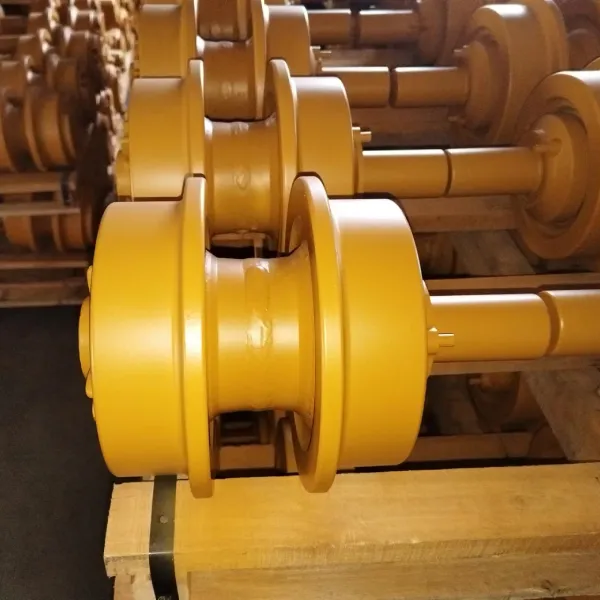
| Rolos de esteira (Rolos Inferiores) | Support the machine's weight on the track chain. | Flange wear from turning; tread wear from contact with the links. | High surface hardness to resist wear; core toughness to resist impact from rough ground. |
| Rolos transportadores (rolos superiores) | Support the weight of the track chain on its return path. | Tread wear from the track chain. | Excellent sealing is critical; forged body provides a strong, stable housing for bearings and seals. |
| Roda dentada | Engages with the track bushings to drive the track. | Tooth wear, "hooking" of teeth as they wear. | Exceptional hardness on tooth contact surfaces to resist wear from bushing engagement. |
| Ocioso | Guides the track at the front of the undercarriage and is used to adjust track tension. | Tread and flange wear, similar to rollers. | Large, complex geometry benefits greatly from the strength and integrity of the forging process. |
cadeias de trilha: This is the skeleton of the track. The precision with which the pins and bushings are manufactured and heat-treated determines how long the chain maintains its correct pitch (the distance between pins). As pins and bushings wear internally, the pitch elongates, which accelerates wear on the sprocket. The links themselves must endure immense tensile forces and abrasive wear, making the refined grain structure of a forged link indispensable.
Rolos e descritos: These components live a life of constant compression and friction. Their ability to roll smoothly and resist wear is a function of their surface hardness and the quality of their internal bearings and seals. A leak in a roller seal allows abrasive grit to enter and oil to escape, leading to rapid and complete failure. The robust, dimensionally accurate body of a forged roller provides the best possible housing for these critical seals.
Roda dentada: The sprocket transfers the power from the final drive to the track chain. The tips of the sprocket teeth experience extremely high contact stress as they engage the track bushings. Forjamento, followed by precise induction hardening of the teeth, is the only way to create a sprocket that can withstand these forces without premature wear or tooth breakage.
By understanding the specific job of each part, one can better appreciate why a generic, one-size-fits-all approach to material and manufacturing is inadequate. Each component requires a tailored solution, and the precision forging process provides the flexibility and control to deliver that tailored solution with unparalleled strength and reliability.
Perguntas frequentes (Perguntas frequentes)
What is the most significant difference between precision forged and cast undercarriage parts? The primary difference lies in the internal grain structure of the metal. Forging kneads and aligns the steel's grain to follow the shape of the part, creating a dense, continuous structure that is significantly stronger and more resistant to shock and fatigue. Casting involves pouring molten metal into a mold, resulting in a random grain structure that can contain microscopic voids, making it more brittle and prone to unexpected failure under stress.
How does my working environment affect which undercarriage parts I should choose? Your environment is a critical factor. For highly abrasive conditions like sand or fine gravel, you need parts with maximum surface hardness to resist wear. For high-impact work like in a rock quarry, you need parts with superior core toughness to absorb shock without cracking. For extreme cold, you need parts made from specific steel alloys that resist becoming brittle at low temperatures. A good supplier will help you match the part's engineering to your specific application.
Can I mix and match undercarriage components from different manufacturers? While it is sometimes possible, it is generally not recommended. Different manufacturers may have slight variations in dimensional tolerances, material specifications, and hardness profiles. Mismatched components can lead to improper fit and accelerated wear on the entire system. Por exemplo, a new, correctly pitched track chain running on a worn sprocket will cause the new chain to wear out much faster. For optimal performance and lifespan, it is best to use a complete, matched system from a single, high-quality manufacturer.
Is a higher price for precision forged parts always justified? When evaluated through the lens of Total Cost of Ownership (TCO), the higher initial price is almost always justified. The extended lifespan and superior reliability of precision forged parts lead to fewer replacement cycles, reduced labor costs, e, o mais importante, a dramatic reduction in costly machine downtime. The small premium paid upfront is an investment that yields significant returns by keeping your machinery productive and profitable.
How can I verify the quality of a potential supplier's parts? Look for objective evidence. Ask for quality certifications like ISO 9001. Inquire about their material sourcing and ask to see chemical analysis and mechanical testing reports for their steel. Discuss their heat treatment processes. A reputable manufacturer will be transparent and able to provide detailed technical data to substantiate their quality claims. Finalmente, consider their warranty and level of technical support, as this reflects their confidence in their own product.
When should I plan to replace my undercarriage? Replacement should be based on measured wear, not just on hours of use. Using specialized tools to measure the wear on track pins, buchas, link rails, and roller flanges allows you to track the wear rate and predict when components will reach the end of their service life. This proactive approach allows you to schedule maintenance before a failure occurs, turning a costly, unexpected breakdown into a planned, efficient service event.
What is the role of heat treatment in the quality of a track shoe? Heat treatment is vital for a track shoe, which needs a difficult combination of properties. The main body of the shoe needs to be tough to resist bending and cracking as it moves over uneven ground. No entanto, the grousers (the raised bars that provide traction) need to be very hard to resist abrasive wear. A process called "through-hardening" followed by careful tempering is used to achieve the necessary core toughness, ensuring the shoe can withstand the immense stresses placed upon it.
Conclusão
The selection of undercarriage parts for heavy machinery is a decision with far-reaching consequences, impacting everything from daily operational efficiency to the long-term profitability of a business. A superficial approach, guided only by the initial purchase price, overlooks the complex interplay of forces, materials, and environments that define the working life of these components. It is a path that often leads to increased downtime, spiraling maintenance costs, and compromised project timelines.
A more enlightened path involves a deeper engagement with the principles of material science, manufacturing processes, e engenharia específica de aplicação. By understanding the metallurgical advantages conferred by specific steel alloys, appreciating the microstructural superiority of the precision forging process, and insisting on designs tailored to the unique challenges of the operating environment, one transforms a simple purchase into a strategic investment. This approach, centered on the concept of Total Cost of Ownership, reconhece que o verdadeiro valor não reside na poupança inicial, mas no prolongamento da vida útil, confiabilidade aprimorada, e desempenho sustentado que os componentes de alta qualidade oferecem. Em última análise, a escolha de peças de material rodante forjadas com precisão é uma afirmação de um compromisso com a qualidade, uma estratégia para mitigação de riscos, e um passo fundamental na construção de uma operação de equipamentos pesados resiliente e bem-sucedida.
Referências
Sociedade Americana de Metais. (1988). Forjamento e processos de formação relacionados. No Manual de Metais: Vol.. 14. Formação e Forjamento (9ª edição.). ASM Internacional.
Boyer, H. E. (Ed.). (1987). Atlas de diagramas de tratamento térmico. ASM Internacional.
Davis, J.. R. (Ed.). (2001). Liga: Entendendo o básico. ASM Internacional. https://doi.org/10.31399/asm.tb.autb.9781627082859
Khurmi, R. S., & Gupta, J.. K. (2005). Um livro de design de máquinas. Editora da Eurásia.
Lange, K. (Ed.). (1985). Manual de conformação de metal. McGraw-Hill.
SMI. (2021). Noções básicas de forjamento: O processo de forjamento. Associação da Indústria de Forjamento. Obtido de
Totten, G. E. (2006). Tratamento térmico de aço: Metalurgia e tecnologias. Imprensa CRC. https://doi.org/10.1201/9781420006463
Verma, J.. P., & Kumar, S. (2019). A review on effect of alloying elements on stainless steel. Materials Today: Proceedings, 18, 466-473.